
Every year, construction companies lose millions of dollars to payroll compliance failures—and many don't realize it until it's too late. Between misclassified workers, improperly calculated fringe benefits, and certified payroll reporting errors, the path to non-compliance is surprisingly easy to stumble down.
Recently ConstructionOwners partnered with Lumber - An AI-Powered Construction Workforce platform and Knowify - a Job costing and project management tool for contracting businesses and surveyed over 100 construction payroll professionals. The goal was to understand the complexities of construction payroll and the challenges posed by compliance regulations.
The findings paint a picture of an industry struggling under immense complexity and pressure. With infrastructure spending at historic highs and government-funded projects proliferating across the nation, understanding these challenges isn't just about avoiding penalties—it's about positioning your company to capitalize on opportunities while protecting your bottom line.
The numbers tell a stark story. Nearly three-quarters of construction payroll professionals experience weekly or monthly workforce fluctuations due to hiring, layoffs, or contract work—with 54% of companies reporting workforce size changes on a weekly or monthly basis. This constant churn creates a compliance environment where even the most diligent teams struggle to maintain accuracy.
As prevailing wage requirements extend across federal, state, and increasingly local projects, construction owners find themselves navigating a compliance minefield that grows more complex by the day. Every Davis-Bacon Act project, every state-mandated prevailing wage job, and every multi-jurisdictional contract brings with it unique wage determinations, specific reporting requirements, and significant penalty exposure.
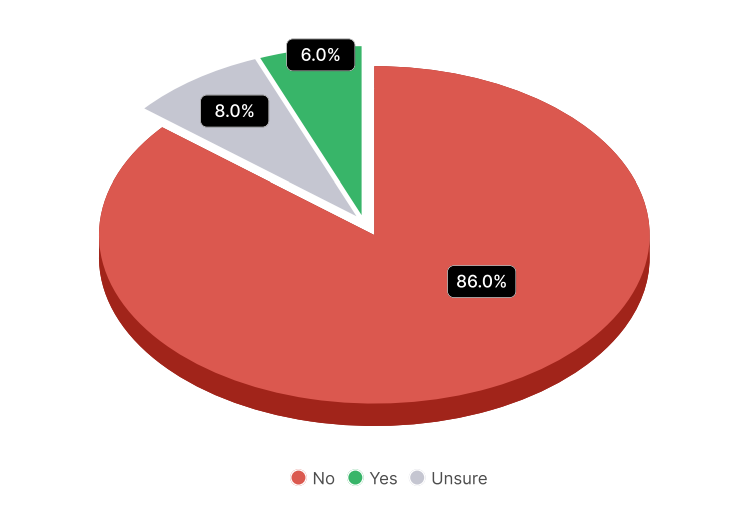
The risk landscape is unforgiving. While 86% of surveyed companies reported no penalties in the past 12 months, 6% did incur fines—and another 8% weren't even sure if they had faced penalties, revealing dangerous gaps in compliance awareness.
Non-compliance can trigger back wage payments stretching back years, penalties that multiply with each affected worker and pay period, debarment from future government contracts, and reputational damage that extends far beyond any single project.
Worker classification stands as perhaps the most persistent challenge in prevailing wage compliance. The fundamental problem is deceptively simple: determining which classification applies to which worker for which tasks. In practice, this becomes extraordinarily complex.
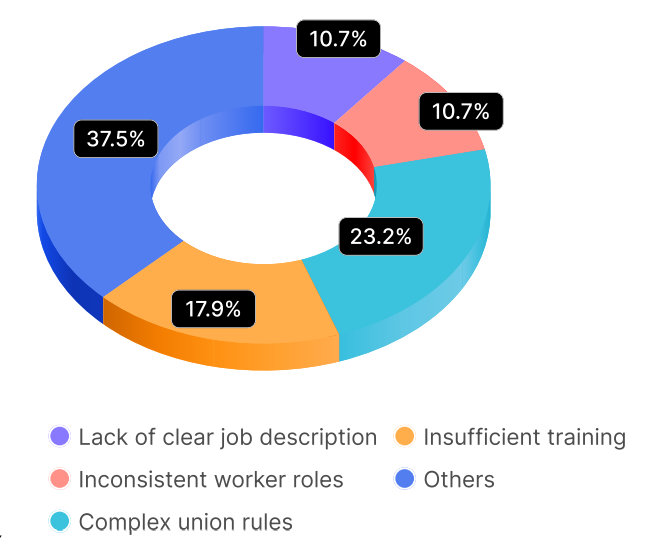
The survey data confirms this challenge: 37.5% of respondents identified worker classification under prevailing wage rules as a significant obstacle, with 23.2% specifically citing complex union rules as a major hurdle. Another 10.7% pointed to inconsistent worker roles—workers who change positions throughout the day or move between job sites—as a critical classification problem.
Construction work rarely fits neatly into predetermined categories. A carpenter who spends part of the day framing and part of the day installing doors may fall under different classifications with different wage rates for different portions of their work. As one payroll professional noted, workers who "fall under multiple categories requiring separate payment and classification" or who "bounce between different locations on the same or different days" create tracking nightmares.
The financial consequences of misclassification are severe. Underpaying workers—even inadvertently—creates liability for back wages plus penalties. Accurate worker classification was identified as difficult to manage by 14.7% of payroll professionals, reflecting how this challenge directly impacts compliance outcomes.
If there's one universal challenge in construction payroll, it's tracking and applying diverse pay rates across multiple sites. The research reveals that 26.5% of payroll professionals cite tracking hours and pay rates as their most difficult certified payroll reporting challenge—making it the single most commonly reported pain point.
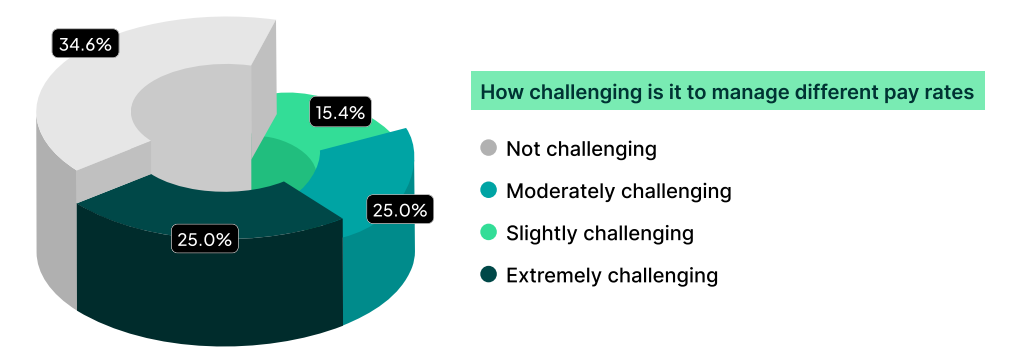
Nearly 50% of payroll professionals rate tracking and applying pay rates as moderately to extremely challenging, with 25% finding it extremely challenging. This difficulty translates directly into errors: overtime miscalculations account for approximately 38.5% of payroll errors, while incorrect pay rate application follows closely at 36.5%.
The frequency of these errors is sobering. Half of all payroll professionals encounter 1-3 errors monthly, and 25% experience more than six errors in a single month. As one respondent explained, "Overtime miscalculations and multiple pay rates across sites make payroll accuracy a constant challenge, often requiring adjustments after the fact."
For companies running multiple projects with different wage determinations, varying overtime rules, and diverse job classifications, the margin for error approaches zero while the complexity remains overwhelming.
Fringe benefits represent another compliance quagmire that is often underestimated. Prevailing wage determinations specify not just hourly rates but also fringe benefit requirements that can be satisfied through bona fide benefit programs or cash payments. Among the many complexities cited by payroll professionals, managing fringe benefits alongside prevailing wage compliance creates layers of calculation challenges.
The complexity multiplies when companies offer some benefits that qualify and others that don't, or when workers are covered under some benefit programs but not others. Common errors include miscalculating the per-hour value of annual benefits, failing to properly document benefit plan contributions, and incorrectly applying apprenticeship ratios that affect both wages and benefits.
These mistakes carry substantial financial risk. Auditors scrutinize fringe benefit calculations closely, and errors typically result in required cash payments to workers plus penalties—effectively paying twice for the same obligation.
The administrative burden of certified payroll reporting cannot be overstated. The data reveals a staggering investment of time: 29.4% of payroll professionals spend 5-10 hours per month on audit preparation and compliance reporting, while 23.5% spend over 20 hours monthly. Nearly 10% dedicate 11-20 hours every month to this single function.
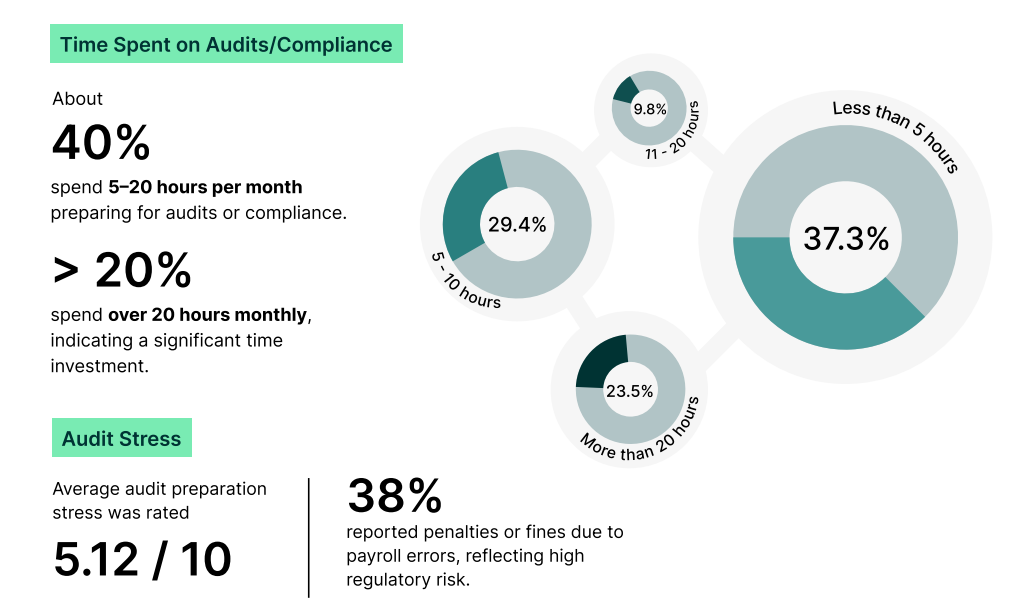
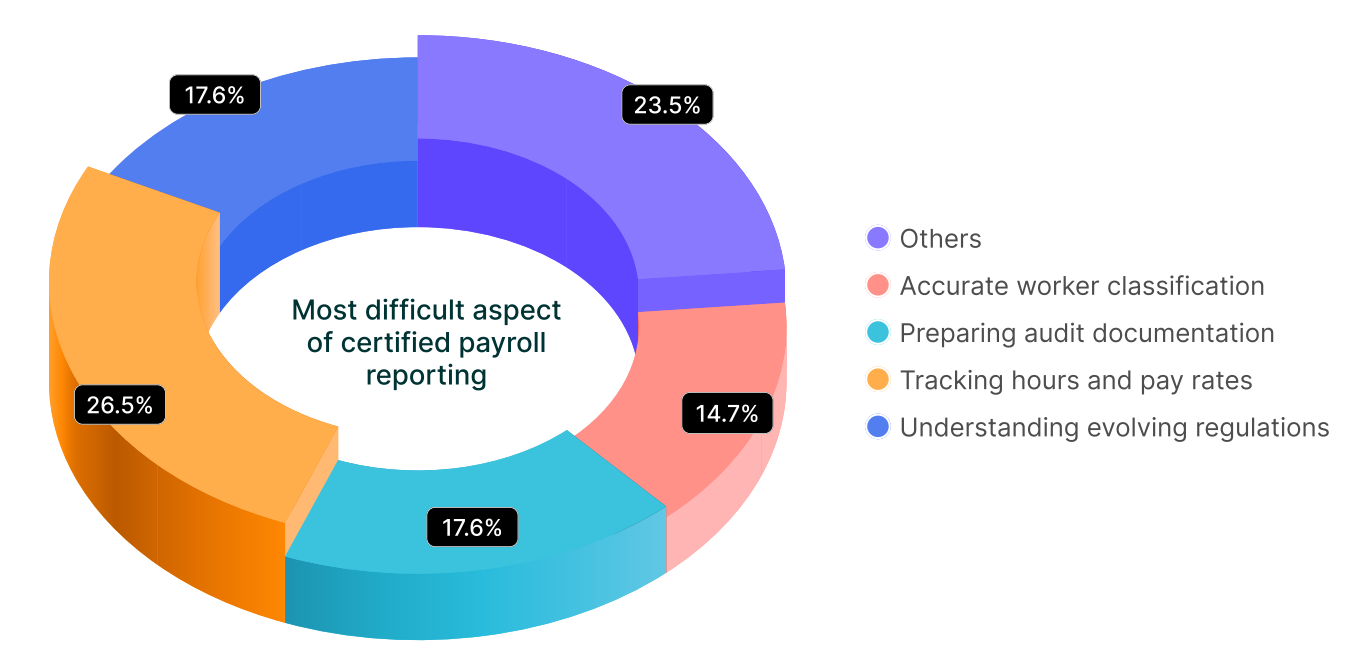
Preparing audit documentation was cited by 17.6% of respondents as one of their most difficult certified payroll challenges, matched by the same percentage struggling with understanding changing regulations. The stress this creates is measurable: payroll professionals rated their average audit preparation stress at 6.2 out of 10.
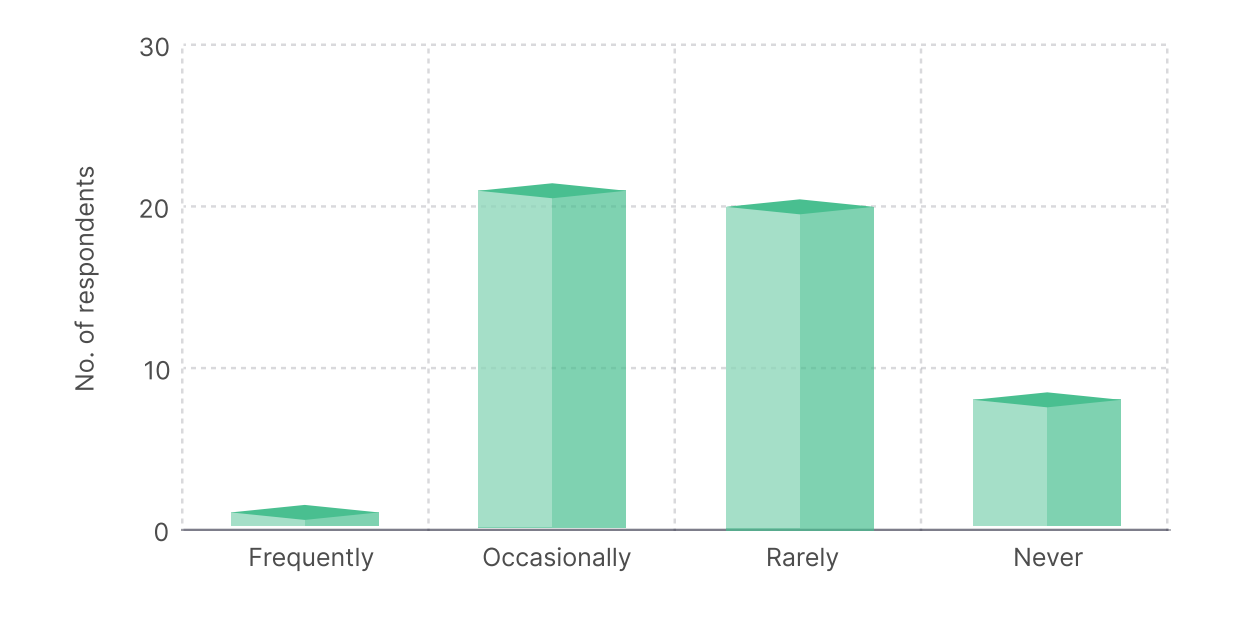
The need for corrections underscores the difficulty: while 40% reported audit corrections are rare, and 16% said they're never needed, 42% indicated that adjustments to previously submitted certified payroll reports had to be made occasionally. Even occasional corrections represent a significant administrative burden, legal exposure, and potential penalty risk.
Each covered project requires weekly submissions documenting every worker, every hour, every classification, and every dollar paid. The accuracy standards are exacting, the penalties for errors are significant, and the time consumption is substantial. Moreover, certified payroll isn't simply a reporting exercise—it's a legal attestation. The person signing these reports certifies under penalty of perjury that the information is accurate.
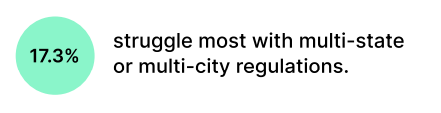
Construction companies operating across state lines or even across county lines within states face bewildering regulatory complexity. The survey reveals that 17.3% of payroll professionals struggle most with multi-state or multi-city regulations, while 26.9% identified prevailing wage and certified payroll compliance as the most complex aspect of their jobs overall.
A company might simultaneously manage projects subject to federal Davis-Bacon requirements, various state prevailing wage laws, and local ordinances—each with different wage rates, different classifications, different fringe benefit rules, and different reporting requirements. Add to this the challenge that 25% of respondents highlighted: dealing with union and non-union rules, which vary dramatically across jurisdictions.
Understanding changing regulations was cited by 17.6% as a major difficulty, reflecting how the regulatory landscape shifts constantly across jurisdictions. Even well-resourced contractors struggle to track which requirements apply to which projects, ensure field supervisors understand the distinctions, and maintain accurate records across this complexity.
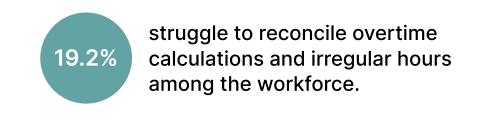
Beyond prevailing wage complications, construction companies face fundamental payroll management challenges that affect every project and every worker. The research from ConstructionOwners, Lumber, and Knowify reveals that 19.2% of payroll professionals struggle most with reconciling overtime calculations and irregular hours among their workforce—a challenge that extends beyond prevailing wage projects to general construction work.
Time tracking remains surprisingly problematic in an industry where workers move between job sites, work irregular hours, and perform varied tasks throughout the day. Inaccurate time tracking cascades into payroll errors, which frustrate workers and create an administrative burden for corrections.
The communication gap compounds these issues. When asked about information flow between field supervisors, HR, and payroll regarding time tracking and worker classifications, only 26% rated communication as "very good" and 32% as "good." Meanwhile, 36% described it as merely "fair," and 6% rated it as poor or very poor. As one respondent noted, they need "more comprehensive information at the project onset to streamline compliance efforts and ensure accuracy."
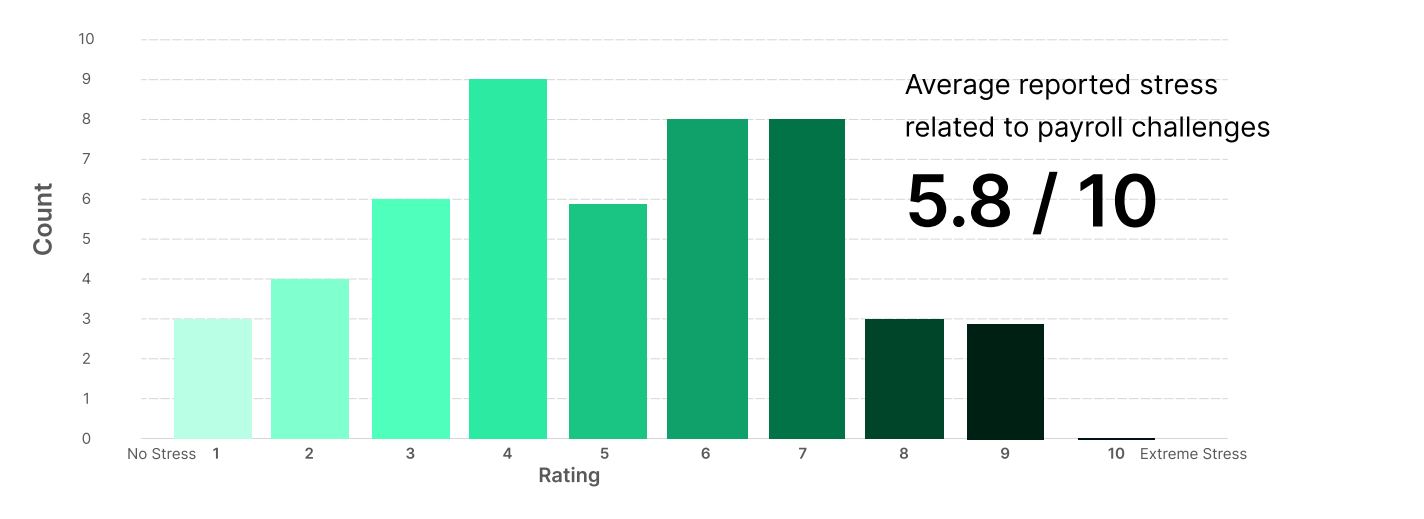
The stress levels tell their own story. Payroll professionals reported an average stress level of 5.8 out of 10 related to overall payroll challenges. Key stressors include complex pay rules, fear of costly penalties, frequent workforce changes, and heavy workloads. One payroll administrator shared, "Complex pay and classification rules combined with unpredictable schedules make payroll processing exhausting," while another noted, "The constant worry of making costly errors that lead to audit penalties weighs heavily on our team."
The personal toll extends beyond stress metrics. As one respondent revealed, "I often work overtime to ensure payroll accuracy and compliance, which affects my work-life balance." When payroll staff spend the majority of their time on manual data entry, error correction, and compliance documentation, they're not contributing to strategic functions that could improve business performance.
The survey findings on payroll software effectiveness reveal a troubling reality: only 21.2% of payroll professionals find their current software "very effective" in handling prevailing wage calculations and certified payroll reporting. A full 32.7% rated their software as merely "somewhat effective," while another 32.7% were neutral—and 9.6% found their software somewhat or very ineffective.
This technology gap creates significant challenges. While 23.5% of respondents reported minimal or no challenges with certified payroll reporting—often attributing this to effective automation—the majority struggle with manual processes that consume time and create error opportunities. Respondents expressed desire for "more efficient software tools with user-friendly features," noting specific needs like "an online back button to allow corrections before submission."
The research highlights a critical gap: most construction companies lack integrated systems that connect time tracking, payroll processing, and compliance reporting.
This forces manual data transfer between systems, creates reconciliation challenges, and makes real-time compliance monitoring nearly impossible. Some respondents mentioned "complexities in dealing with third-party compliance officers" and challenges with "payroll reports generated from sites, which often lack comprehensive summaries and are less accurate for proper classification purposes."
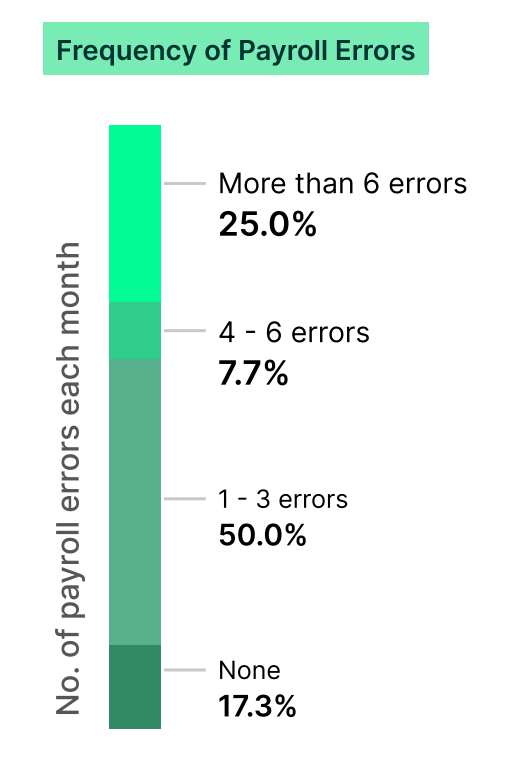
The true cost of payroll compliance failures extends far beyond direct penalties. The administrative hours consumed represent a hidden cost that construction owners often underestimate. When 23.5% of payroll staff spend over 20 hours monthly just on audit preparation, and when 50% of teams encounter 1-3 payroll errors every month requiring correction, the opportunity cost becomes staggering.
Project delays resulting from payroll disputes or compliance investigations affect schedules, trigger liquidated damages, and damage client relationships. Legal fees for defending against wage claims or compliance actions add up quickly. The 38% of companies in the broader survey who reported experiencing penalties or fines due to payroll errors learned these lessons the hard way.
Perhaps most significantly, compliance problems create competitive disadvantage. Companies with robust compliance systems can bid more aggressively on government projects, knowing their cost basis is accurate and their risk exposure is managed. Companies with weak compliance face either elevated risk or inflated cost estimates that make them uncompetitive.
Employee impact deserves emphasis as well. Workers who experience payment errors, benefit calculation mistakes, or delayed resolution of payroll issues become disengaged. In a tight labor market where workforce retention is already challenging, companies cannot afford to lose skilled workers over preventable payroll problems.
As Shreesha Ramdas, CEO and Co-founder of Lumber, states, "Effective payroll management is the backbone of construction workforce wellbeing—streamlining processes and reducing errors not only eases stress for payroll teams but also strengthens overall project success."
The payroll professionals surveyed were clear about their needs. While insufficient training was highlighted by 17.9% as an obstacle to accurate worker classification, the broader call for support reflects multiple dimensions:
Enhanced Training and Education: Payroll teams need "understanding how to verify wage classifications accurately upfront and staying aware of changing regulations." The 16% who struggle with understanding changing regulations need ongoing education about regulatory updates.
Improved Technology Solutions: With only 21.2% finding their software very effective, there's clear appetite for better tools that integrate time tracking, classification management, and compliance reporting seamlessly.
Better Communication Systems: Given that only 26% rate field-to-payroll communication as "very good," establishing clearer protocols for information flow from job sites is essential. Teams need "clearer communications from job sites" and "more comprehensive information at the project onset."
Additional Resources: Some respondents called for "dedicated personnel to delegate work to," recognizing that the volume and complexity of work exceeds current capacity.
Clearer Guidance: The 10.7% who cited lack of clear job descriptions as an obstacle, along with those struggling with "inconsistent worker roles," need better frameworks for classification decisions.
Process standardization creates consistency and reduces errors. Developing clear protocols for worker classification, time tracking, fringe benefit calculation, and certified payroll preparation ensures that compliance doesn't depend on individual knowledge or interpretation.
Regular internal audits allow companies to identify and correct problems before external auditors arrive—particularly important given that 42% occasionally need to make corrections after audit findings. Self-assessment creates opportunities for process improvement and helps build a culture of compliance awareness.
Expert consultation, whether through specialized consultants or technology partners with compliance expertise, provides access to knowledge and resources that most construction companies cannot maintain in-house. The regulatory environment changes constantly, and staying current requires dedicated attention.
For construction owners, the message from this research is clear: payroll compliance and prevailing wage management cannot be afterthoughts or back-office concerns. When 26.9% of payroll professionals identify prevailing wage compliance as their most complex challenge, and when half of all teams encounter multiple payroll errors monthly, these issues directly affect profitability, competitiveness, and viability.
The first step is honest assessment. With 8% of companies unsure whether they've faced penalties in the past year, many owners lack visibility into their actual compliance posture. How robust are your current systems? How confident are you in your classification accuracy? What would happen if you faced an audit tomorrow?
Next, calculate the true cost of your current approach. If your team is spending 20+ hours monthly on audit preparation alone, and experiencing 3-6 errors monthly requiring correction, what is the real cost in staff time, potential penalties, and opportunity loss?
Finally, invest in solutions proportionate to your exposure. Companies running occasional prevailing wage projects need different tools and processes than companies where prevailing wage work represents the majority of revenue. The key is matching your compliance infrastructure to your actual risk profile—and recognizing that 34.6% rating communication as merely "fair" indicates room for improvement even in seemingly functional operations.
The construction industry faces real challenges in payroll compliance and prevailing wage management. But these challenges are solvable with the right combination of technology, process, training, and commitment. The cost of inaction—measured in penalties, staff stress, employee dissatisfaction, and competitive disadvantage—far exceeds the investment in proper systems.
As the data makes clear, the majority of construction companies are managing to avoid penalties, but many are doing so at tremendous cost in time, stress, and administrative burden. The question isn't whether you can afford to address these issues. The question is whether you can afford not to—and whether you're willing to settle for survival when the right investments could position you for competitive advantage.
Download the reports - Prevailing Wage Challenges | Challenges faced by Payroll Backoffice Staff