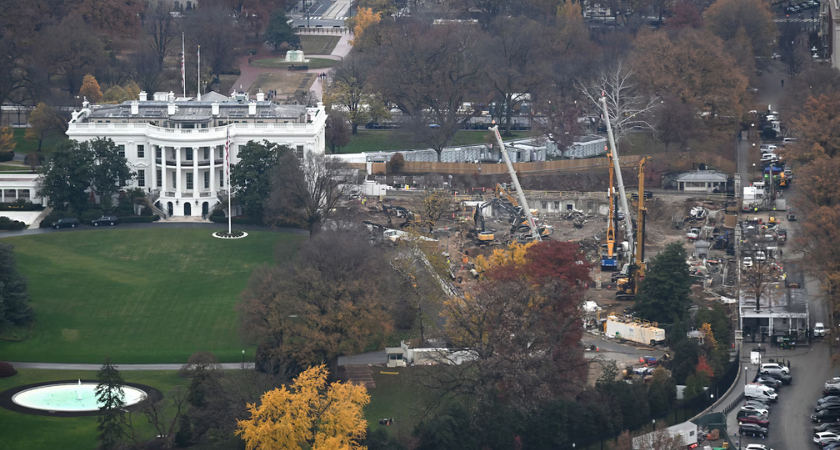
The White House has outlined an unusually compressed nine-week timeline to secure federal approval for President Donald Trump’s proposed White House ballroom, a move that has intensified scrutiny from preservation advocates and federal review bodies.

The accelerated schedule comes as construction activity has already begun on the White House grounds, raising questions about whether the administration is complying with federal preservation laws designed to ensure public oversight and interagency review before major construction projects proceed.
According to White House officials, formal applications were submitted on Dec. 22 to the National Capital Planning Commission (NCPC) and the Commission of Fine Arts (CFA), the two congressional panels responsible for reviewing federal construction projects. Officials said meetings with staff from both commissions were held on Dec. 19 to present conceptual renderings and a slide deck that had previously been released in July.
However, the NCPC offered a conflicting account. Planning commission spokesperson Stephen Staudigl said the agency had not received a formal submission, highlighting inconsistencies that underscore broader concerns about the approval process. The CFA confirmed that an application had been filed for its review.
Despite the uncertainty, the White House has laid out a plan to move the ballroom project through approval in just over two months — a timeline significantly shorter than that of comparable federal construction efforts. Informational presentations are scheduled for the NCPC on Jan. 8 and the CFA on Jan. 15, followed by anticipated votes at the CFA on Feb. 19 and the NCPC on March 5.
The expedited process follows a Dec. 17 court order from U.S. District Judge Richard J. Leon, who directed Trump administration officials to begin consultations with both commissions by the end of December.
“The Court will hold the Government to its word,” Leon wrote in the order.
Preservation advocates argue the administration is sidestepping meaningful review by pushing ahead with early construction work while approvals remain unresolved. The National Trust for Historic Preservation, which filed a lawsuit seeking to halt the project, contends the administration has failed to take adequate steps toward transparency or compliance.
“They have, repeatedly, broken the rules first and asked for permission later,” lawyers for the group wrote in court filings.
White House officials maintain that submitting conceptual designs and engaging commission staff satisfies the court’s directive, even without detailed blueprints. The administration has said aboveground construction would begin no earlier than April, contingent on swift approval from both commissions.
.jpg)
Critics also point to how sharply the process diverges from past precedent. Comparable projects, including a White House security fence completed during Trump’s first term, took years to navigate multi-stage reviews that included public meetings and environmental assessments. In contrast, the ballroom review is unfolding while demolition and site preparation have already taken place.
Since September, crews have cleared foliage, demolished the East Wing, and installed underground infrastructure, prompting concerns that early work could limit the scope of meaningful oversight. Administration officials have argued that the NCPC’s authority applies only to vertical construction, not demolition or site preparation — a claim disputed by preservation groups and former commission officials.
The $400 million ballroom project is privately funded, a fact that has drawn additional attention from lawmakers and watchdog groups. While the White House has identified some donors, including Amazon, Lockheed Martin and Palantir, many contributions remain undisclosed, even as those companies maintain business interests before the federal government.
Sen. Richard Blumenthal, the top Democrat on the Senate Homeland Security and Governmental Affairs Permanent Subcommittee on Investigations, has called for greater transparency.
“The American people are entitled to all the relevant facts about who is funding the most substantial construction project at the White House in recent history,” Blumenthal wrote.
As the administration pushes forward, the ballroom project has become a flashpoint in a broader debate over executive authority, historic preservation, and the balance between speed and public accountability in federal construction.
Originally reported by Jonathan Edwards and Dan Diamond in Washington Post.