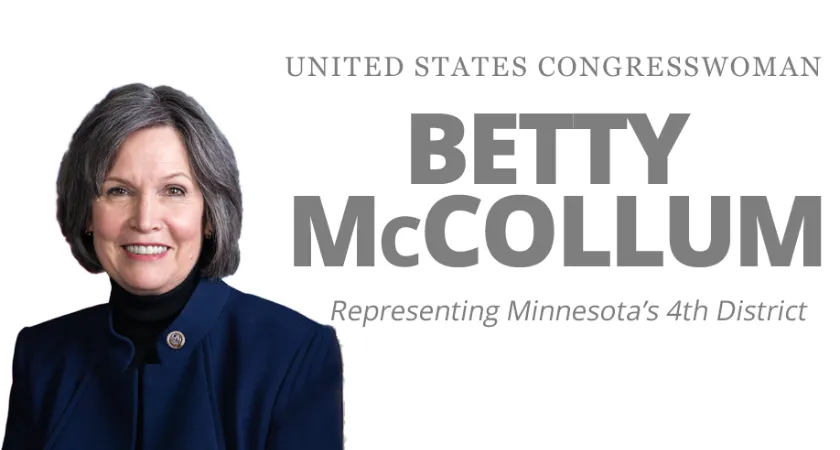
WASHINGTON, D.C. — Congresswoman Betty McCollum announced that $16,089,000 in federal funding will be directed to 13 community projects across Minnesota’s Fourth Congressional District, supporting upgrades to libraries, public safety facilities, roads, and water systems.
The funding was approved as part of the Fiscal Year 2026 bipartisan appropriations bills (H.R. 6938; H.R. 7148), which passed the Senate following earlier House approval and now await the president’s signature.
After a turbulent prior budget cycle marked by political gridlock, the final legislation advanced without partisan policy riders, clearing the way for local investments that officials say address long-standing infrastructure and safety needs.
“This $16 million in federal investment in East Metro communities will make our neighborhoods stronger, safer, and more secure,” McCollum said. “Through investments in our libraries, fire departments, police departments, roads, bridges, and water treatment facilities, we are strengthening our communities as we face economic and environmental challenges together. I thank local officials for their partnership on these projects and advocacy for our communities.”
Transportation and Public Safety Improvements
Five of the funded initiatives fall under the Transportation, Housing and Urban Development Subcommittee, targeting mobility and emergency response capabilities:
- $3,150,000 – Hayden Heights Library Renovation (Saint Paul): Completion of reconstruction to modernize the aging facility and better serve East Side residents.
- $2,000,000 – East Metro Public Safety Training Center Expansion (Maplewood): Expansion of a regional training hub used by 27 agencies to prepare first responders.
- $1,350,000 – Weir Drive Reconstruction Phase II (Woodbury): Elevating flood-prone sections of roadway that currently restrict access to homes, schools, and businesses.
- $1,250,000 – Burn Building Restoration (Saint Paul): Replacement of a 52-year-old condemned fire-training structure to support realistic lifesaving instruction.
- $250,000 – County Highway 18 & Settlers Ridge Parkway Roundabout (Washington County): Safety upgrades for drivers, pedestrians, and cyclists.
Local officials have emphasized that these projects address both daily quality-of-life concerns and long-term resilience, particularly as extreme weather events place greater strain on infrastructure.
Clean Water and Environmental Health
Two additional awards through the Interior, Environment, and Related Agencies Subcommittee focus on safe drinking water:
- $1,092,000 – Municipal Water Supply Project, Phase 2 (Gem Lake): Construction of a new system after contamination was discovered in private wells.
- $1,092,000 – PFAS Water Treatment Facility (Stillwater): Treatment infrastructure to remove harmful chemicals exceeding EPA limits.
Community leaders have described the water projects as urgent, noting that PFAS contamination has affected multiple East Metro cities and required costly local responses.
Justice and Technology Investments
Six projects funded through the Commerce, Justice, Science Subcommittee aim to modernize public safety operations and reduce recidivism:
- $1,031,000 – Recidivism Reduction Workforce Program (Finishing Trades Institute): Pre-apprenticeship training for incarcerated individuals to support reentry.
- $750,000 – Wet Bulb Globe Temp Sensor Network (Ramsey County): Data collection to improve urban heat forecasting.
- $1,031,000 – CCTV Improvement (Saint Paul): Upgrading downtown and port surveillance systems.
- $1,031,000 – Records Management Replacement (Saint Paul): Streamlining police reporting and evidence tracking.
- $1,031,000 – Body-Worn & Squad Cameras (Washington County): Acquisition of 170 body cameras and 100 fleet cameras.
- $1,031,000 – Woodbury Records System: Enhancing case management and officer safety.
Building Local Momentum
The congresswoman’s office said the funding reflects collaboration between municipal leaders and federal partners to target projects with measurable community impact. Many of the initiatives had been requested by cities for several years but lacked dedicated federal support.
The investments are expected to generate construction jobs in the near term while delivering lasting benefits such as safer drinking water, reduced flooding risk, and improved emergency preparedness.
With final enactment expected soon, local governments are preparing to move into design and construction phases throughout 2026.
Originally reported by McCollum.