Most large contractors don't struggle to adopt software. They struggle with what happens after. Every office sets up the platform its own way, nobody revisits the configuration, and years later the same tool works differently in every region. Then the industry gets busy, crews start moving between offices, and every new job opens with people relearning a system they thought they already knew.
Brad Booker, Director of Project Controls at Turner Construction Company, set out to fix exactly that. When he stepped into his role, he found Turner was running more than 30 different versions of Procore across the country. Over the past year, he led the effort to replace them with one standard way of working.
Brad's background is in project delivery and Lean construction, and his Turner career goes back to the 1990s, when he started as a project manager. This year marked his third Groundbreak, and his second as part of the conversation on stage: Turner presented its standardization journey at last year's event.
At Procore Groundbreak 2026 in Orlando, Florida, thousands of construction professionals, technology leaders, and innovators gathered under one theme: build and win together in the AI era.
The venue had a personal connection for Brad. Turner is the construction manager at risk on the Orange County Convention Center's $560 million Grand Concourse Expansion, which broke ground in December 2025. Attendees were, quite literally, walking through one of Turner's active projects.
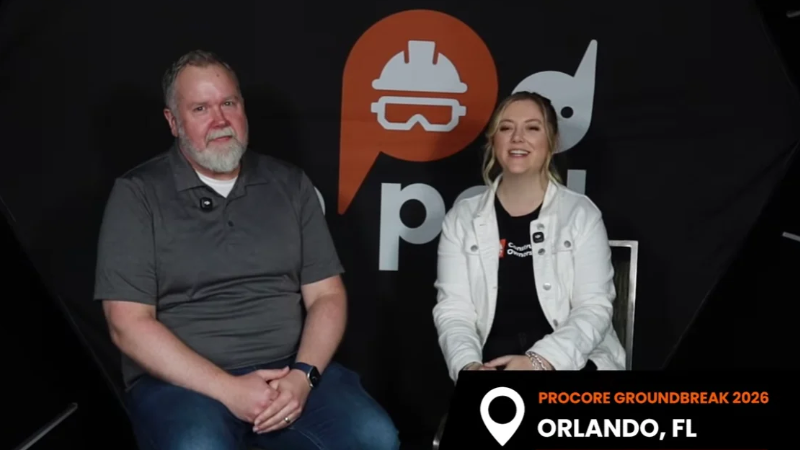
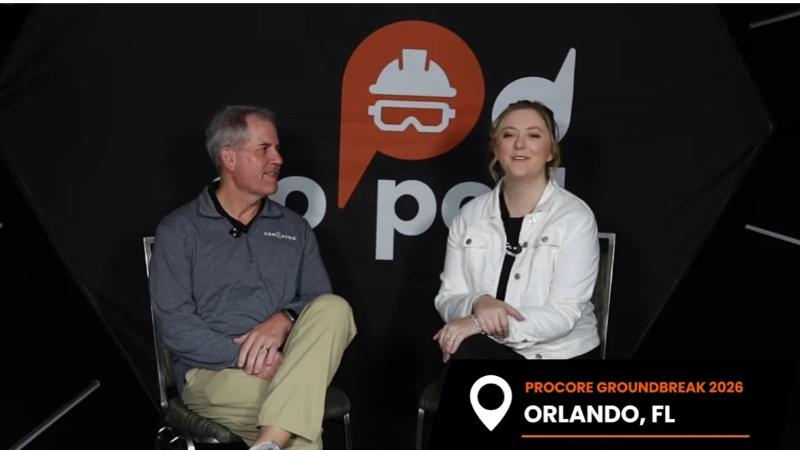
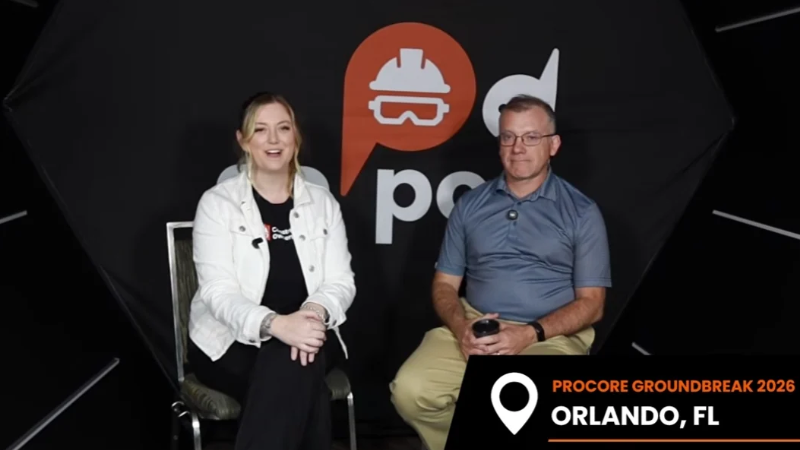
While at the conference, Caroline Raffetto, editor-in-chief of Constructionowners.com, sat down with Brad at the Lumber booth for a live, in-person episode of CO Pod. They talked about consolidating 30 Procore setups into one, rolling out change in phases, and how Turner brought AI to its entire workforce without throwing everyone in at once.
Caroline: How's the conference been for you?
Brad Booker: The conference has been great. It's been interesting seeing all the new things with AI and what everybody has to offer.
Caroline: How many years have you been coming to Groundbreak?
Brad Booker: This is my third year. It does seem pretty big this year. I don't know if it's the layout or just the size of the expo floor, but there are definitely a lot of vendors, and a lot more rooms and sessions.
Caroline: What's special about this conference is the venue itself. You're working on the Orange County Convention Center right now. How has Procore helped you there?
Brad Booker: Yes, we're working on the expansion right now. We use Procore whenever we can. It's our platform of choice, and it helps us manage things day to day and keep things streamlined and simple for our folks. There's been a big push toward standardization, and that's helped a lot.
Caroline: You led a massive standardization effort, taking a bunch of different Procore setups and putting them all into one. How has that benefited your projects and the company?
Brad Booker: We started that last year. We were actually one of the speaking sessions last year talking about the whole process. We're a very large company, and when I got into this role, we found out we had over 30 versions of Procore being used across the country. All set up differently, all doing different things. We were like, what are we doing?
So we went through an effort of looking at all the new tools and abilities in Procore and picking the one best way for us to use it. We did that over the last year.
Caroline: That must have been a tough decision, especially with 30 versions, where some work for some teams and not for others. How did you decide this is the one?
Brad Booker: With the explosion of construction going on right now, the big problem was that we're pulling people from offices all over the country to go to different places. They'd show up and say, "Wait a minute, this isn't how I use my Procore." We had to get rid of that productivity loss at the beginning of a job, where people were figuring out how to use this version versus the right version.
And quite frankly, we hadn't updated it in so long. People used what they knew when they were first exposed to Procore, and so many things have improved over the years. That's why we took the time and effort to standardize across the whole company.
Caroline: You work on massive projects, with lots of workers, dollars, and square footage. It must have been tricky for people to learn on the go.
Brad Booker: Very difficult, especially with as many changes as come out of Procore every month. It's a big process. We have to stay on top of the technology, figure out the right thing for teams to use, get the word back out to them, and reconfigure things as we need to.
Caroline: Then there's change management. I'll say it: teams hate change. How did your teams respond at first, and what's the reaction now?
Brad Booker: This has been the whole year of rolling it out. We rolled it out in phases. We started in April, expanded it in July, and the last phase of the rollout is the first week of November.
We started small for exactly that reason: to get people used to what's happening and how it's going to work, and to make sure we had plenty of trainers in place to coach them through the whole process.
Caroline: Training seems to be the most important piece. You can't just hand people a shiny new tool and say, "Have at it."
Brad Booker: It's that, but it's also giving them different ways of learning it. Not just, here's a training, go take it, now go forth and execute. It's also giving them resources, so if someone learned about a tool six months ago and is only starting to use it now, they can readily get to what they need and use it right away.
Caroline: I've heard from a lot of people that starting small and building up is the way to go.
Brad Booker: I'd agree. That's absolutely the right way to do it. You work out the bugs, too. You figure out whether it's really working or whether you missed something, and you're only affecting a few teams. Then you roll it out at a much larger scale, having fixed some of those things.
Caroline: Turner has always been on the forefront of the technology boom, including AI. What did that look like at first? There's often a fear factor, but also excitement.
Brad Booker: We're very fortunate on that front. We got access to AI several years ago, and leadership basically said, "Start playing with this." They gave it to several hundred people. After six to eight months, they expanded it to the whole company and said, everybody play with this. And they held regular classes to teach new things people were doing, help people build prompts, and get better at it. So once again, it was a gradual introduction. Figure out what works, then roll it out to the whole company.
Caroline: Would it be safe to say Turner is pretty AI-native at this point?
Brad Booker: I'd like to think so. I use it almost every day, and my team uses it constantly. And that's just one small part of the company. Everybody's using it.
Caroline: With new products like AI Go coming out from Procore, are you excited?
Brad Booker: We are very excited about that. We're looking forward to engaging with it and seeing what it can do differently from the other AIs we've used.
Caroline: It's an exciting time in our industry, and it's amazing to talk with front-runners like Turner who are making these changes at such a large scale. Thank you for sharing that journey with me.
Brad Booker: Absolutely. Thank you.
Thirty versions of the same platform rarely happen on purpose. They pile up quietly. Each office configures the tool for its own needs, nobody goes back to update it, and the gap between what the software can do and how people actually use it keeps widening. Brad's point is that the cost stays hidden until people start moving.
That's exactly what the current building boom has done. Turner now pulls staff from offices across the country onto major jobs, and every one of them arrived expecting their version of Procore. The first weeks of a project went to relearning a tool instead of running the work. One standard configuration turns a cross-country transfer into a familiar login.
The rollout mattered as much as the decision. Turner moved in three phases across the year, starting in April, expanding in July, and finishing in November. Each phase put trainers on the ground and caught problems while only a few teams were affected. Training didn't stop at a single class, either. Teams got resources they could come back to months later, when they actually needed a feature.
Turner's approach to AI followed the same playbook. A few hundred people tested it first. Six to eight months later, it went company-wide, backed by regular classes on prompting and new use cases. Pilot small, learn what works, then scale with support.
For construction owners and contractors, the takeaway is practical. Audit how your core platforms are actually configured across offices, not just which ones you pay for. Revisit setups regularly, because the software keeps changing every month. Roll out in phases with real coaching. And give people a way to learn a tool when they need it, not only when it launches.
A platform is only as standard as its setup. When your people move between jobs, your tools should feel the same everywhere they land.
Brad Booker is the Director of Project Controls at Turner Construction Company. He led Turner's company-wide effort to consolidate more than 30 Procore configurations into one standard, rolled out in phases across 2026. With a background in project management and Lean construction, Brad speaks on platform standardization, change management, field adoption, and practical AI in construction.