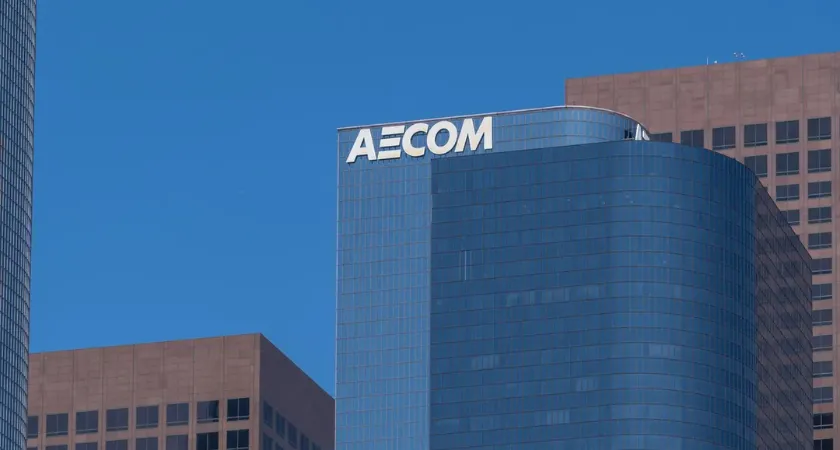
Federal construction activity slowed at the end of 2025 following a 43-day government shutdown, but AECOM executives say the pause only delayed — not diminished — demand. Speaking on the firm’s fiscal first-quarter earnings call, leaders expressed confidence that awards will accelerate through the spring and summer as funding clarity returns to Washington.
.webp)
The Dallas-based infrastructure giant reported lower revenue and profits for the quarter, yet emphasized record backlog and improving visibility across transportation, municipal and private-sector markets. Company leadership pointed to the pending federal surface transportation authorization as a key catalyst for renewed momentum.
“We now expect, now that there’s been a resolution, second and third quarter, we should see that pickup we’re expecting in the federal award activity to come through,” said Gaurav Kapoor, AECOM’s chief financial officer, during the call.
More than half of the $1.2 trillion Infrastructure Investment and Jobs Act remains unspent, creating a sizable pipeline for designers, engineers and program managers. Current earmarks for the surface transportation authorization expire at the end of September, a deadline the industry is watching closely.
“The recent passage of all key federal funding bills for fiscal 26 provides greater certainty for our clients,” said CEO Troy Rudd during the call. “Progress is accelerating for the multiyear surface transportation authorization.”
Kapoor added that an extension would broaden the transportation construction cycle beyond core roadway projects.
“That’s going to continue to provide positive momentum for our transportation business and ancillary business lines that provide services like environment,” Kapoor said on the call.
Beyond federal programs, executives highlighted healthier-than-expected state and municipal finances, particularly in California, Florida and Texas. Tax receipts for fiscal 2025 have outperformed projections made six to 12 months ago, improving the outlook for local infrastructure spending. Those conditions, Kapoor said, should support a steadier flow of design and consulting work even before federal dollars fully ramp.
As multiyear capital programs come online, AECOM plans to tilt more of its business toward advisory and program management services, which Rudd said are poised to outpace traditional design work.
For that reason, Rudd added the firm is intentionally looking to expand its advisory and program management offerings alongside design. He added the goal of those services would be for it to ultimately account for roughly half of its business.
Data center construction represents another major tailwind. Massive investments tied to artificial intelligence are creating secondary demand for power, water and environmental infrastructure — areas where AECOM already has a strong footprint.
“Investment in the private sector is also gaining momentum. This is evident in the booming data center market, where we benefit both directly and indirectly from the infrastructure opportunities,” said Rudd during the call. “This includes water, facilities, energy and environmental services, all sectors where we lead our industry.”
AECOM posted $74.52 million in profits for the fiscal first quarter, a 55.4% decline from $167.04 million a year earlier. Revenue totaled $3.83 billion, down 4.6% year over year. Despite the dip, backlog climbed to a record $25.96 billion, up roughly 9%.
Milwaukee-based investment firm Baird described the quarter as largely in line with expectations, citing strong awards and optimism around AI-related infrastructure.
“Net, pretty good,” wrote Andrew Wittmann, senior research analyst at Baird. “AI benefits and potential challenges still in infancy, those investments expected to build through year-end.”
Industry analysts note that AECOM’s focus on program management mirrors a broader shift among global engineering firms toward higher-margin advisory services. Owners undertaking megaprojects increasingly seek partners to oversee procurement, risk management and digital delivery rather than only traditional design.
.webp)
The anticipated surface transportation bill could unlock years of work for consultants involved in environmental permitting, utility relocation and construction oversight. Many agencies used the shutdown period to refine project lists, meaning a surge of solicitations could arrive quickly once authorization is finalized.
Data center growth also continues to reshape regional infrastructure priorities. New campuses require transmission upgrades, water treatment capacity and resilient transportation access — all disciplines where AECOM has established contracts. Executives said the company is positioning multidisciplinary teams to capture that follow-on work rather than only the buildings themselves.
Originally reported by Sebastian Obando, Reporter in Construction Dive.