CHEYENNE — Two major spending bills totaling more than $1.06 billion in projected funding cleared a key legislative hurdle Thursday, advancing out of a Wyoming House committee after lengthy discussion on rural health care and statewide construction needs.
.webp)
Both proposals were originally part of Gov. Mark Gordon’s recommended 2027–28 biennium budget but were later separated by the Joint Appropriations Committee to allow closer legislative scrutiny and standalone debate.
Lawmakers on the House Appropriations Committee ultimately voted 7-0 to move both measures forward.
Wyoming Department of Health Director Stefan Johansson presented House Bill 122, which outlines how the state plans to manage a $205 million annual influx of federal funding tied to the One Big Beautiful Bill Act.
The proposal establishes a perpetuity fund that would deposit 80% of the initial Rural Health Transformation Program allocation to create a long-term funding stream. Over time, deposit percentages would shift to 69.5% and 30.5% toward initiatives designed to phase out or evolve.
“This is truly a chance, in a few of these basic and core functions of the health care system, to do some things that we’ve all wanted to do for a long time,” Johansson said, describing the bill as a tool to implement “sustainable transformation and reform.”
He said the funding would prioritize core services identified by Wyoming residents through Department of Health surveys, including critical access hospitals, emergency medical services and workforce development.
Much of the committee’s discussion centered on so-called maternity deserts — rural counties lacking consistent labor and delivery services. Over the past six years, four or five maternity units in Wyoming have closed, forcing families to seek care in neighboring states.
“Access to that care can be so far away, often in peripheral states and larger markets,” Johansson said.
He explained that the funding model aims to stabilize rural hospitals burdened by high fixed costs that traditional volume-based reimbursement systems fail to sustain.
In addition to infrastructure stabilization, the program would fund initiatives to attract and retain medical professionals in rural communities — a persistent challenge across Wyoming’s sparsely populated regions.
Because the bill covers fiscal years 2026 through 2028 at an estimated $205 million annually, it addresses roughly $615 million in total federal funding, though final amounts remain subject to federal award determinations.
The committee approved a technical amendment proposed by WDH Deputy Director Franz Fuchs narrowing performance reporting requirements to entities receiving perpetual funding rather than short-term pilot programs.
The bill now heads to the House floor.
The committee also advanced House Bill 111, allocating $445.7 million in combined federal, state and private funds for capital construction projects across Wyoming.
Staff from the Legislative Service Office said the measure includes $232.9 million for major maintenance projects affecting state facilities, community colleges and the University of Wyoming.
One of the largest projects is an $87 million remodel of the Veterans’ Home of Wyoming in Buffalo. Suzanne Norton, construction administrator for the State Construction Department, told lawmakers the project is “shovel-ready” and could begin immediately after the legislative session.
“The current folks that reside there will stay where they’re at. It’s not just a great, big new building, it’s going to be phased,” Norton said.
Presidents from several community colleges testified about aging facilities and rising costs.
Joe Schaffer, president of Laramie County Community College, emphasized the urgency of an exterior renewal initiative targeting deteriorating concrete buildings.
“That delay will not only have price escalations, but also just the challenges of moving contractors on and off campus,” Schaffer said.
Similarly, Walter Tribley, president of Sheridan College, advocated for a $15.2 million science center renovation.
He described the existing facility as having “good bones” but being “clearly out of date,” noting the absence of modern fire suppression systems and adequate lab ventilation.
Lawmakers adopted an amendment introduced by Rep. Trey Sherwood to authorize the use of $2 million in privately raised funds for improvements to the Wyoming State Fair show center floor. Norton explained that installing a concrete surface would reduce long-term biohazard treatment costs compared to maintaining a dirt floor.
However, a separate proposal to add approximately $23 million in additional state matching funds for LCCC buildings failed after receiving no second.
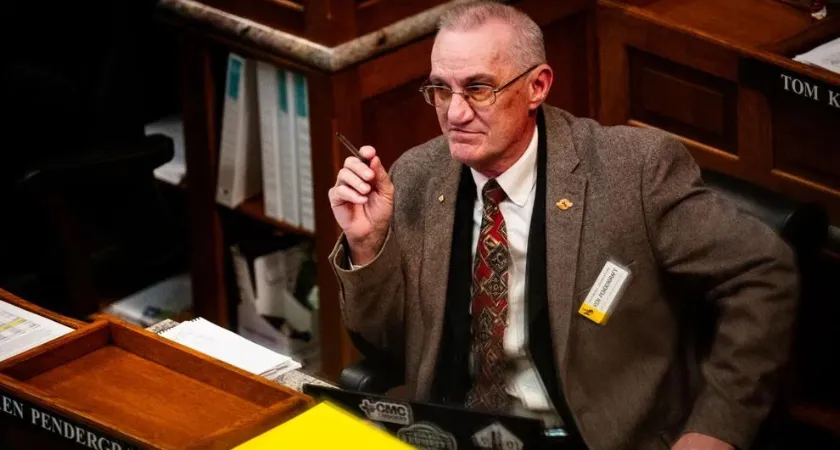
The construction bill, as amended, passed the committee 7-0 and will be presented to the full House by Vice Chairman Rep. Ken Pendergraft.
Together, the rural health and construction measures represent one of the most significant funding packages debated during this budget session of the 68th Wyoming Legislature.
Supporters argue the bills address long-standing structural challenges: stabilizing rural health systems, modernizing aging public infrastructure and preventing more costly emergency repairs down the line.
With unanimous committee support, both bills face favorable odds in the full House, though floor debate may further refine funding details and oversight provisions.
If enacted, the measures could shape Wyoming’s public health delivery system and capital infrastructure landscape for decades.
Originally reported by Noah Zahn Wyoming Tribune Eagle in Wyoming News.