Cultural institutions are increasingly investing in immersive visitor experiences, creating new opportunities for contractors with expertise in specialty interiors, exhibit construction and adaptive reuse. In Chicago, Berglund Construction recently completed work on a major new exhibit at the Griffin Museum of Science and Industry, underscoring the expanding role of builders in experience-driven public projects.
.webp)
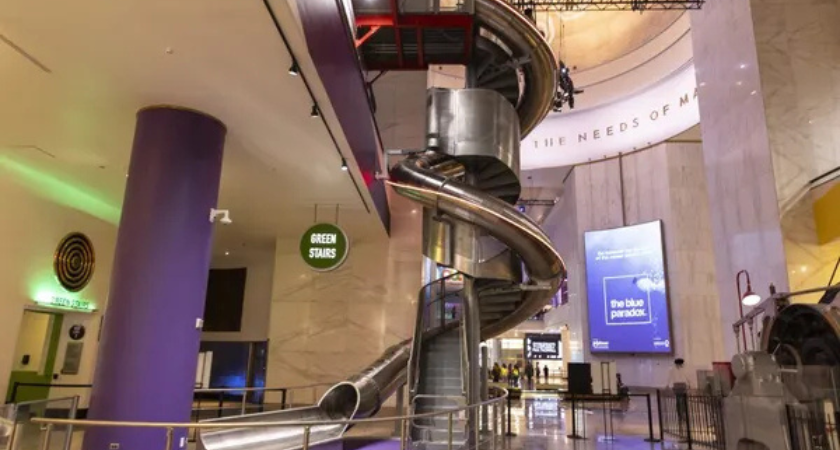
The newly launched “Powering the Future” exhibit introduces visitors to energy technologies and sustainability concepts through interactive installations and hands-on educational features. The permanent exhibit includes large-scale architectural elements, including a 33-foot slide designed as a centerpiece attraction within the space.
For contractors and construction owners, projects of this nature represent a growing niche that blends traditional construction management with highly coordinated specialty trades, exhibit fabrication and visitor-focused design execution.
According to Berglund Construction, the project required extensive collaboration among project managers, designers and exhibit teams to deliver complex interactive spaces while maintaining the operational standards expected within a major public institution. Museum projects often involve heightened logistical demands, including protection of adjacent exhibits, phased construction schedules and integration of advanced audiovisual and technology systems.
Jeff Berglund, president of the company, said the project reflects the firm’s ongoing commitment to building spaces that support education and public engagement. Bonnie Griffin, senior project manager, noted that the exhibit required a high level of coordination to integrate interactive features and specialized design components.
The project also adds to Berglund’s broader portfolio of civic and cultural work across the Midwest. The contractor has participated in several preservation and museum-related assignments, including restoration efforts tied to historic public buildings and exhibit spaces in the Chicago region.
Demand for these types of projects has grown as museums, universities and cultural organizations compete to attract visitors through immersive and technology-enabled environments. Construction firms operating in the sector are increasingly expected to coordinate digital infrastructure, specialty fabrication and experiential design while meeting tight operational and scheduling requirements.
Industry analysts have also pointed to the continued growth of adaptive reuse and restoration work within cultural construction markets. Many institutions are modernizing aging facilities rather than pursuing entirely new buildings, creating opportunities for contractors with expertise in renovation, preservation and phased occupancy construction.
In addition to museum work, Berglund has been involved in restoration and modernization projects connected to libraries, civic facilities and cultural landmarks throughout the region. The company’s recent work includes preservation-focused construction assignments that combine historic protection requirements with modern building performance upgrades.
For construction owners and developers, the expansion of experiential and cultural construction signals a broader market shift toward projects centered on community engagement and public interaction. These developments often require specialized planning, early trade coordination and integrated delivery methods to balance architectural creativity with operational functionality.
As institutional owners continue investing in visitor-focused environments, contractors with expertise in specialty construction, restoration and complex interiors are expected to remain well-positioned in the evolving cultural facilities market.
Source: Berglundco.