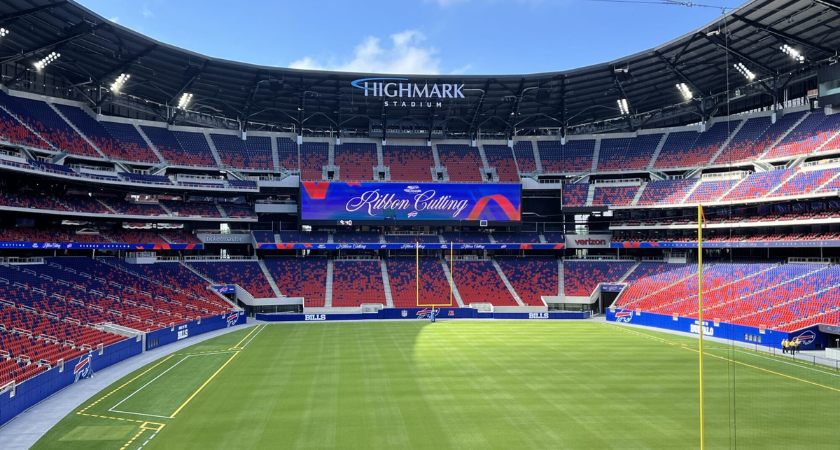
Large-scale sports venue construction continues to generate significant economic and workforce activity across major U.S. markets, with owners increasingly using public-private partnership models to deliver complex projects. Gilbane-Turner has completed the new Highmark Stadium for the Buffalo Bills, marking the delivery of a major sports and entertainment facility in Western New York.
The $2.1 billion project establishes a long-term home for the NFL franchise while creating a large-scale regional construction and economic development investment.
Located on a 242-acre site in Orchard Park, the stadium encompasses approximately 1.6 million square feet and includes seating for 60,108 spectators.
The facility was designed to address Western New York’s winter climate through the use of a 360-degree canopy along with integrated heating and snow-melt systems. The project also includes premium hospitality areas, upgraded audiovisual infrastructure, accessibility improvements and public art installations tied to the Buffalo region’s cultural identity.
Populous served as architect for the project in collaboration with the Buffalo Bills and Legends.
The stadium rises 116 feet above grade and is expected to host football games, entertainment events and other large public gatherings throughout the year.
Gilbane-Turner delivered the project through a public-private partnership involving New York State, Erie County and the Buffalo Bills organization.
According to project information released by the construction team, more than 6,000 craft workers participated in the buildout, contributing an estimated 5 million labor hours.
The project also surpassed New York State’s Minority- and Women-Owned Business Enterprise participation benchmark. More than $490 million in payments went to MWBE firms, including over $250 million awarded directly to Western New York-based MWBE businesses.
The venue is scheduled to open to the public in August with a preseason Bills event before the start of the NFL regular season.
Large professional sports facilities continue to represent a major segment of institutional and entertainment construction activity across North America. Projects of this scale typically require extensive coordination between public agencies, private ownership groups, construction managers, specialty contractors and organized labor.
For contractors and construction owners, stadium developments increasingly emphasize workforce inclusion goals, advanced building systems, fan-focused amenities and year-round operational flexibility. The completion of Highmark Stadium also highlights continued investment in large civic and entertainment assets intended to support tourism, regional economic activity and long-term infrastructure development.
Source: Gilbaneco.