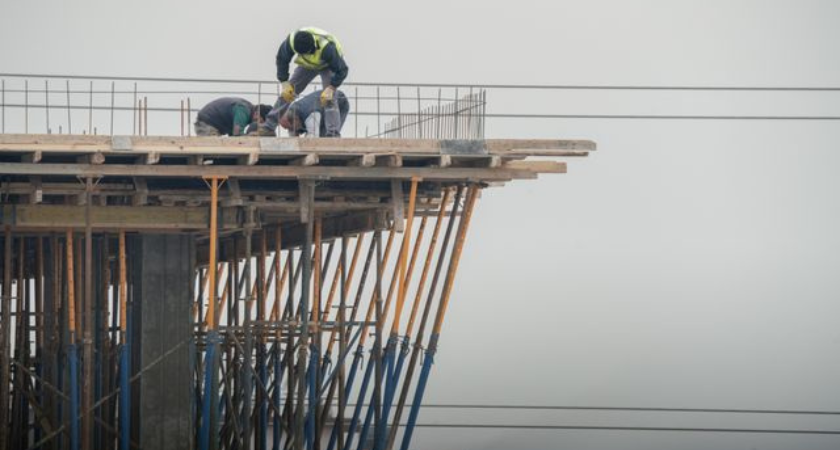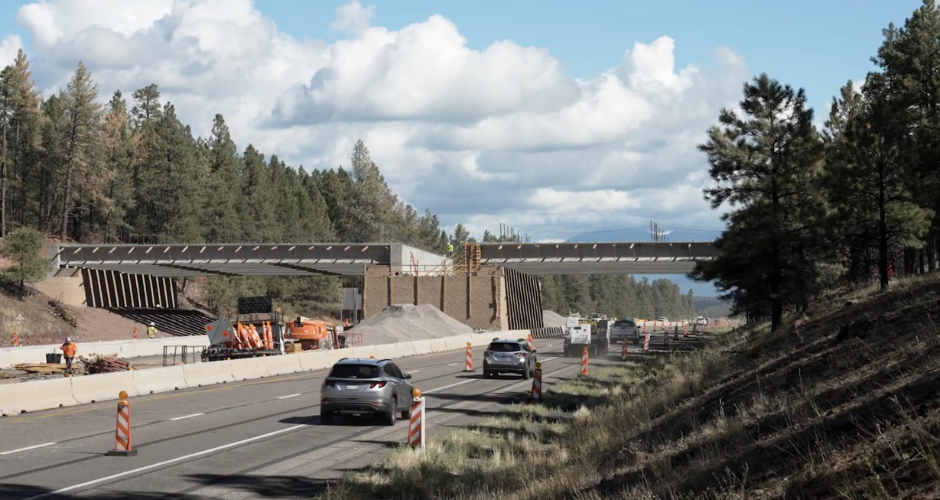
Construction crews working on the highly anticipated I-17 wildlife overpass south of Flagstaff are preparing for a seasonal shutdown beginning November 26, but transportation and wildlife officials say the project is progressing exactly as planned. The $15.8 million crossing—designed to reduce deadly vehicle-animal collisions and reconnect fragmented habitat—is slated to be fully operational by mid-2026.
Funded largely through a Federal Highway Administration Wildlife Crossings Pilot Program grant, the project pairs engineering and environmental science to safeguard migrating animals, especially elk, that frequently cross the interstate. For decades, northern Arizona has been considered one of the state’s most dangerous regions for wildlife-vehicle crashes, and transportation planners have long searched for a solution.
Arizona Game and Fish Department (AZGFD) Wildlife Connectivity Specialist Jeff Gagnon confirmed that progress remains steady despite cold weather forcing a pause. “A lot of it has been built and the decks have been poured and that probably will be finished sometime middle of next year,” Gagnon said. He explained that fencing is underway and “the escape ramps are mainly done, but they need to be receded in order to be able to finish those up.”
From 2018 to 2022, the 32-mile stretch of I-17 between Stoneman Lake Road and Flagstaff accounted for 58% of all wildlife-related crashes in the region, and roughly 75% of those collisions involved elk weighing up to 1,000 pounds. Gagnon said road-upgrade planners understood the need for wildlife protection early on: “When they went to plan for the upgrade of I-17 and I-40… they wanted to include options to reduce collisions with wildlife, including elk.”
The planning effort dates back nearly two decades, combining habitat research, engineering studies, and traffic safety analysis. The overpass—paired with fencing and escape ramps—is considered one of Arizona’s most comprehensive wildlife mitigation systems to date.
Although winter weather halts construction of side walls and prevents concrete curing at high elevation, ADOT officials say the most disruptive traffic impacts are now over. ADOT spokesperson Doug Nintzel noted, “Those types of restrictions are behind us because the bridge decks have been poured… we are in the homestretch here.” While occasional lane restrictions may still be needed, Nintzel said drivers should expect far fewer delays than during overhead work.
Once temperatures warm in the spring, crews will:
This vegetation covering will transform the structure into a natural “land bridge,” designed to blend into the landscape so animals instinctively use it.
Although the overpass won’t open to wildlife until fencing is complete, AZGFD plans to begin research as soon as possible. Motion-sensor cameras and GPS collars for elk will track how quickly animals adapt to the new crossing. Gagnon cautioned that collision data hasn’t declined yet, explaining, “I don’t know that we would see anything yet, because the fence isn’t in place and the project is not far enough along to be able to keep animals off the road.”
He added that any short-term improvement likely results from slowed traffic in the construction zone, not the overpass itself. Officials plan to continue monitoring movement and collision data during construction and for several years afterward to measure long-term safety benefits.
Because winter conditions in northern Arizona can vary drastically, there is no fixed restart date. Work will resume as soon as weather allows, maintaining its current timeline for completion next year.
Once complete, the I-17 overpass will join a growing network of U.S. wildlife crossings designed to protect both humans and animals. With northern Arizona’s elk-migration corridor fractured for decades, the project represents a landmark effort to restore a safer, more connected habitat while reducing crash risks on a major interstate.
Originally reported by Ashley Hinchy in KAFF News.