

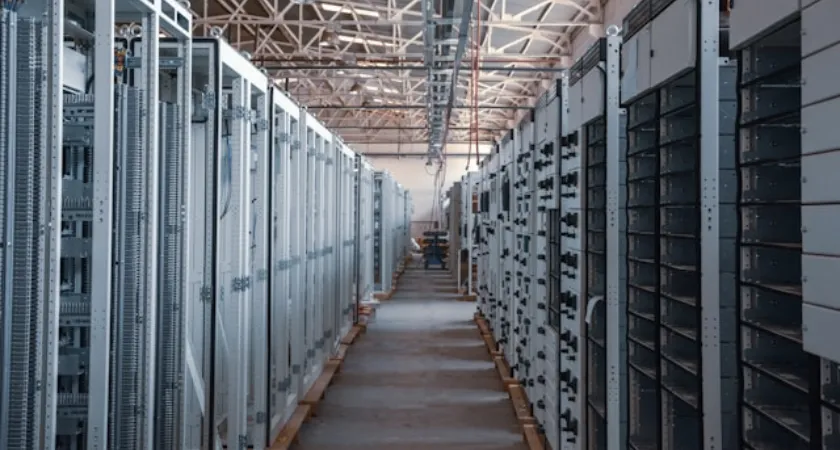
New federal data shows that while overall construction spending slipped last year, one corner of the industry — data centers — continued to surge.
.webp)
According to the U.S. Census Bureau, total construction spending in 2025 declined 1.4% compared to the previous year. But spending on data center construction jumped nearly 30% year over year in December, reflecting massive investments tied to artificial intelligence infrastructure.
The numbers highlight how aggressively major technology companies are building out computing capacity to power AI tools, cloud services and advanced data processing. Still, economists say the broader economic effect has been relatively limited.
For years, data centers were grouped under traditional office construction. That changed as spending accelerated rapidly.
“The Census Bureau did not break out data centers as their own category because it was presumed that they were just a part of office buildings,” said Joseph Politano, economic analyst with Apricitas Economics.
Now, he said, spending on data center construction is starting to eclipse spending on all other office buildings.
By December, construction spending on data centers reached an annualized rate of $45 billion — a sizable figure for a relatively young sector, but still modest compared to total construction nationwide.
Much of the activity has been concentrated in tech hubs and areas with favorable tax incentives and power infrastructure, including Northern Virginia and parts of Texas and the Midwest.
Despite the rapid expansion, data center construction has faced notable obstacles.
“We're seeing a lot of slowdowns because… you don't have enough workers, material prices are too expensive,” said Macrina Wilkins, director of market insights at the Associated General Contractors of America.
Tariffs have increased prices for steel, aluminum and copper, while tighter immigration policies have reduced the available construction labor pool. Supply chain constraints for electrical components have also slowed some projects.
Yet large technology firms appear undeterred.
“Because there's a lot of incentive and a lot of motivation and momentum that I think is helping the industry, instead of in any way taking away from it,” Wilkins said.
Zack Fritz, an economist with the Associated Builders and Contractors, cautioned that the segment remains relatively small in the bigger picture.
“Overall, it's not that large of a category,” Fritz said. “For context, it's a little bit smaller than the warehouse segment right now.”
Although capital spending on AI infrastructure runs into the hundreds of billions of dollars, much of that money does not directly increase U.S. economic output.
Joseph Briggs, who leads global economics research at Goldman Sachs, explained that a significant portion of data center spending goes toward imported semiconductors and electronic components.
“As a result, the boost of growth is small,” Briggs said.
He estimates that roughly two-thirds of total data center investment is spent on imported chips and computing equipment. Because imports are subtracted in the calculation of gross domestic product, that dampens the net contribution to growth.
Goldman Sachs estimates the data center construction boom added about 0.2% to U.S. GDP growth in 2025 — a measurable but modest impact in a $30 trillion economy.
.webp)
Outside of data centers, the construction sector faced a tougher year. Higher interest rates weighed on commercial real estate, office demand remained soft and residential building slowed in several regions.
In that context, AI-related infrastructure has emerged as one of the few consistently expanding segments. Analysts expect additional growth as companies compete to scale up generative AI systems and cloud computing capacity.
However, economists caution that long-term growth will depend not only on building physical infrastructure but also on productivity gains and domestic supply chain expansion.
For now, data centers remain a bright but relatively small engine within a cooling construction landscape — powerful enough to stand out in federal data, but not large enough to carry the broader economy on their own.
Originally reported by Meghan McCarty Carino in Market Place.






