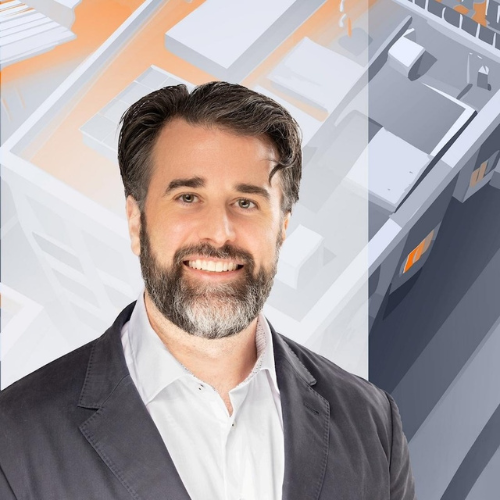
KLAUS Multiparking America has announced a key leadership move, promoting Kevin Paxton to the role of Architectural Design & Sales Specialist as demand for mechanical and space-efficient parking systems continues to rise across U.S. real estate markets. The company says the promotion will help strengthen technical support during the earliest and most critical stages of project development, when design decisions significantly influence overall building feasibility and cost.
The announcement comes amid growing development pressure in major cities, where land scarcity, rising construction prices, and changing EV infrastructure requirements are reshaping parking strategy for multifamily, commercial, mixed-use, and urban infill projects.
.jpg)
With an architectural background, Paxton will now work closely with architects, engineers, developers, and general contractors at the concept and schematic design stages. His expanded responsibilities include optimizing mechanical and semi-automatic parking layouts, reducing excavation depth, improving structural efficiency, and helping teams resolve building code, life-safety, and MEP coordination challenges before they escalate into costly redesigns.
Paxton will also prepare detailed KLAUS shop drawings—such as plans, elevations, and coordination diagrams—ensuring that system requirements align with each project’s architectural vision and structural framework. Early-stage engagement has become increasingly important as developers seek to maximize leasable area and minimize construction volume while still meeting regulatory requirements and EV-ready mandates.
The role extends into value engineering, budget alignment, and planning for EV-charging integration—factors that increasingly influence approval timelines and long-term operational planning in parking facilities. KLAUS says the aim is to provide forward-compatible solutions capable of supporting evolving charging technologies, building codes, and safety standards.
Paxton’s ability to bridge conceptual design intent and technical execution has been highlighted as a core advantage for clients pursuing mechanical parking systems. Because coordination issues often arise late in the design cycle, KLAUS emphasizes the importance of early-phase collaboration to prevent structural conflicts, mechanical clashes, or costly scope changes.
“Kevin’s thoughtful approach and technical experience create meaningful value for our clients,” says Christopher Tiessen, President/CEO of KLAUS Multiparking America. “His work ensures seamless integration of our systems across a diverse range of development types—including multifamily, mixed-use, hospitality, student housing, senior living, and office conversions.”
The promotion reflects larger trends reshaping American cities. Mechanical and automated parking—once considered niche—is increasingly used to maximize site efficiency, reduce building footprints, and meet both zoning and financial constraints. Rising urban density and market pressure have accelerated adoption of systems capable of increasing parking capacity without consuming substantial ground-floor or underground space.
EV adoption is also driving innovation in the sector, with municipalities expanding EV-ready requirements and developers seeking systems that can incorporate chargers without compromising operation, ventilation, or fire-safety.
KLAUS Multiparking America, the U.S. subsidiary of KLAUS Multiparking GmbH in Germany, has delivered more than 835,000 global parking spaces through a portfolio of mechanical and automated parking solutions. The company supports projects nationwide, including major markets such as New York, New Jersey, Massachusetts, Pennsylvania, Virginia, Washington, D.C., Ohio, Utah, California, Florida, and Georgia.
Originally reported by Business Insider.