Investment in career and technical education facilities is accelerating as colleges and school systems respond to skilled labor shortages across construction, manufacturing and industrial sectors.
Lease Crutcher Lewis is involved in multiple workforce-oriented education projects in Oregon that reflect broader efforts to expand training capacity for high-demand trades and technical occupations. The facilities are designed to support hands-on instruction while aligning campus infrastructure with evolving industry workforce needs.
Lane Community College’s Industry and Trades Education Center in Eugene represents one of the state’s larger recent investments in technical workforce education. The 55,000-sq.-ft. facility opened in January 2025 as part of a $121 million voter-approved bond program.
Designed by Hennebery Eddy Architects, the center consolidates construction, plumbing, mechanical and engineering-related programs into a single facility. Training programs previously operated in separate campus buildings.
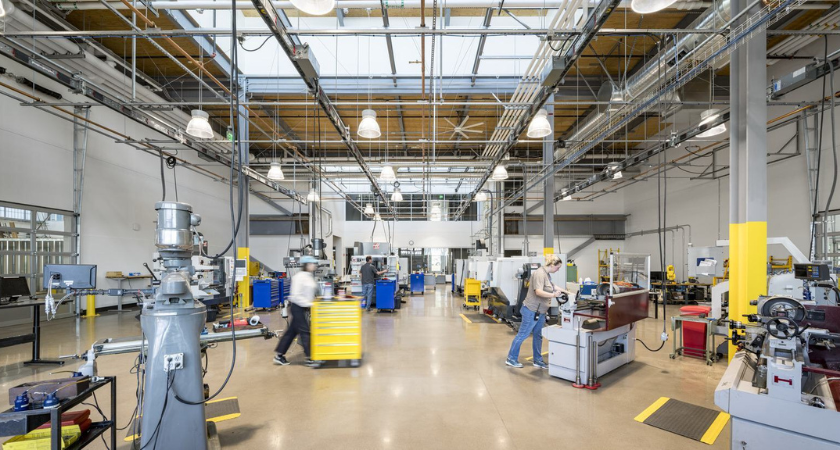
The project includes high-bay laboratory spaces capable of accommodating full-scale building systems and industrial equipment. Educational programs housed in the facility include advanced manufacturing, automation and unmanned aircraft systems training.
Building systems and exposed structural components also are integrated into the educational environment to support hands-on instruction and technical learning.
Lease Crutcher Lewis is also constructing the Oregon Coast Advanced Technology & Trades Center at Oregon Coast Community College in Newport.
The 22,000-sq.-ft. facility, designed by GLAS Architects with Hacker and BNDRY Studio, will support programs tied to construction, welding, HVAC, maritime technology and industrial maintenance.
Project planners structured the building around shared technical skill areas rather than individual academic departments. Planned laboratory areas include spaces dedicated to building systems, electronic systems, mechanical systems and heavy industrial fabrication activities.
The facility also incorporates support amenities including gathering areas, lockers, showers and meeting spaces intended to accommodate working students and employer engagement activities.
Construction workforce shortages continue to influence education and facility planning across the United States. According to a 2025 Associated General Contractors of America survey, a large majority of Oregon construction firms reported difficulty filling both craft and salaried positions.
As a result, community colleges and school districts increasingly are developing industry-focused facilities designed to expand workforce pipelines and strengthen local labor availability.
For contractors, owners and developers, the growing emphasis on technical education construction is creating continued demand for specialized institutional projects that incorporate adaptable lab environments, industrial infrastructure and employer-driven program design.
Source: Lewis Builds.