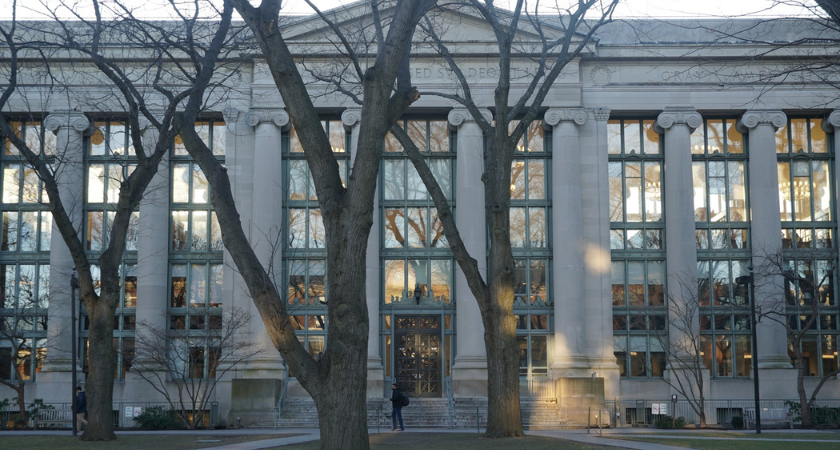
Colorado Gov. Jared S. Polis used a Harvard Law School appearance on Monday to sharply criticize the Trump administration’s tariffs on construction materials, arguing that the trade barriers have driven up project costs and deepened the housing affordability crisis facing Colorado.
.jpg)
Speaking at an event hosted by the HLS Democrats and moderated by Professor Nikolas Bowie, Polis reflected on his shift from business entrepreneur to public official, serving a decade in Congress before becoming governor in 2018. The conversation covered economic policy, federal-state relations, and the urgent housing pressures confronting Colorado.
Polis said the quickest way to bring down housing costs is to eliminate unnecessary obstacles in the construction pipeline — including tariffs that restrict supply and inflate prices.
“Get rid of tariffs — and import the lowest cost materials from Canada, where they grow a lot of wood and from other places, and build houses,” Polis said, adding that Trump is doing the opposite. His comments underscored a broader argument for lowering trade barriers, expanding labor mobility and making it easier for homeowners to add new units on their property.
He explained that Colorado has been attempting to expand its housing stock by loosening restrictive zoning, allowing accessory dwelling units, and reducing the influence of HOA rules that prevent density. Polis said that while local reforms matter, federal policies still have outsized economic consequences for states trying to keep pace with population growth.
The governor also discussed his philosophy on taxation, emphasizing incentives over penalties. Polis said he believes the government should tax harmful behaviors rather than productive economic activity. He highlighted this approach by pointing to his administration’s support for pollution taxes while avoiding broad increases on income.
He said policymakers should shift the tax base toward “things we want to discourage” and away from “things that are good,” arguing that such an approach encourages innovation and sustainability without burdening working families.
.jpg)
The event also explored the tension between state needs and federal cost-cutting. Polis said budget reductions at the federal level have already created significant pressure in Colorado as the state works to maintain core public services.
“I mean, whatever you read about it, it’s like 10 times more chaotic every day,” Polis said, reflecting on recent federal actions.
He added that the governor’s office has created a dedicated team to respond to federal funding actions — a shift from previous years when the focus was on maximizing federal dollars available through the Biden administration. Now, Polis said, the priority is damage control: minimizing losses as multiple federal programs face cuts.
Colorado is currently involved in more than 30 lawsuits over federal funds, targeting issues ranging from wildfire mitigation and disease prevention to public safety and mental health resources. Despite those ongoing legal battles, Polis emphasized that the state is committed to protecting essential services.
“We still have schools and prisoners and all that other stuff you do with states, and most of that is state funded,” he said, noting the state’s constitution requires a balanced budget — unlike the federal government.
“The federal government not only doesn’t balance the budget, doesn’t have to balance the budget, but never balances the budget,” Polis said. “Debt is getting worse and worse.”
He concluded by underscoring the urgency of the housing crisis, saying residents care more about results than political debates over jurisdiction.
“People want housing they can afford. They really don’t care whether it’s the federal, the state. They don’t care.”
Originally reported by Sidhi Dhanda and Caroline G. Hennigan, Crimson Staff Writers in The Crimson.