

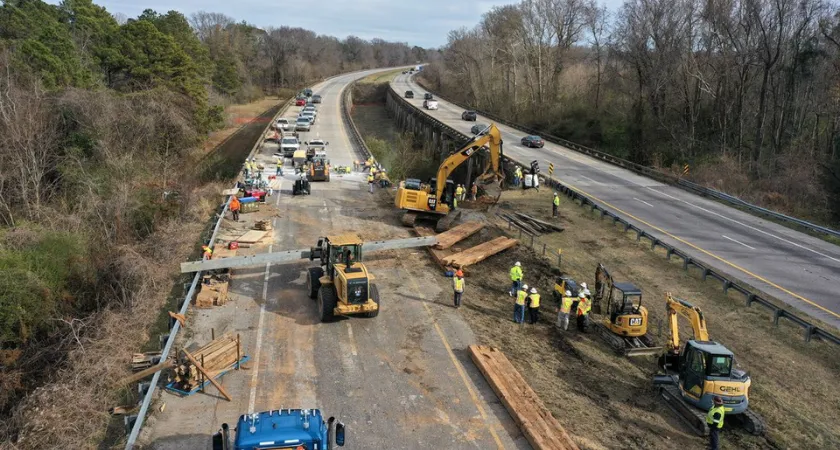
Henry McMaster is urging lawmakers to approve an additional $1.1 billion for road and bridge improvements, citing escalating construction costs and mounting infrastructure demands across South Carolina.
.webp)
According to the South Carolina Daily Gazette, the requested funding nearly equals the total amount legislators have allocated to road and bridge work over the past four years combined. The governor’s office pointed to nationwide construction inflation and South Carolina’s rapidly growing population as key pressures driving the need for supplemental funding.
Updated revenue projections released in November indicate lawmakers have nearly $2.5 billion in additional funds available for the fiscal year beginning July 1. That total includes $1.7 billion in surplus reserves and higher-than-expected tax collections, along with $734 million in recurring revenue from continued economic growth, based on figures from the state Board of Economic Advisors.
McMaster’s proposal would use more than 60 percent of the state’s one-time surplus. He has argued that prioritizing infrastructure now is essential as the state simultaneously works toward income tax reductions that could constrain future revenues.
"Our population is skyrocketing, and inflation is driving up construction costs, creating potential delays," he said in a statement quoted by the Daily Gazette.
South Carolina Department of Transportation Secretary Justin Powell warned lawmakers that transportation funding has failed to keep pace with inflation. In a December letter, he highlighted the limitations of the state’s 28-cent gas tax, which fully phased in during 2022.
When legislators approved the phased 12-cent increase in 2017, one penny of the gas tax could fund paving for 114 miles of two-lane highway. By 2025, that same penny will cover only 87 miles, Powell wrote, underscoring the purchasing power decline.
Of the $1.1 billion requested:
Powell cautioned that without additional funding, projects already underway could be delayed by years, compounding cost increases due to extended timelines.
Two of the state’s largest interstate expansions illustrate the challenge. The widening of I-26 between Columbia and Charleston has grown from just over $2 billion in 2022 to $3 billion. Meanwhile, the I-95 widening from the Georgia border to U.S. 278 in Jasper County has jumped from $977 million to nearly $2.3 billion. Columbia’s Carolina Crossroads project — intended to modernize the heavily congested “Malfunction Junction” interchange — has risen from $2.1 billion to $2.8 billion by the end of 2025.
A substantial portion of the requested funds would address the state’s aging bridge inventory. Of South Carolina’s 8,450 bridges, more than 2,800 are over 60 years old — the age when major rehabilitation or full replacement often becomes necessary. As of early December, approximately 80 bridges remained closed.
Although lawmakers recently approved $400 million for bridge improvements, the department had sought $300 million for a third installment and received $200 million instead. The agency says additional funding is needed to accelerate repairs and prevent further closures.
The proposal also includes $75 million to begin preconstruction design work for widening I-85 between Anderson and Oconee counties and I-77 between Chester and Rock Hill. Early design efforts could strengthen the state’s competitiveness for federal infrastructure grants and potentially advance timelines beyond the current 2035 projected start date.
Another $75 million would fund a study of improvements along I-26, I-85 and I-77 near Charlotte, aligning South Carolina’s planning efforts with North Carolina’s ongoing interstate upgrades in the region.
Additionally, the Department of Transportation is requesting $25 million to support transferring certain state-owned roads to local governments. South Carolina maintains the nation’s fourth-largest state highway system despite ranking 23rd in population — a structural imbalance that has complicated maintenance funding. Previous “road buyback” proposals stalled due to concerns from local governments about assuming long-term costs. The agency now seeks authority to negotiate financial terms for such transfers, with final approval resting with the Legislature.
.webp)
The governor’s proposal places lawmakers at a crossroads: dedicate a significant share of surplus funds to infrastructure modernization or preserve more of the surplus amid broader tax reform discussions.
Supporters argue that addressing inflation-driven cost increases now could prevent steeper expenses later, particularly as the state continues to experience population growth, industrial expansion and freight demand along key interstate corridors.
If approved, the funding infusion would represent one of the most significant one-time infrastructure allocations in state history — aimed at preventing project slowdowns, modernizing aging bridges and keeping major interstate expansions on track.
Originally reported by South Carolina Daily Gazette in Construction Equipment Guide.






