California’s long-debated transit-oriented housing law is approaching its July 1 start date — but confusion over how to implement it and continued political resistance are threatening a turbulent rollout.
.webp)
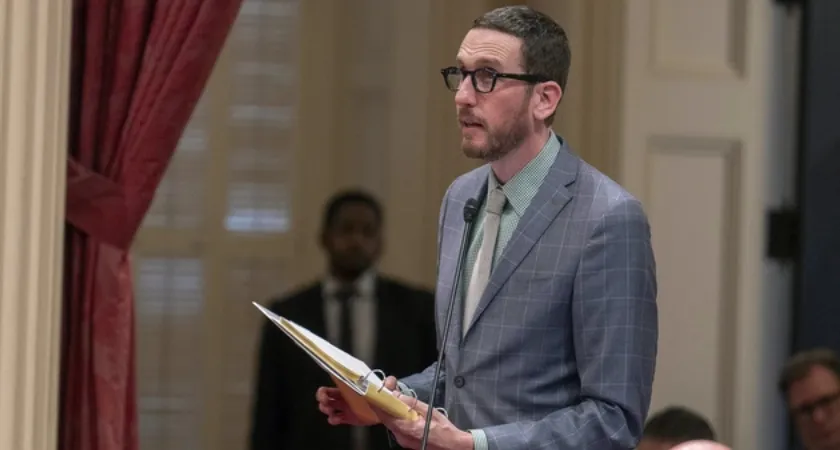
Senate Bill 79, authored by Democratic state Sen. Scott Wiener of San Francisco, took seven years of negotiations, rewrites and failed attempts before finally passing last year. The measure allows mid-rise housing construction near major transit hubs in select regions of the state.
Now, with just months before the law takes effect, uncertainty over its complex language is slowing preparations and reigniting opposition.
“We’re happy to have conversations with people who have good-faith feedback, including about that issue,” Wiener said of postponing when SB 79 takes effect.
Wiener has not ruled out delaying implementation if technical and political challenges cannot be resolved in time.
Wiener first introduced legislation to increase housing near transit in 2018, arguing that denser development was critical to address California’s housing shortage, reduce greenhouse gas emissions and combat soaring home prices.
SB 79 allows mid-rise buildings near transit stops in the Bay Area, greater Los Angeles, Sacramento and San Diego. The tallest buildings — up to nine stories — are permitted closest to heavy rail stations such as BART in San Francisco and subway lines in Los Angeles. Buildings ranging from five to eight stories are allowed further from heavy rail or near lighter transit systems such as rapid bus or light rail.
To secure enough votes for passage, Wiener narrowed the law’s geographic scope and included multiple carveouts. Areas vulnerable to wildfire or sea-level rise can be excluded, and parcels already containing apartment buildings are protected from certain redevelopment provisions. Cities are also allowed to craft alternative housing plans that add density elsewhere in exchange for preserving lower-density zones near transit.
Many of these provisions were negotiated in the final weeks of the legislative session — leaving implementation details to be sorted out later.
The responsibility for defining exactly where the law applies was handed to regional metropolitan planning organizations. These agencies must draw official maps identifying transit hubs and the boundaries within which denser housing can be built. The state Department of Housing and Community Development (HCD) oversees compliance.
But defining eligibility has proven complicated.
The law calculates eligible parcels based on their distance from a transit stop’s “pedestrian access point.” For major hubs like Los Angeles’ Union Station, which has multiple entrances, that definition is unclear. Questions also arise for bus rapid transit stops that may consist of little more than a posted sign.
“This is probably the most challenging housing bill to implement because of all the unknowns,” said Jason Rhine, senior director of legislative affairs at the League of California Cities. “There are a lot of cooks in the kitchen.”
Regional agencies in Southern California and San Diego say they need more guidance from the state before releasing maps. State housing officials maintain they are meeting their obligations.
“We trust that our regional partners are doing the same,” said David Zisser, assistant deputy director of housing policy for the state. “We have been consistently communicating with them and providing technical support to help implement the law effectively so that we can build more housing faster.”
Wiener has expressed frustration at the slow progress.
“The maps need to be done as quickly as possible,” he said.
He also suggested that some critics are overstating confusion to undermine the law.
“The back-and-forth between the state and the regional entities is ‘not an acceptable state of affairs,’” Wiener said.
Opposition has been particularly strong in Los Angeles. The City Council voted to oppose SB 79, Mayor Karen Bass reportedly urged Gov. Gavin Newsom to veto it, and City Attorney Hydee Feldstein Soto has organized other cities around a potential legal challenge.
Metro, Los Angeles County’s transportation agency, recently called for excluding the county from SB 79 altogether. Officials argue that uncertainty around the law could complicate the agency’s ongoing $120 billion transit expansion.
“The law is causing the cities to begin to oppose our projects,” said Madeleine Moore, Metro’s deputy executive officer for government relations. “We don’t want to be in a position where we cannot deliver this high-quality transit.”
Wiener dismissed proposals to exempt Los Angeles County.
“When people come forward and make proposals to exempt the largest county in the United States out of the law, that’s not going to be well received,” Wiener said.
He argues that billions in public transit investments must be paired with housing density to boost ridership and maximize taxpayer returns.
To clarify ambiguous language in SB 79, Wiener initially introduced SB 677. He has since shelved that bill in favor of a broader cleanup measure, SB 908, which he says will contain a comprehensive set of revisions.
Ideally, SB 908 would pass with an urgency clause, allowing it to take effect immediately before SB 79’s July 1 implementation. However, that would require two-thirds support in both legislative chambers — a difficult threshold given the law’s controversy.
“Given how controversial SB 79 was, I’m not going to take a risk on losing the bill by putting an urgency (clause) in, unless I’m really confident it’s going to actually get a two-thirds vote,” Wiener said.
If SB 79 takes effect in July but clarifying legislation does not activate until January 2027, cities and developers could face months of legal uncertainty.
Wiener acknowledged the timing concerns but made clear he will not allow the law’s core purpose to be weakened.
“I know that there are people who would like to jump in and blow the law up,” Wiener said. “I’m not going to let that happen.”
As California continues grappling with a severe housing shortage and rising living costs, the success — or failure — of SB 79’s rollout may shape the future of transit-oriented development across the state.
Originally reported by Liam Dillon in Politico.