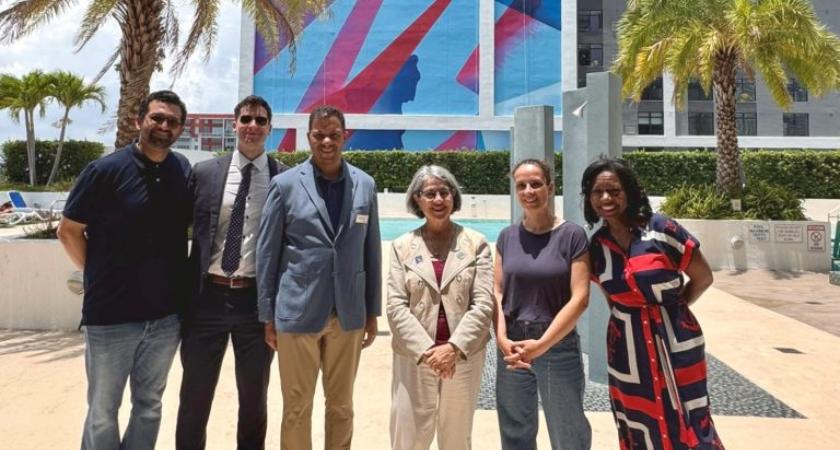
Large-scale public art installations are increasingly being incorporated into multifamily and mixed-use developments as developers seek to differentiate projects in competitive urban markets. These installations often require additional coordination between construction teams, artists, façade specialists and development stakeholders during final project phases.
Shawmut recently completed construction coordination activities tied to a four-panel mural installation at Excel Miami, a residential tower developed by Clearline Real Estate in downtown Miami.
The mural installation covers multiple elevations of the 24-story tower, with the largest section extending approximately 245 feet along the south-facing façade.
Excel Miami includes 427 residential rental units along with street-level retail space. Project teams indicated the building is scheduled to begin welcoming residents in September.
The mural was created by German artist Claudia Walde, known professionally as MadC, whose work focuses on large-format urban art and abstract compositions.
Construction management responsibilities included preparing building surfaces, coordinating installation logistics and maintaining schedule alignment during completion of the exterior artwork program.
Exterior art features integrated into high-rise developments can introduce additional construction planning requirements involving access systems, façade protection, staging and safety coordination.
Projects incorporating custom architectural graphics or large-scale visual installations frequently require collaboration among contractors, façade consultants, specialty coating teams and design stakeholders during closeout activities.
The Excel Miami installation was completed while broader tower construction activities continued toward final occupancy preparation.
Developers across South Florida continue pursuing multifamily and mixed-use projects that combine residential construction with public-facing design elements, amenity programming and streetscape enhancements.
In urban residential markets such as downtown Miami, developers are increasingly incorporating public art and architectural branding features into towers intended to support neighborhood identity and street-level engagement.
High-density residential construction in the region has also contributed to continued demand for specialty façade systems, architectural finishes and mixed-use project delivery expertise.
For owners and contractors, projects incorporating large-scale façade artwork and custom exterior elements can increase coordination complexity during late-stage construction and commissioning phases.
The Excel Miami project also reflects broader development trends in urban multifamily construction where architectural identity, public realm integration and visual differentiation are becoming larger considerations alongside core residential delivery objectives.
Source: Shawmut.