Estimating software has emerged as the dominant technology in the preconstruction phase of construction projects, outpacing all other digital tools in adoption and usage, according to a new report from BuiltWorlds.
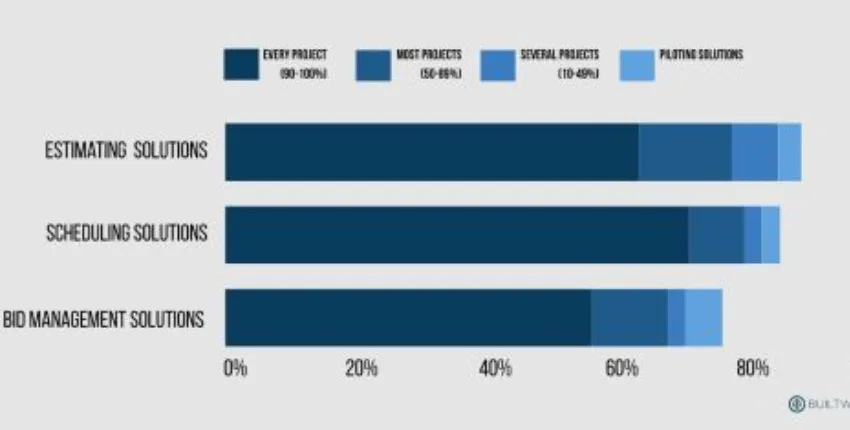
The firm’s latest Annual Preconstruction Benchmarking Report found that nearly 90% of surveyed contractors—primarily general contractors—have implemented estimating solutions in some capacity. Even more notably, 64% reported using these tools on every project, marking a sharp increase in consistent adoption across the industry.
Estimating Software Becomes Industry Standard
The report highlights a dramatic rise in the role of estimating tools over the past few years. Usage on every project has increased by 42% year-over-year and surged nearly 392% since 2022, when only 13% of firms reported widespread implementation.
“As tech literacy and overall implementation rises throughout our industry, I’m not entirely surprised to see that estimating solutions have become a popular option,” says BuiltWorlds Research Director Audrey Lynch, noting the 22% year-over-year increase in regular usage (ie, respondents reporting usage on “several,” “most,” or “every” project). “These technologies are becoming critical to budgets and profitability but also standardization and accuracy. Ninety percent of respondents agreed that the top use case for estimating solutions was ‘achieving consistent estimating practices across the organization.’”
Among the tools evaluated, Drawer AI received the highest user ratings, while On-Screen Takeoff from ConstructConnect also ranked prominently among users.
Other Preconstruction Tools Gaining Momentum
While estimating software leads the way, other preconstruction technologies are also seeing strong adoption. The report found that scheduling tools and bid management platforms are widely used, with 83.3% and 71.5% of respondents respectively reporting regular use.
“For both scheduling and bid management, more than half of the contractors using those solutions were doing so on every project,” Lynch points out. “If you look year over year, both solutions saw big increases in consistent usage. It suggests a rising level of standardization among those using the technologies.”
Scheduling tools are most commonly used to create visual project timelines and track completion progress, with 85% of users identifying these as key functions. Meanwhile, bid management platforms are primarily used to improve bid comparisons and leveling, cited by 81% of respondents.
The rapid rise of estimating software reflects a broader digital transformation across the construction industry, where contractors are increasingly relying on data-driven tools to improve accuracy, reduce risk, and maintain profitability in a volatile market.
Standardization is a key driver behind adoption. By using consistent estimating platforms across projects, firms can better control costs, reduce discrepancies, and streamline communication between teams. This is particularly important as projects grow more complex and margins tighten.
The growing adoption of scheduling and bid management tools further underscores a shift toward integrated preconstruction workflows. Rather than operating in silos, contractors are leveraging multiple technologies in tandem to improve planning, coordination, and decision-making before construction even begins.
Looking ahead, industry experts expect continued growth in artificial intelligence-powered tools and automation within preconstruction, building on the strong foundation established by estimating platforms.
About the Organization
BuiltWorlds is a global research and networking platform focused on innovation in the buildings and infrastructure sectors. With a network spanning more than 250 companies across 25 countries, the organization provides insights, analysis, and educational programming to help industry leaders navigate an evolving construction landscape.
Originally reported by BuiltWorlds.