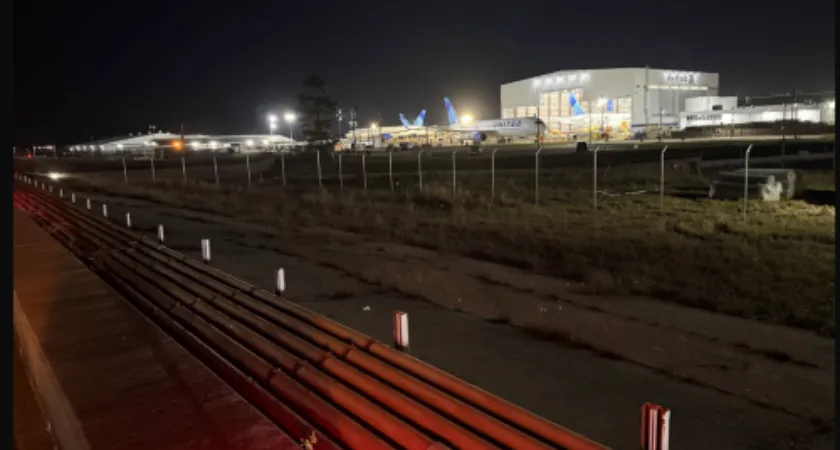
Infrastructure contractor F.H. Paschen has begun work on a critical aviation infrastructure project at George Bush Intercontinental Airport, targeting long-standing erosion issues affecting a key taxiway bridge.
The $2.2 million project, commissioned by the Houston Airport System, focuses on stabilizing the Taxiway SF Bridge retaining wall and upgrading essential electrical systems at one of the busiest airports in the United States.
Handling more than 700 daily domestic and international flights, the airport relies heavily on the integrity of its ground infrastructure—much of which operates behind the scenes but is vital to maintaining smooth operations.
Focus on Erosion Repairs and System Upgrades
The two-month construction effort centers on repairing erosion damage that has developed over time around the bridge structure. Crews will remove compromised soil and reshape the terrain using stabilized materials designed to prevent future degradation.
Work will also include repairing and re-waterproofing sections of the retaining wall, along with replacing damaged concrete components to ensure long-term durability. In parallel, outdated electrical systems will be upgraded with modern equipment to improve reliability and operational efficiency.
Engineering support for the project is being provided by AtkinsRéalis.
“This project matters to the Texas economy because it addresses the hidden but essential parts of the airport that keep everything else moving,” said Bill Rocha, who leads F.H. Paschen’s operations in Texas. “By working closely with the Houston Airport System and partners like AtkinsRéalis, we are focused on delivering repairs that strengthen the facility for years to come.”
Maintaining Operations During Construction
Given the airport’s high traffic volume, construction is being carefully coordinated to avoid disruptions to daily operations. Temporary fencing and containment systems will be installed, forming a secure boundary aligned with TSA requirements.
Strict traffic control measures will also be enforced throughout the project, ensuring that construction activities do not interfere with aircraft movement or airside logistics.
“Our main goal is to complete these repairs efficiently while maintaining a safe environment within the active airfield,” said Charlie Habermacher, F.H. Paschen Project Manager. “We have planned every step to make sure our work on the retaining wall and electrical systems doesn't get in the way of the airport's daily operations.”
Experience in Complex Aviation Projects
F.H. Paschen brings extensive experience in airport construction, particularly in high-security, operational environments. The firm recently completed a $4.7 million renovation project at Dallas-Fort Worth International Airport for American Airlines, upgrading employee restrooms and modernizing aging plumbing systems.
That project required working within active terminals while maintaining strict security protocols—experience that translates directly to the current work at Bush Intercontinental Airport.
Expanding Footprint in Texas
The new project also reflects the company’s growing presence across Texas. In late 2025, F.H. Paschen opened a new office in Galveston, adding to its existing locations in Houston and Irving.
The firm continues to expand its portfolio across sectors including aviation, healthcare, and public infrastructure, with a strong focus on complex, fast-track construction and job order contracting for public agencies.
Projects like the Taxiway SF Bridge repairs highlight the importance of maintaining aging infrastructure at major transportation hubs. While runway expansions and terminal upgrades often draw public attention, underlying systems such as retaining walls, drainage, and electrical networks are equally critical to operational safety.
Erosion-related issues, if left unaddressed, can compromise structural stability and lead to costly disruptions. By proactively investing in repairs, airport authorities can extend the lifespan of existing assets while avoiding more extensive reconstruction in the future.
This project also demonstrates how infrastructure upgrades can be executed in live environments without interrupting service—an increasingly important capability as global air travel demand continues to grow.
Originally reported by F. H. Paschen.