

How High-Performance Coatings Slash Total Cost of Ownership Over Your Facility's Lifespan
.png)
Key Highlights
- Upfront savings often backfire. Cutting costs on exterior coatings during construction can lead to expenses that "completely eclipse" original savings within just a few years.
- PVDF-based coatings dramatically extend lifespan. High-performance formulations using PVDF (polyvinylidene fluoride) resin can extend coating life up to 40 years, versus 5–10 years for standard paints.
- Repaint costs go beyond material price. Full repaint cycles carry hidden costs — specialized labor, scaffolding, operational downtime, and risk of substrate damage (water incursion, corrosion) if deferred.
- Real-world case: Solano Community College. A premium latex paint faded and chalked within five years. Switching to a high-performance coating system restored the original color, eliminated chalking, extended the repaint cycle to 20+ years, and delivered $48,000 in direct savings plus labor and scaffolding reductions.
- AAMA 2605 is the industry benchmark. This standard requires coatings to survive a 10-year weathering test in South Florida, maintaining color retention (Delta E <5.0), at least 50% gloss retention, and resistance to chalking, abrasion, salt air, and industrial cleaners.
- Energy and cost benefits are measurable. Reflective roof coatings can cut roof surface temperatures by up to 28°C (50°F), lower interior temperatures by 3–5°C, and reduce cooling costs by up to 30%.
- Sustainability gains are significant. PVDF-based coatings show a 74% lower product carbon footprint than standard polyester alternatives over a 50-year building lifespan, largely due to needing only one recoat instead of three.
- Real-world case: Charles de Gaulle Airport. Replacing an absorptive asphaltic roof coating with a reflective PVDF-based cool roof coating cut the airport's energy bills by 21%.
- Bottom line: Facility owners should evaluate coatings on a 30-year total cost-of-ownership basis — factoring in labor, downtime, substrate risk, and energy performance — rather than upfront per-gallon price alone.
New construction won't stay new forever. In many cases, the inevitable upkeep arrives much sooner than building owners anticipate, and the material decisions made on day one have financial consequences felt throughout the building's lifecycle.
It’s a process problem as much as it is a product failure.
Competitive bidding and lump-sum construction models pressure owners to minimize upfront costs. Coating quality is frequently the casualty. "Paint is just paint," many assume. "What's the worst that can happen?"
A lot, actually. Standard paints look great on the initial budget, but in just a few years, those deferred expenses can completely eclipse your original savings.
The solution is to start treating high-performance coatings as a long-term operational investment that controls costs, protects structural integrity, and advances sustainability goals.
Accounting For the Long-Term Costs
Once the keys are handed over and the general contractor packs up, facility managers are left holding the bag and the maintenance budget.
They often inherit maintenance headaches that could have been solved on day one with investments in the building envelope, the building’s weather-proof, airtight outer shell that protects it from everything the environment throws at it.
The exterior envelope is a common target for value engineering, as it accounts for a significant share of construction costs and is supplied by an ecosystem full of lower-cost products that claim comparable performance. However, substituting cheaper solutions rarely delivers similar performance or long-term durability.
As Modern Building Envelope reports, “While the materials themselves may perform well under controlled testing conditions, real-world construction rarely replicates those ideal conditions.”
These lower-cost coatings don’t perform as well as high-performance coatings, and they lead to additional, unnecessary costs throughout the building’s lifespan.
“The cost of repairing that failure after the building is occupied can be several orders of magnitude greater than the original savings,” Modern Building Envelope explains.
Initial construction plans must prioritize high-performance formulations utilizing polyvinylidene fluoride (PVDF) resin technology. The impact is undeniable. This single specification extends the coating lifespan up to 40 years, preserving capital and eliminating operational disruption.
Traditional, low-cost wall and roof coatings face a severely limited lifespan. Depending on the climate, facilities will require full repaint cycles every five to 10 years. For commercial building owners, each cycle costs far more than new paint.
The true cost includes:
- Labor overhead: Specialized labor costs often outpace coating material costs during a repaint.
- Operational downtime: Scaffolding and property closures can restrict tenant access, leading to anything from minor inconveniences to direct revenue loss for high-traffic assets like hotels and retail spaces.
- Substrate vulnerability: If a standard coating degrades prematurely and maintenance is deferred, water incursion and structural corrosion can take hold.
Fixing building envelope failures is exponentially more expensive than preventing them during initial construction.
For instance, Solano Community College, a higher education institution in Fairfield, Solano County, California, experiences extreme weather conditions, which are increasingly common nationwide. They caused the building’s exterior, originally painted with a premium latex paint, to fade from a bright “Solano Safety Blue” to a tired battleship grey in just five years. Even a subtle contact with the walls left a chalky residue on the hands.
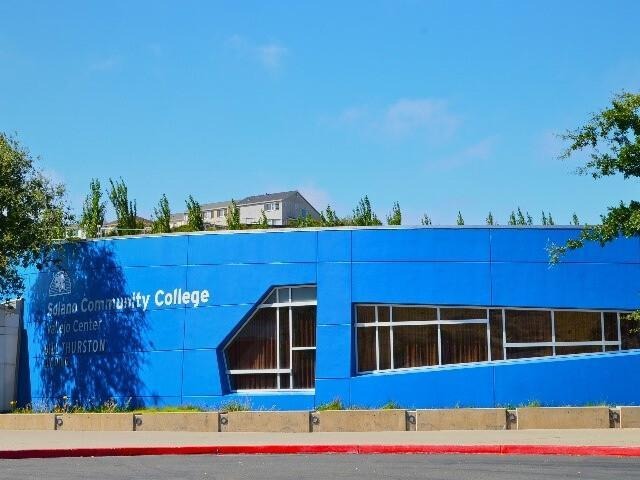
Solano College facility featuring exterior coatings (photo courtesy of Arkema)
To avoid continuous repainting, the college turned to a high-performance coating system that restored the building's original color integrity and eliminated the chalking problem entirely. More importantly, it extended the expected repaint cycle from five years to over 20 years, allowing the college's facilities team to redirect maintenance budgets toward other deferred priorities.
In addition to $48,000 in direct savings, the college capitalized on labor reallocation, saved on scaffolding rentals, and avoided disruptions to campus operations.
External Finishes Are Functional Assets
Architectural renderings frequently celebrate the color, gloss, and immediate visual impact of a new building's facade.
However, viewing exterior finishes purely through an aesthetic lens ignores their primary engineering purpose: protecting the building envelope from relentless environmental degradation.
This isn’t achieved through marketing claims or unverified promises.
The premier designation for architectural finishes is the AAMA 2605 standard. To earn this validation, a coating must survive a 10-year continuous weathering test in South Florida, facing south at a 45-degree angle to maximize exposure to intense UV radiation. To pass, the coating must demonstrate:
- Color Retention: The finish must exhibit minimal color shift, with a strict Delta E <5.0 over a decade of brutal sun exposure.
- Gloss Preservation: The coating must retain at least 50% of its original gloss over the same 10-year period.
- Erosion and Chemical Resistance: The formulation must resist chalking, heavy abrasion, salt air, and aggressive industrial cleaners without breaking down or pulling away from the substrate.
The result is a functional finish, not just an aesthetically pleasing one. The benefits include:
- Lower energy use: Properly formulated reflective roof coatings have been shown to reduce roof surface temperatures by up to 28°C (50°F) and interior temperatures by 3-5°C (6-9°F), reducing cooling costs by up to 30%. On top of that, these reflective coatings can reduce the peak energy fees often charged to commercial building during peak cooling hours.
- Lower carbon footprint: Lower energy bills mean less fossil fuel is needed to generate electricity.
- Longer repaint and repair cycles: High-performance coatings extend the repaint cycle from a typical 5–7 years to 15–40 years, reducing repainting and touch-up requirements.
- Lower maintenance costs and less downtime: The longer lifespan and reduced maintenance also mean less disruption for building occupants and less downtime for the building. This could reduce the frequency of necessary exterior washings from annually to every two or three years and also reduce the need for touch-up paint.
Simply put, high-quality coatings keep the building looking pristine while extending repair and maintenance cycles, ultimately advancing facility sustainability.
Advancing Facility Sustainability Through Smart Material Selection
The construction sector is responsible for a disproportionate share of global carbon emissions. With new embodied carbon standards, which assess a building's carbon footprint across its entire lifecycle, builders and facility owners are incentivized to specify materials that reduce upfront material waste and long-term operational emissions.
As a result, modern construction demands a difficult balance between maintaining strict operational budgets and achieving aggressive corporate sustainability mandates. High-performance exterior coatings serve as a highly effective bridge between these two distinct priorities.
According to a quantitative analysis of life-cycle embodied carbon in residential buildings, creating long-lifespan, adaptable structural frames yields the largest reduction in long-term embodied carbon.
Independent, comprehensive life-cycle analyses demonstrate a clear environmental hierarchy. Utilizing a PVDF-based coating system results in a 74% lower product carbon footprint than standard polyester alternatives over a 50-year lifespan for a metal-clad building.
Less environmental impact is a direct result of product durability. When a facility only requires one recoat over 50 years instead of three, it eliminates the massive carbon output associated with manufacturing, transporting, and applying multiple rounds of replacement materials.
Beyond reducing the carbon overhead of the materials themselves, advanced finishes actively optimize the thermal performance of the building envelope to lower daily energy demands.
For instance, reflective formulations reject solar radiation, keeping exterior surfaces and internal spaces significantly cooler.
This passive cooling capability relieves the burden on existing HVAC equipment, so the system draws less power from the grid and directly lowers the facility's ongoing carbon footprint.
Consider Charles de Gaulle Airport in Paris, France. A study found that its existing asphaltic roof coating was absorbing most of the solar energy, heating the roof structure and transferring that heat into the building. Applying a durable, reflective PVDF-based cool roof coating reduced the airport's energy bills by 21%.
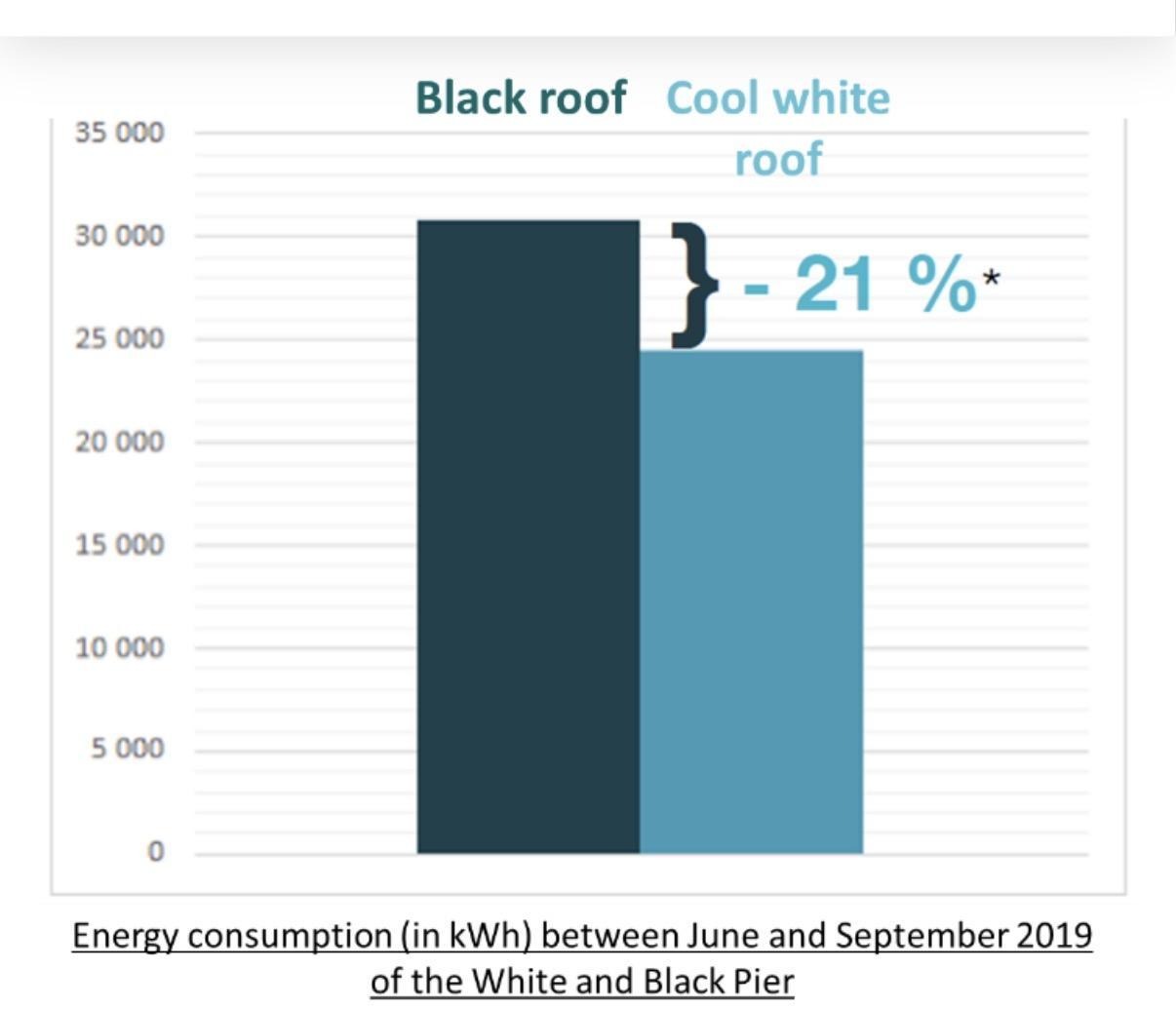
Energy consumption in kWh photos courtesy of Arkema
For a facility operating at that scale, with terminals running climate control around the clock across millions of square feet, a 21% reduction translates into substantial annual savings and a measurable decrease in the airport's overall carbon output.
The cheapest coating on day one is almost never the cheapest coating over the life of the building. Smart material specification is the simplest lever facility owners have to control costs they haven't incurred yet.
Future Proofing the Bottom Line
The temptation to cut corners during the initial bidding and construction phases will always exist, but falling for the misconception that “paint is just paint” creates a long-term financial trap. The decisions made on day one will determine a facility's operational reality and upkeep costs for decades to come.
Investing in high-performance, PVDF-based coatings lowers the total cost of ownership by extending repaint cycles, preventing catastrophic substrate failure, and eliminating crippling operational downtime. These advanced materials do the heavy lifting for corporate sustainability, aggressively driving down both daily cooling costs and lifecycle carbon emissions.
Put differently, a building’s exterior is its first line of defense against harsh elements, structural decay, and runaway upkeep costs that compound year after year.
Before the next project goes to bid, challenge your team to run a simple total cost-of-ownership comparison over a 30-year horizon. Go beyond the per-gallon price on a spec sheet and factor in labor, scaffolding, tenant disruption, substrate repair risk, and energy performance. In nearly every scenario, the high-performance formulation pays for itself multiple times over, and the facility you hand off to the next generation of owners will prove it.
.jpg)


TOP STORIES
View AllRECOMMENDED
.png)

