.webp)
State transportation officials have selected a design-build team to carry out a major interstate expansion in one of Arizona’s most critical freight and commuter corridors.
The Arizona Department of Transportation (ADOT) awarded a $410 million contract to Coffman-Fisher to deliver the northern segment of the I-10 Wild Horse Pass Corridor improvements project. The team includes San Diego-based Coffman Specialties, Dickinson, North Dakota-based Fisher Sand & Gravel and Edmonton, Alberta-based Stantec.
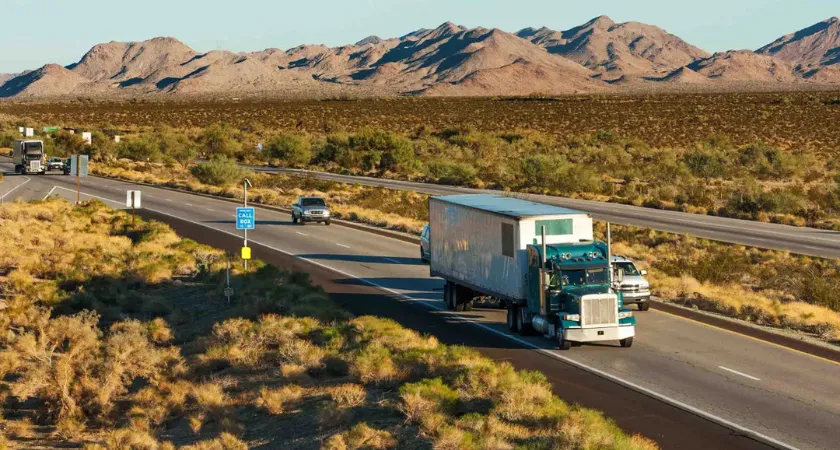
The project spans approximately 12 miles of Interstate 10 between Phoenix and Tucson, targeting a heavily traveled stretch that supports Arizona’s manufacturing, warehousing and logistics sectors. According to Stantec, the $410 million segment is part of a broader corridor program valued at roughly $1 billion.
Once complete, improvements are expected to ease congestion for up to 126,000 vehicles per day while enhancing safety and travel reliability in both directions.
“The I-10 corridor serves as a vital connector between Tucson and Phoenix, and we welcome the opportunity to help improve the connectivity of these communities,” said Robert Lemke, senior project manager at Stantec, in a release. “Working alongside ADOT and Coffman-Fisher as our design-build partner, we deliver a safer and more connected commuter experience across Arizona.”
The scope of work includes adding one general-purpose lane and one high-occupancy vehicle lane in each direction from Loop 202 to south of Riggs Road. Crews will also construct one additional general-purpose lane in each direction from south of Riggs Road to the Gila River Bridges.
Interchange improvements are planned at Wild Horse Pass, Queen Creek, Riggs Road and Koli Road. Enhancements will also include intelligent transportation systems, upgraded lighting, new signals, updated signing, pavement markings and drainage improvements throughout the corridor.
Together, these upgrades are designed to reduce bottlenecks, improve merging conditions and modernize infrastructure along a stretch that has experienced sustained population and industrial growth over the past decade.
In a notable shift from the originally proposed plan, the design-build team developed an alternative approach to repaving the corridor with new asphalt.
Instead, crews will replace the entire stretch with concrete pavement. According to the project release, the concrete design is expected to provide a 30-year lifespan at nearly the same upfront cost as asphalt, delivering “significant long-term maintenance savings.”
That decision reflects a broader trend among state DOTs to prioritize lifecycle cost efficiency and durability, particularly on high-volume freight corridors. The Phoenix-to-Tucson route is a key artery for regional supply chains, linking distribution centers, industrial parks and cross-border trade routes.
.webp)
Beyond congestion relief, the improvements are positioned to strengthen Arizona’s competitiveness as a logistics and manufacturing hub. The I-10 corridor plays a central role in connecting central and southern Arizona to national and international markets.
Construction activity is also expected to generate significant job opportunities across engineering, skilled trades and materials supply chains. With design-build delivery, ADOT aims to accelerate project timelines and maintain tighter coordination between design and construction teams.
As work progresses, motorists can expect phased construction schedules intended to maintain traffic flow while upgrades are underway.
Originally reported by Sebastian Obando, Reporter in Construction Dive.