ARIZONA — The southernmost stretch of the Arizona Trail has been փակed to the public as construction of a new border wall continues along the state’s southeastern edge, officials confirmed this week.
.avif)
According to the National Park Service, the closure is necessary to “ensure visitor safety” amid ongoing construction and blasting activity. The affected segment — approximately one mile at the trail’s southern terminus — is expected to remain closed through the end of 2027.
The trail, which spans roughly 800 miles from north to south across Arizona, draws hundreds of hikers each year. Its southern endpoint, located at the U.S.-Mexico border, has long served as a symbolic finish line for those completing the route.
The closure follows a major federal investment in border infrastructure. In 2025, the Department of Homeland Security awarded nearly $310 million to Fisher Sand & Gravel Company to construct approximately 27 miles of new border fencing in southeastern Arizona.
Construction has since advanced through areas including the San Rafael Valley, where several miles of fencing have already been installed. The barrier consists of 30-foot-tall steel bollards, significantly altering the landscape along the border.
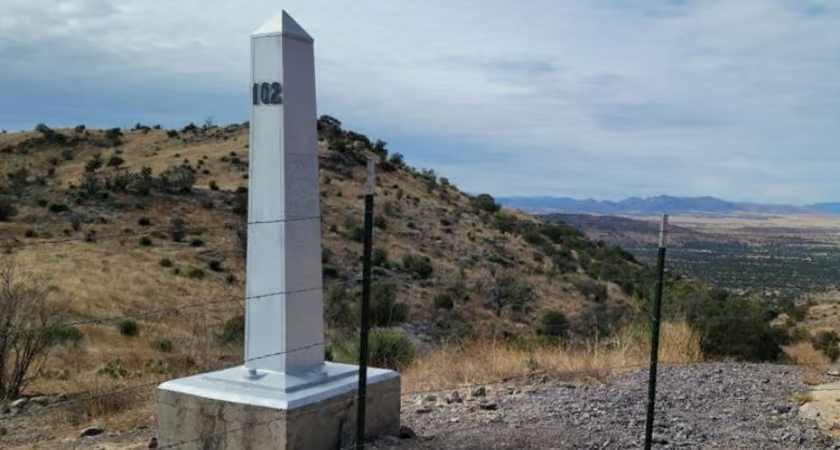
The southern segment of the Arizona Trail passes through the Huachuca Mountains and ends at Border Monument 102, a landmark historically used by hikers to mark the completion of the route.
“Now, that's going to be behind two 30-foot-tall steel barriers, with a 150-foot-wide road in the middle,” said Matthew Nelson, executive director of the Arizona Trail Association.
The Arizona Trail Association estimates that between 400 and 500 hikers complete the trail each year. With the closure in place, officials are encouraging visitors to seek alternative viewpoints, such as Coronado Peak, which offers expansive views of the surrounding region.
“When you're there on the AZT, and you're looking into Mexico, it looks so familiar,” Nelson said. “I think that perspective of these borders being political boundaries, but not so much ecological or topographic, is just a really great perspective.”
Environmental advocates have also voiced concerns about the long-term impact of the border wall on wildlife habitats. The region is home to diverse species, including black bears, mountain lions, jaguars and ocelots, which rely on cross-border movement for survival.
The Center for Biological Diversity has filed legal challenges against the federal government, alleging that environmental protections were bypassed during construction. Additional lawsuits have been filed regarding similar border wall projects in other regions.
As construction continues, federal officials are also installing secondary fencing in areas where barriers already exist, further expanding the scope of the project.
The closure marks a significant shift for one of the nation’s most iconic long-distance trails, raising questions about access, conservation and the long-term balance between infrastructure development and environmental preservation.
Originally reported by Angela Gervasi, AZPM in Calo News.