

Every Construction Safety Week, companies across North America pause to reinforce a message that has remained unchanged for decades: safety is the top priority on every job site.
Toolbox talks are held. New reminders are issued. Supervisors review protocols. Yet despite stronger regulations, better training, and more advanced equipment, construction remains one of the most hazardous industries in the world.
According to the U.S. Occupational Safety and Health Administration (OSHA), construction accounts for nearly 20% of all workplace fatalities, despite employing only a fraction of the total workforce. Similarly, data from the Bureau of Labor Statistics (BLS) shows that thousands of non-fatal injuries occur annually due to falls, equipment interaction, and site coordination issues.
The question is no longer whether safety systems exist—but why incidents still happen even when those systems are in place.
The answer increasingly points to a less discussed issue: visibility gaps on dynamic job sites.
These are not policy failures. They are not necessarily training failures either. Instead, they are operational blind spots created by the scale, complexity, and constant movement of modern construction environments.
This article explores those visibility gaps in depth and explains how construction safety thinking is evolving from reactive supervision toward continuous situational awareness. It also examines how digital observation methods, including aerial monitoring and data-driven workflows, are influencing this shift in practical, measurable ways.

Understanding the Reality Behind Construction Safety Week
Construction Safety Week was established to reinforce a simple idea: safety must be intentional, not assumed. Over time, it has become a structured industry-wide effort across contractors, developers, and infrastructure operators.
However, the modern construction environment is significantly more complex than when traditional safety frameworks were first designed.
Today’s job sites often include:
- Multiple subcontractors working simultaneously
- Fast-changing structural phases
- Heavy equipment movement in confined areas
- Tight project timelines driven by economic pressure
- Increasing integration with surrounding urban environments
Each of these factors introduces variability. And variability makes consistent oversight harder.
Even with strict compliance measures in place, safety outcomes depend heavily on what supervisors can actually see and interpret in real time.
This is where the first major challenge emerges.
The Core Problem: Visibility Gaps in Dynamic Work Environments
A visibility gap occurs when decision-makers lack complete or timely awareness of what is happening across a job site.
On paper, most safety systems assume continuous monitoring. In practice, however, construction sites are too large and too dynamic for any single team to observe everything at once.
Industry research indicates that a significant portion of construction incidents are linked to lack of situational awareness rather than lack of safety rules. Reports from safety organizations suggest that many job site accidents occur due to miscommunication, limited line-of-sight, or delayed hazard recognition.
1. Scale and Physical Limitations
Large infrastructure projects often span multiple acres. Residential high-rises extend vertically beyond direct line of sight. Industrial builds include restricted or hazardous zones where human access is limited.
No matter how experienced a site supervisor is, it is physically impossible to observe every critical zone simultaneously.
2. Fragmented Communication Flow
Information on job sites often moves through layered communication channels:
- Field workers report to foremen
- Foremen report to site managers
- Site managers coordinate with safety officers
By the time information reaches decision-makers, the original context may already have changed.
3. Time Delay Between Observation and Action
Traditional safety inspections are periodic rather than continuous. This creates a delay between:
- A hazard forming
- The hazard being detected
- The corrective action being taken
Studies in construction risk management have shown that even short delays in hazard response can significantly increase incident probability, especially in high-activity zones where conditions change minute by minute.
4. Blind Spots in High-Risk Zones
Certain areas are inherently difficult to monitor:
- Roof edges and elevated platforms
- Excavation pits
- Areas behind large machinery
- Temporary scaffolding structures
These are often the same areas where high-risk incidents occur.
The result is a paradox: sites may be compliant on paper but partially invisible in practice.
Why Traditional Safety Systems Alone Are No Longer Enough
Modern construction safety systems are built around structured processes:
- Scheduled inspections
- Worker training programs
- Compliance checklists
- Incident reporting systems
These systems are essential, but they are fundamentally retrospective. They are designed to confirm whether safety procedures were followed—not to continuously reveal emerging risks as they develop.
This creates a structural limitation: safety is often verified after exposure, not during risk formation.
As projects become larger and more interconnected, this gap becomes more significant.
The industry is therefore shifting its focus toward real-time situational awareness rather than periodic verification.
The Shift Toward Real-Time Job Site Awareness
Real-time awareness in construction refers to the ability to understand site conditions as they evolve, not after the fact.
This shift is not driven by a single technology. It is the result of multiple converging trends:
- Digital construction management platforms
- Sensor-based equipment tracking
- AI-assisted risk detection tools
- Aerial observation systems
Among these, aerial visibility has emerged as a particularly effective method for addressing large-scale blind spots.
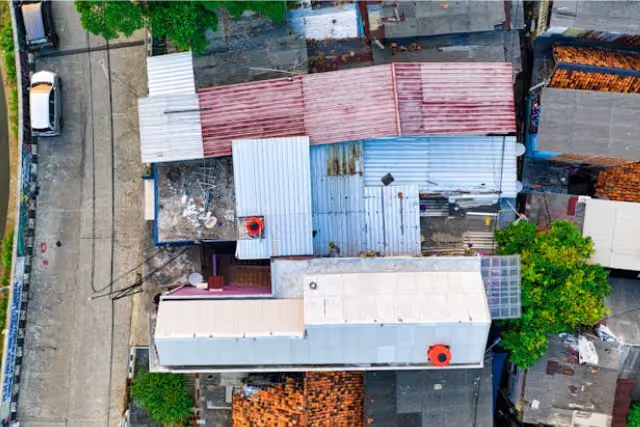
By capturing a top-down view of the entire site, project teams can gain a spatial understanding that is difficult to achieve from ground level alone.
This is where modern aerial data systems, including drone services for construction, are increasingly being used as part of broader safety observation workflows.
However, the key point is not the technology itself—it is what the technology enables: a shift from fragmented observation to unified visibility.
Aerial Visibility and Its Role in Safety Improvement
Aerial observation introduces a different perspective on construction safety. Instead of focusing on isolated areas, it allows teams to understand the site as a connected system.
1. Identifying Spatial Conflicts
Many safety risks are spatial rather than procedural. For example:
- Equipment operating too close to worker zones
- Material storage blocking emergency pathways
- Overlapping activities in confined areas
From ground level, these conflicts can be difficult to recognize early. From above, patterns become more visible.
2. Monitoring High-Risk Progression Phases
Certain construction phases carry higher inherent risk:
- Structural assembly
- Roof installation
- Deep excavation
- Heavy lifting operations
Aerial observation allows supervisors to monitor how these phases interact across the site in real time.
3. Supporting Documentation and Accountability
Visual records of site conditions help teams:
- Validate safety procedures
- Review incident timelines
- Improve training based on real scenarios
This shifts safety management from subjective reporting toward evidence-based review.
4. Enhancing Coordination Across Teams
Large projects often involve multiple contractors working in parallel. A shared visual reference helps align understanding across teams, reducing miscommunication.
From Safety Monitoring to Predictive Awareness
One of the most important shifts in modern construction safety is the move toward prediction rather than reaction.
Instead of asking:
“What went wrong?”
The industry is increasingly asking:
“What conditions are forming that could lead to risk?”
This change is supported by better data availability, improved visualization tools, and integrated monitoring systems.
When combined with analytical platforms, aerial data can help identify recurring patterns such as:
- Congestion points at specific times of day
- Repeated unsafe proximity between workers and machinery
- Delays in clearing hazardous zones
These patterns are not always visible through traditional inspection methods.
Connection to Urban Development and Planning Complexity
Safety challenges are also influenced by how cities themselves are evolving.
Modern urban-planning trends show increasing density, vertical construction, and mixed-use development. These environments introduce additional constraints:
- Limited staging space for materials
- Proximity to active public areas
- Higher regulatory scrutiny
- Increased coordination requirements between stakeholders
As a result, construction safety is no longer an isolated site-level concern. It is now deeply connected to how urban environments are designed and managed.
In dense city projects, even small safety oversights can have broader public impact, making visibility and coordination even more critical.

The Evolving Role of Digital Observation in Safety Culture
The introduction of digital observation tools is not replacing human expertise. Instead, it is extending it.
Site supervisors still interpret risk. Safety managers still make decisions. Workers still execute tasks.
What is changing is the quality and completeness of information available at the time decisions are made.
This shift has several implications:
- Safety decisions become more data-informed
- Risk identification becomes earlier in the process
- Communication becomes more visual and standardized
- Accountability becomes clearer and more structured
The construction industry is gradually moving toward a hybrid model where human judgment and digital awareness operate together.
How Construction Teams Can Reduce Visibility Gaps
While visibility challenges are complex, there are practical steps construction teams can take to improve situational awareness on job sites:
- Implement real-time monitoring tools to track site activity continuously rather than relying solely on periodic inspections
- Standardize communication workflows to reduce delays and ensure accurate information flow between teams
- Use aerial inspections on large or multi-phase projects to gain a comprehensive view of site conditions
- Integrate safety data into daily briefings so teams can respond proactively to emerging risks
Key Takeaway
Construction Safety Week serves as a reminder that safety is not a one-time initiative—it is a continuous operational responsibility.
However, the challenges facing modern job sites are evolving. Many safety issues today are not caused by lack of rules, but by lack of complete visibility into complex and fast-changing environments.
The future of construction safety will likely be defined by how effectively the industry can reduce these visibility gaps through better coordination, better data, and more comprehensive situational awareness.
In this context, safety is becoming less about checking boxes and more about seeing the full picture—clearly, continuously, and in real time.
Sources & Industry References
- Occupational Safety and Health Administration (OSHA) – Construction Safety Standards
- Associated General Contractors of America (AGC) – Safety Data Reports
- Bureau of Labor Statistics (BLS) – Construction Injury and Fatality Statistics
- Construction Safety Week Initiative – Industry Awareness Programs
- McKinsey & Company – Reinventing Construction Industry Reports



TOP STORIES
View AllRECOMMENDED
.avif)

