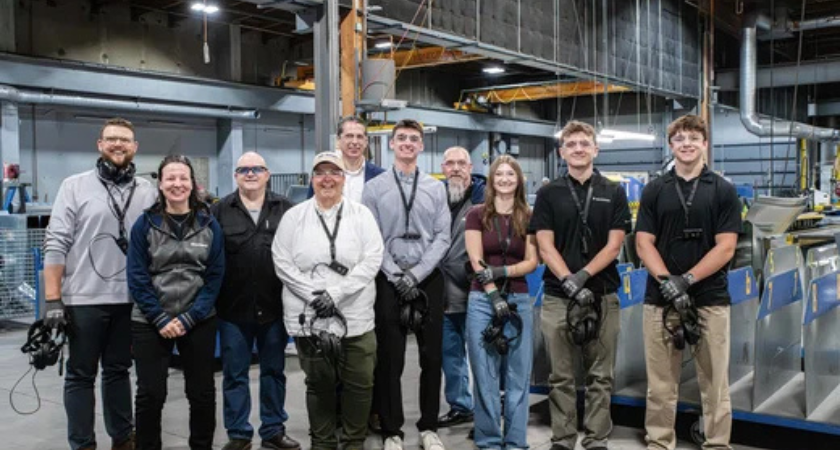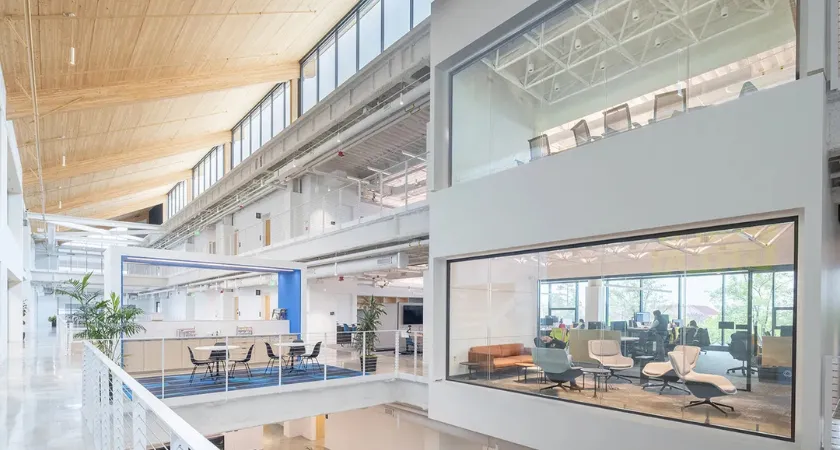
DPR Construction has relocated its headquarters from Redwood City, California, to a new flagship campus in Santa Clara designed to integrate office operations, craft teams and fabrication work in one collaborative environment.
.webp)
The 113,702-square-foot facility serves as both the company’s corporate headquarters and a new Prefabrication Assembly Facility, allowing teams to assemble construction components in a controlled environment before they are transported to jobsites.
The new campus brings together administrative staff, craft workers and fabrication specialists under a single roof, reflecting the contractor’s growing investment in prefabrication and modular construction techniques.
The Santa Clara facility includes 68,160 square feet of open office space and 45,542 square feet dedicated to prefabrication activities. DPR said the layout is intentionally designed to encourage collaboration between design teams, project managers and craft professionals.
The company aims to eliminate the traditional separation between office-based employees and field workers by allowing everyone to share the same workspace and amenities.
“I think traditionally, construction, even to this day, there’s this invisible wall or firewall, and it’s like you’re either on the office side or you’re working with your hands,” Kevin Chen, co-business leader for the Bay Area, told Construction Dive. “It just doesn’t feel [as] collaborative as it can be.”
By bringing the two groups together, DPR hopes to improve communication and coordination during the construction process.
The new facility is located in the heart of Silicon Valley, which also helps provide more predictable commutes for craft workers in the region’s notoriously congested transportation network.
A major feature of the new headquarters is DPR’s technology-driven prefabrication lab, where building components can be assembled in advance using virtual design and construction tools.
The company says manufacturing components offsite helps improve safety, quality and productivity while reducing jobsite congestion and schedule risks caused by weather delays or supply chain disruptions.
The prefabrication facility houses DPR’s self-perform teams working on drywall, finish carpentry, architectural concrete, roofing, building envelopes and specialty systems.
DPR has increasingly relied on prefabrication techniques in recent years, particularly for large-scale data center and mission-critical projects that require precise coordination and accelerated schedules.
The contractor has previously used prefabrication to build electrical rooms, central utility plants and mechanical piping systems for projects in Texas.
“We were already building data centers for many, many years,” Chen said. “But as they got larger and as they got quicker, there was no better way to service our advanced tech customers than with our prefab capabilities.”
The Santa Clara lab is not DPR’s first investment in prefabrication technology. In 2021, the contractor launched a prefabrication research facility in Research Triangle Park, North Carolina, aimed at developing new modular construction techniques.
These initiatives reflect a broader trend in the construction industry toward offsite manufacturing, where building components are produced in controlled environments before installation onsite.
.webp)
By shifting portions of construction to fabrication facilities, contractors can reduce labor requirements in the field, improve quality control and accelerate project timelines.
For DPR, the strategy is particularly valuable in the rapidly expanding data center market, where projects must be delivered quickly to meet surging demand driven by artificial intelligence and cloud computing infrastructure.
The company believes that integrating prefabrication with advanced digital modeling tools will allow it to deliver more predictable construction outcomes while helping clients manage cost and schedule risks.
Originally reported by Matthew Thibault, Reporter in Construction Dive.