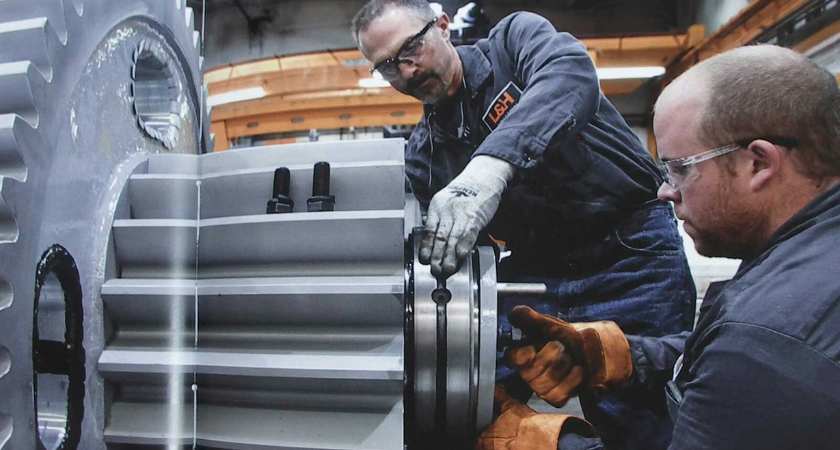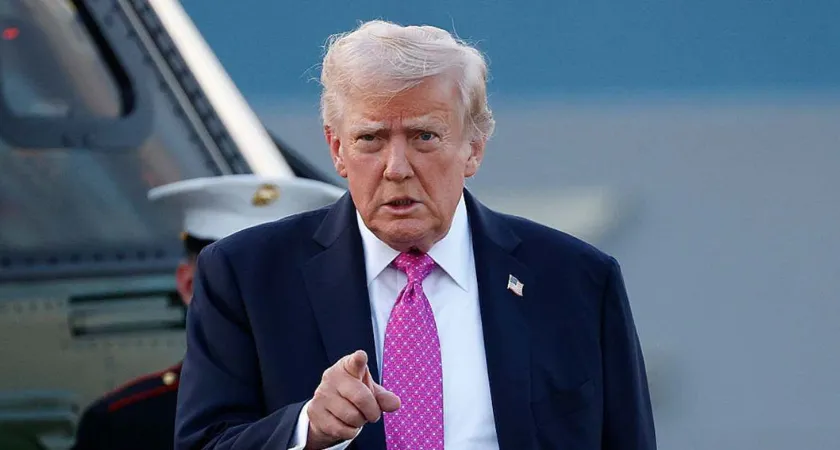
Spending to build and expand U.S. manufacturing facilities has fallen since President Donald Trump returned to office, according to U.S. Census Bureau figures — a trend that conflicts with the president’s repeated assertion that factory construction is soaring.
Trump has frequently cited a “41% increase” in factory investment, portraying it as proof that his trade and economic policies are fueling a manufacturing boom.
“Investment in American factories is up 41%. That’s a record. Nobody goes 41% up. You go 2% up, 1% up. You go down by 3%. If Kamala [Harris] got elected, the 41% up would be 41% down,” Trump said at a White House press conference on Jan. 20.
He repeated the claim the next day at the World Economic Forum in Davos:
“Factory construction is up by 41%, and that number is really going to skyrocket right now, because that’s during a process that they’re putting in to get their approvals and we’ve given very, very quick, fast approvals.”
FactCheck.org reviewed the underlying data and found a different picture: manufacturing construction spending peaked in 2024 during the Biden administration and has edged downward since.
Under President Joe Biden, manufacturing construction experienced an unprecedented surge. Annual average spending rose more than 200%, climbing from $75.5 billion in 2021 to $235.6 billion in 2024, driven largely by the bipartisan CHIPS and Science Act and post-pandemic reshoring.
Economist Anirban Basu of the Associated Builders and Contractors explained the early momentum:
“Supply chain disruptions at the start of the COVID-19 pandemic convinced many producers to reshore capacity, while a sudden and sharp increase in construction materials prices—which rose more than 40% during the early years of the pandemic—also boosted nominal construction spending.”
However, quarterly Census data indicate that from late 2024 through the third quarter of 2025 — Trump’s first months back in office — spending declined 6.7%. Monthly figures show a 7.3% drop from January to October 2025.
The American Institute of Architects expects further cooling:
“Manufacturing construction spending has seen phenomenal growth… However, growth paused last year as spending in this category fell about 5% and is projected to decline another 4% this year and 1% in 2027.”
After multiple inquiries, the White House told FactCheck.org it compared January–August 2025 spending with the average of 2021–2024, producing roughly a 40% increase. But the methodology ignores that the entire surge occurred under Biden and that spending has since softened.
Basu attributed the recent slowdown partly to Trump’s tariff policies:
“With CHIPS Act-enabled megaprojects winding down and the stiff headwind of trade policy, manufacturing construction spending has fallen by nearly 10% over the past 12 months.”
He added that 2025 activity remains elevated “largely due to the surge in megaproject activity induced by the CHIPS Act.”
Tariffs have also pushed up costs:
“[I]t should be noted that spending in the fabricated metal manufacturing subsegment is up 19% over the past year. Some of the increase can be contributed to tariffs and the resulting increase in demand for domestic production.”
Despite billions poured into new facilities, manufacturing employment has continued to slip. The Bureau of Labor Statistics shows the economy lost 63,000 manufacturing jobs in Trump’s first 11 months, following a loss of 98,000 in the prior 11 months.
Industry observers say job growth may come later. A December 2024 article in Manufacturing Today noted:
“Unlike traditional industrial projects, today’s semiconductor and clean energy facilities require longer timelines. Factories of this scale can take two to three years to complete… This extended timeline means the full benefits will not be realized for several more years.”
.webp)
Basu agreed but warned tariffs could blunt those gains:
“The massive facilities incentivized by the CHIPS Act will employ thousands of people. That said… recent trade policy and the effects on manufacturing input prices have put downward pressure on the industry’s employment.”
Some analysts remain optimistic. Morgan Stanley’s Chris Snyder called tariffs “a positive catalyst” for relocating production:
“What we’re seeing is the cost of imports have gone higher with tariffs, and now it’s more economically advisable for these companies to make the product in the United States.”
Others disagree. The Wall Street Journal reported that tariffs “haven’t worked, so far,” increasing costs and creating uncertainty that executives view as “a lost year for investment.”
While factory construction remains historically high, the recent trajectory under Trump is downward, not upward. The oft-repeated 41% claim relies on a comparison that credits Biden-era spending to the current administration.
As FactCheck.org concluded, “factory construction so far has declined under Trump and his claim that it has increased 41% depends on a spending surge that occurred under Biden.”
Originally reported by Eugene Kiely in Fact Check.