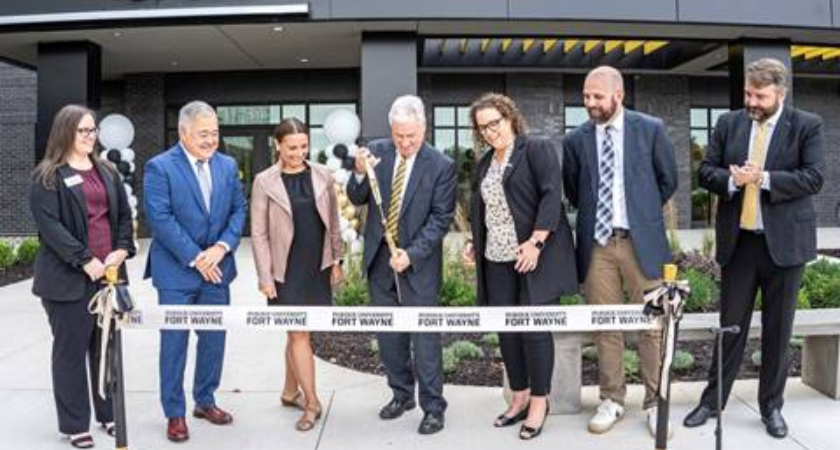
Student housing capacity has become an important consideration for universities seeking to support enrollment growth and expand residential offerings, particularly at campuses historically oriented toward commuters. Purdue University Fort Wayne has added 601 beds through a new residential development that expands its on-campus housing inventory.
Gilbane and Purdue Fort Wayne recently held a ribbon-cutting ceremony for Trace, a four-story student housing complex at 5104 Meeks Drive on the university's North Campus in Fort Wayne, Indiana. The 213,000-square-foot development was delivered through a public-private partnership.
Trace contains 176 apartment units ranging from studios to four-bedroom layouts. The 601-bed complex is positioned near Ginsberg Hall and is intended to provide additional residential capacity for Purdue Fort Wayne students.
Approximately half of the beds are allocated to students covered by university housing agreements. The remaining beds are available for students leasing directly from the property, including students attending other higher education institutions.
The development includes a convenience store, fitness center, gaming room, study areas, lounges, reception and leasing spaces, and multipurpose rooms. Outdoor features include basketball and sand volleyball courts, grilling areas, fire pits, hammocks and landscaped open areas.
The site also includes more than 450 parking spaces, pedestrian connections and a dedicated area for campus shuttle and rideshare drop-offs.
Gilbane served as both developer and construction manager for the project. AVB was the design-builder, while Progressive AE provided architectural services. Strategic Facility Partners will own the property, with Inwood Management responsible for operations.
The project incorporates several sustainability measures, including energy-efficient appliances and lighting, water conservation systems, native landscaping, stormwater treatment and construction waste management practices.
Purdue Fort Wayne has experienced sustained demand for student housing, with university housing reaching full capacity for seven consecutive fall semesters, according to project information. The Trace development adds residential capacity as the university continues efforts to establish a more residential campus environment.
The project demonstrates how public-private partnerships can be used to add higher education housing without relying solely on traditional university-led development. For owners and developers, the model provides another approach to delivering specialized residential assets while aligning university housing requirements with private development and operations.
For construction teams, the project also illustrates the coordination required to deliver multifamily-style student housing with residential amenities, site infrastructure, sustainability measures and campus transportation connections within an active university environment.
Source: Gilbane.