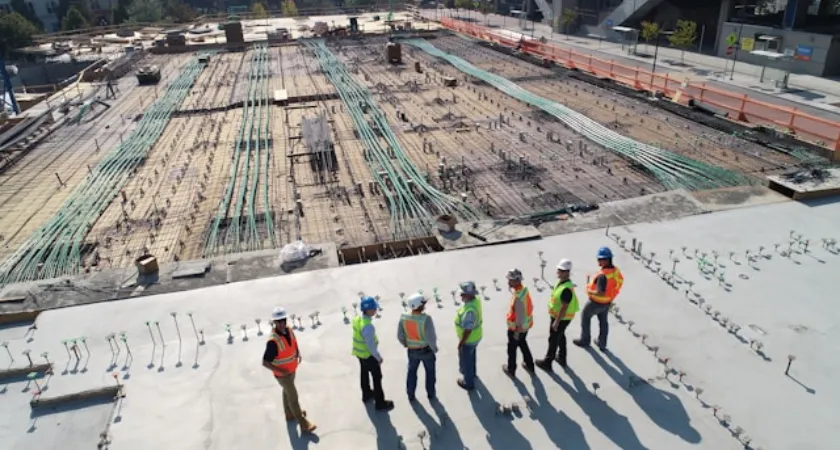
A new industry outlook from Research and Markets suggests the global construction sector is navigating a prolonged period of modest growth, as financing constraints, protectionist trade policies and supply chain adjustments reshape the market landscape through 2029.
.avif)
According to the “Construction Market Size, Trends and Growth Forecasts by Regions and Countries, 2025–2029 (Q4 2025)” report, added to the company’s offering in Dublin, the global market expanded by just 0.5% in real terms in 2025.
Heading into 2026, the global construction market remains fragmented as stakeholders adjust to a new trade environment shaped by tight financing conditions and increasingly protectionist US policies. Beyond the direct impact of higher cross border trade costs, 2025 produced knock on effects across the construction value chain as suppliers reconfigured supply routes to avoid levies, contributing to persistently high material prices.
Contractors are also contending with skilled labor shortages, which are pushing up delivery costs and driving a rise in insolvencies across Europe and North America. At the same time, consumer and investor confidence remains subdued, reflecting uncertainty over the economic and geopolitical risks of investing in regions caught between competing US and Chinese interests. Against this backdrop, The analyst estimates global construction output grew only modestly in 2025, at 0.5% in real terms.
Elevated borrowing costs have been particularly challenging for private developers. Higher interest rates in the United States and Western Europe have slowed residential investment, while stricter lending standards have limited new project starts. Developers in several mature markets have postponed or downsized projects amid concerns over demand and financing availability.
In developed markets such as the US and Western Europe, elevated interest rates and weak sentiment continue to weigh on residential building. US construction spending is estimated to have fallen by 0.4% in 2025, with multifamily construction down 11% and single family output declining 3.1%. Residential markets also contracted in Europe, with output falling by an estimated 3.0% in Germany, 2.6% in Sweden, and 1.3% in France.
Three regions are forecasted to have recorded negative construction output in 2025, led by North America, where activity is expected to have declined by 2.2%. North-East Asia and Latin America are also projected to have faced decline, falling 1.0% and 0.2%, respectively.
Infrastructure has been the main stabilizer: the EU's Recovery and Resilience Facility, Canada's renewable energy and transport programs, and Australian initiatives are supporting activity. Among the strongest infrastructure performers in 2025 were India and Saudi Arabia, expected to have grown by 8.1% and 4.0%, respectively.
In contrast to stagnation in advanced economies, South Asia, South-East Asia, and the Middle East and North Africa are each expected to deliver growth of more than 5% in 2025.
.avif)
Large-scale public investment programs in transportation, renewable energy, urban development and water infrastructure are helping offset weakness in private real estate. Governments in India and Saudi Arabia, in particular, are advancing strategic infrastructure agendas aimed at long-term economic diversification and population growth support.
The report highlights that key market opportunities lie in infrastructure projects across South Asia, South-East Asia and the Middle East, where growth is outpacing global averages despite ongoing industry fragmentation and tighter financial conditions.
Looking ahead to 2029, the outlook suggests that while short-term volatility will likely persist, markets backed by sustained public investment and policy stability could provide relative resilience in an otherwise cautious global construction environment.
Originally reported by Research and Markets in Yahoo Finance.