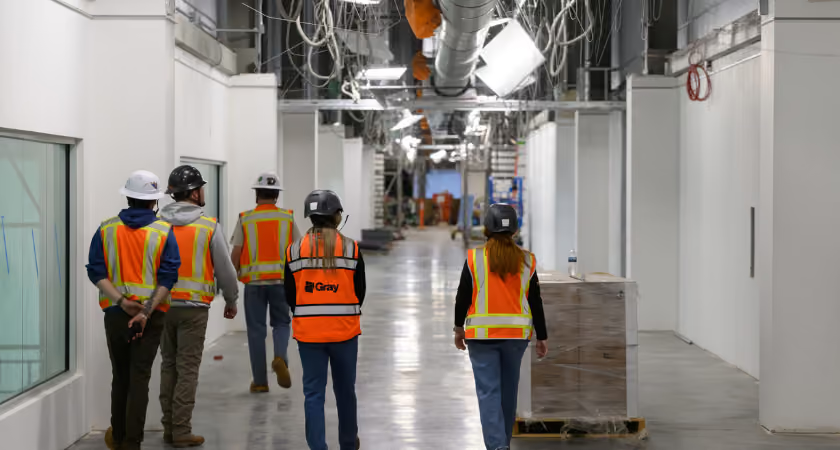
Gray's latest safety guidance focuses on making training an ongoing part of construction operations. The contractor says effective programs should combine leadership involvement, role-specific responsibilities, site-specific orientations, frequent reinforcement and hands-on verification.
Gray provides orientations in English, Spanish, German and Korean and requires new employees and subcontractors to complete site orientation before beginning work. Field employees also complete an in-house OSHA 30-hour course every five years, while office personnel complete OSHA 10 training.
The company also conducts Plan-of-the-Day and Plan-of-the-Next-Day meetings to identify high-risk activities, including mobile equipment operations, work at heights, confined-space entry and lockout/tagout.
Technology forms another part of Gray's approach. The company uses HammerTech for digital pre-task plans that are reviewed with crews before work begins and signed by workers performing the task.
Gray also identifies virtual and augmented reality as tools that can provide workers with controlled environments for practicing high-risk activities. The broader construction industry is increasingly incorporating technology into safety planning, hazard identification and worker training.
Gray applies its safety requirements to trade partners as well, requiring subcontractor employees to complete prequalification and site orientation before starting work. The company says its incident-rate figures include trade workers and subcontractors, providing a broader measure of jobsite safety performance.
The emphasis comes as construction companies continue to focus on reducing workplace fatalities and serious incidents. Construction remains one of the highest-risk industries in the United States, with 1,034 construction-related fatalities cited in Gray's discussion of 2024 federal data.
Gray also participates in Construction Safety Week and OSHA's Safe & Sound Week and has received Diamond-level recognition through Associated Builders & Contractors' Safety Training Evaluation Process.
For contractors and construction owners, Gray's approach highlights the importance of combining workforce training, daily hazard planning, digital tools and subcontractor accountability rather than relying on safety policies alone.
Source: Gray.