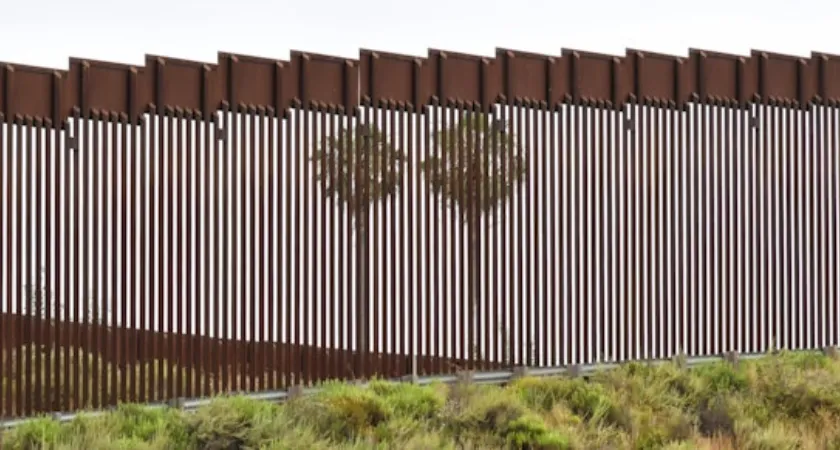
More than 130 conservation organizations, tourism outfitters and rural businesses are calling on Congress to halt federal funding for border wall construction in the Big Bend region of Texas, warning that the project could damage wildlife habitats, tourism and public access to the Rio Grande.
.webp)
The coalition, led by the Center for Biological Diversity, urged lawmakers to prohibit funding for wall construction through Big Bend National Park and Big Bend Ranch State Park in the upcoming Department of Homeland Security appropriations bill.
Advocates argue that a wall through the remote desert region would restrict access to the Rio Grande while disrupting wildlife migration and altering one of the most iconic landscapes in the American Southwest.
“Congress needs to step in and stop this massively destructive, universally despised trainwreck before it scars the Big Bend region forever,” said Laiken Jordahl, national public lands advocate with the Center for Biological Diversity. “We won't let Washington bureaucrats wall off the Rio Grande, block animals from their drinking water and pave over our beloved campsites, swimming holes and trailheads. Big Bend is worth fighting for and we’re just getting started.”
The debate follows actions taken earlier this year by the U.S. Department of Homeland Security to accelerate border infrastructure planning in the Big Bend region.
On Feb. 17, the department waived 28 environmental and cultural protection laws to fast-track construction activities, including segments proposed within Big Bend Ranch State Park. Federal officials have also awarded construction contracts and initiated surveying work in portions of the region, according to local media reports.
Initial planning maps released in February showed potential border wall segments sealing off most accessible sections of the Rio Grande inside both parks. After public backlash from local officials, residents and business leaders, the agency issued revised maps removing physical wall segments from the national park and replacing them with unspecified “detection technology.”
However, significant wall construction remains planned across portions of the state park, and federal officials have said the project remains in the planning stages.
“Border security is important, and here in Big Bend we’ve shown it can be done with technology and boots on the ground — not a destructive wall,” said Bob Krumenaker, former Big Bend National Park superintendent and chair of Keep Big Bend Wild. “Law enforcement across the political spectrum say that a wall is simply unnecessary to secure the border here, and its harm to local communities and the resources and values of these wild lands would be grossly out of proportion to any possible benefits. Nothing would permanently destroy the wildness of Big Bend more than a border wall with its accompanying roads, fences and lights.”
Tourism and outdoor recreation businesses in the region say the proposed project could have major economic consequences for rural communities that rely heavily on visitors drawn to the natural landscape.
“I am a second-generation business owner, and a wall here will personally put me and my family out of business,” said Will Blackstock, owner of Further Adventures in Terlingua, Texas. “Building a physical barrier through beloved public lands is absurd. The economic impacts on our rural economy would be devastating, as river-focused tourism is the mainstay of many of our area’s largest businesses and is a principal draw for visitation to the Big Bend area. I was born and raised in Big Bend. This place is my home and this fight is personal on every level.”
.webp)
Billy Bartko, owner of Far Flung Outdoor Center in Terlingua, echoed those concerns.
“The communities of Far West Texas depend heavily on tourism, outdoor recreation, and the preservation of the region’s natural beauty,” Bartko said. “Visitors come from around the world to experience the quiet, open landscape, and the sense of wilderness that defines Big Bend. Transforming that environment with miles of steel wall, construction corridors and lighting threatens the very qualities that sustain local businesses and livelihoods here. The only beneficiaries of this project would be the contractors paid to build the wall. For everyone else — the residents, landowners, businesses, wildlife, and the land itself — the costs would be enormous and permanent.”
Big Bend National Park and Big Bend Ranch State Park together protect more than 1.1 million acres of desert landscapes along the Rio Grande. The region contains important wildlife habitat, historic cultural sites and long stretches of river designated by Congress as a Wild and Scenic River.
The parks are also a significant economic driver for rural West Texas communities. In 2024, Big Bend National Park recorded more than 561,000 visitors who contributed nearly $56.8 million to nearby communities, generating $63.7 million in total economic output and supporting jobs across Brewster County and surrounding areas.
Supporters of the parks say preserving the region’s natural character is essential for both wildlife conservation and the long-term sustainability of the local economy.
Originally reported by Center For Biological Diversity.