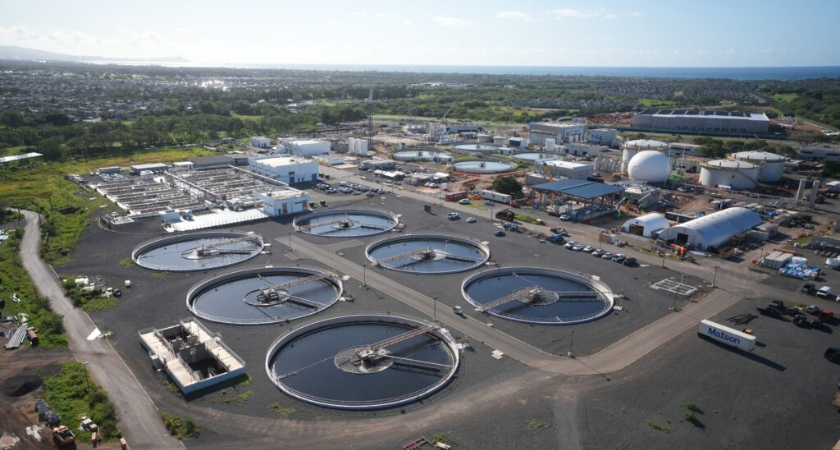
Wastewater infrastructure is increasingly being designed around interconnected treatment, resource-recovery and support systems rather than as a simple linear sequence from influent to discharge. For utility owners planning new facilities or upgrades, understanding how these systems interact can inform decisions involving capacity, energy consumption, maintenance and operational reliability.
Hensel Phelps recently outlined the major components of a modern wastewater treatment process, using its work at the Honouliuli Wastewater Treatment Plant in Hawaii to illustrate how individual treatment systems operate together.
The liquid treatment process begins when wastewater enters the facility and moves through preliminary treatment, primary treatment, biological processing and final effluent treatment.
At the headworks, screening equipment removes large debris such as wipes, plastics and rags that could interfere with downstream pumps and piping. Grit removal systems then separate heavier materials such as sand and gravel.
Primary treatment uses settling and flotation processes to remove additional solids and organic material before biological treatment. At Honouliuli, high-rate biological contactor tanks and dissolved air flotation systems are being used to increase the amount of organic material captured earlier in the process. Some biological solids are recycled to support treatment, while remaining material moves into solids processing.
Secondary treatment relies on microorganisms to remove dissolved and suspended organic matter. Depending on facility design, these organisms may remain suspended in activated sludge systems or grow on fixed media.
Final effluent treatment provides additional filtration and disinfection before treated water is discharged or reused. Ultraviolet light and chlorination are among the technologies commonly used to reduce pathogens and help facilities meet regulatory requirements.
Solids removed during liquid treatment enter a separate processing stream designed to stabilize material, reduce its volume and prepare it for beneficial use or disposal.
At Honouliuli, a blend tank facility combines onsite solids with material received from neighboring wastewater plants. The combined stream undergoes screening and dewatering before entering a thermal hydrolysis process supplied by Cambi.
The thermal hydrolysis system uses heat and pressure to condition sludge before anaerobic digestion. The process is intended to improve digestibility, increase biogas production and support greater solids loading in digesters. Honouliuli is the first wastewater facility in Hawaii to use the technology.
Anaerobic digestion subsequently breaks down organic material while producing biogas. After digestion, the remaining solids are dewatered and processed through a dryer that can produce Class A biosolids for beneficial use.
Biogas is also treated as a potential energy resource. At Honouliuli, hydrogen sulfide and siloxanes are removed before the gas reaches a combined heat and power system. Electricity generated by the system supports plant operations, while recovered heat is directed to the solids-drying process.
Treatment equipment depends on supporting systems that operate throughout the facility. These include instrumentation and controls, chemical feed systems, compressed air, water distribution, backup power and odor-control equipment.
Honouliuli includes a centralized emergency generator facility to maintain critical treatment functions during electrical outages. Because wastewater continues entering a treatment plant during grid disruptions, backup power is an important component of operational continuity.
The facility also uses different odor-control technologies for varying air conditions. A biotrickling system addresses higher-concentration odor sources, while a biofilter system uses carbon media to treat lower-concentration air streams.
Wastewater projects require coordination among treatment equipment, solids handling, energy systems and plantwide infrastructure. For owners, these connections can affect how facilities are sized, operated and maintained over their service lives.
The Honouliuli example also demonstrates how wastewater infrastructure can incorporate resource recovery alongside conventional treatment. Technologies that process solids, generate biogas and recover heat can connect environmental compliance with broader operational objectives.
For contractors and project teams, the integrated nature of these facilities also creates construction and commissioning considerations across multiple process systems. Understanding those relationships early can help align facility design with long-term utility operations.
Source: Hensel Phelps.