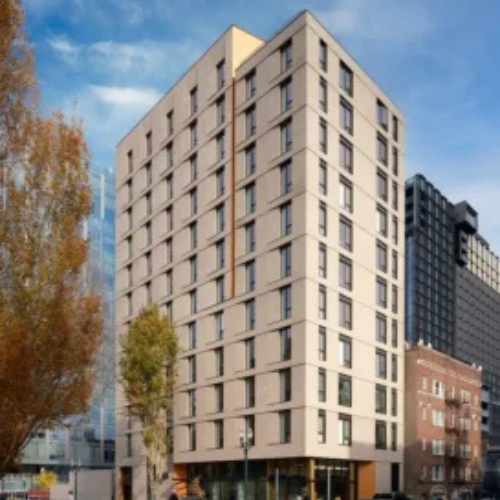
Julia West House, a landmark new community in downtown Portland, has officially opened its doors as Oregon’s tallest mass-timber building and a major advancement in permanent supportive housing. Rising 12 stories at 145 feet, the building marks a transformative investment in serving houseless elders and BIPOC individuals through dignified, sustainable, and trauma-informed design.
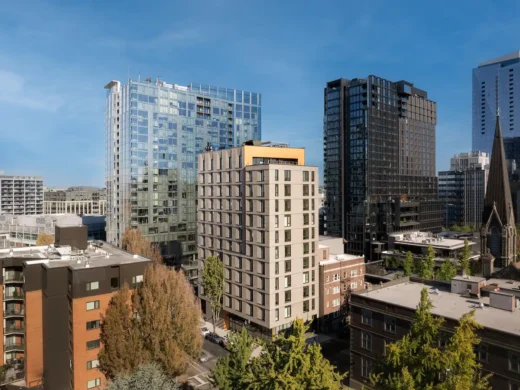
What was once a small, 5,000-square-foot lot has become a 56,000-square-foot residential community featuring 90 fully furnished apartments—60 studios and 30 one-bedroom units—reserved for individuals earning 30% or less of the area median income. The project is designed around healing environments, support services, and architecture that prioritizes wellness, safety, and connection.
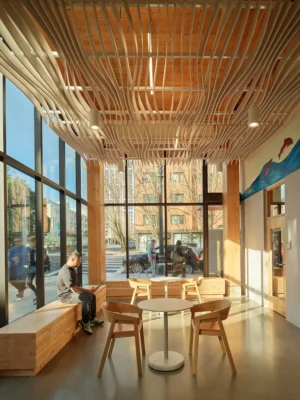
Developed by Community Development Partners (CDP) and designed by Holst Architecture, the building introduces a mass-timber high-rise that blends biophilic design, restorative architecture, and comprehensive services. Large windows, natural daylight, exposed wood ceilings, glulam beams, and greenery create a warm, calming environment intended to support the physical and emotional stability of residents.
Recent data underscores the urgency of the project: nearly one-quarter of Portland’s houseless population is age 55 or older, and BIPOC communities are disproportionately affected. Julia West House aims to meet those needs. Residents began moving in during early October, and the building is already more than 65% occupied.
The effort traces back to the First Presbyterian Church of Portland (FPC), which owned the site for decades and hosted various community programs there. After reviewing CDP’s proposal to create deeply affordable supportive housing, the church sold the property in 2024, continuing its long-standing mission of service.
The project broke ground in February 2024, spearheaded by CDP, Holst Architecture, KPFF (structural engineering), and Walsh Construction Co. As one of Oregon’s earliest examples of Type IV-B mass-timber construction, Julia West House showcases the environmental advantages of engineered wood systems. The building will achieve National Green Building Standard and Energy Star certifications, reducing long-term operating costs and promoting sustainability.
Architecturally, the façade incorporates carved-out communal spaces and a striking basalt-like fissure that symbolically connects residents—echoing the region’s historic waterways where communities traveled and gathered. These shared spaces throughout the tower promote community building and reduce social isolation among older adults.
Julia West House integrates wraparound services from multiple local partners. Northwest Pilot Project (NWPP) and the Native American Rehabilitation Association of the Northwest (NARA NW) provide case management, housing stability support, access to benefits, and programs addressing social determinants of health. Community for Positive Aging (CfPA) and Lift Urban Portland facilitate additional resident services.
For 20 households served by NARA NW, support includes recovery programming rooted in Native American traditions and spirituality, fostering a culturally grounded approach to wellness.
Residents also have access to a rooftop patio, communal kitchen, lounge, community room, laundry facilities, secure bike parking, and on-site offices for service providers and property management—an arrangement designed to ensure immediate and continuous access to care.
The development was funded through a mix of public and private sources, including a 4% Low-Income Housing Tax Credit allocation, USDA Wood Innovations funding, and a Portland Clean Energy Community Benefits Fund (PCEF) grant awarded by the Portland Housing Bureau. Rental assistance and supportive service funding were provided by Oregon Housing and Community Services (OHCS) and the Multnomah County Homeless Services Department (HSD).
Additional funding comes from the voter-approved Supportive Housing Services measure.
The building represents not just an architectural milestone, but a community commitment to ensuring elders—especially those from BIPOC communities—have safe, stable, long-term housing.
With its biophilic interiors, restorative design approach, and deeply affordable units, Julia West House sets a new standard for what supportive housing in urban centers can look like. Located at 580 SW 13th Avenue, the development places residents steps away from transit options, healthcare providers, food resources, and public amenities.
The project is featured in WoodWorks’ recent case study, “Small footprint, big impact: 12 stories of mass timber affordable housing,” underscoring its significance as a national model for sustainable, service-oriented urban housing.
Originally reported by e-Architect.