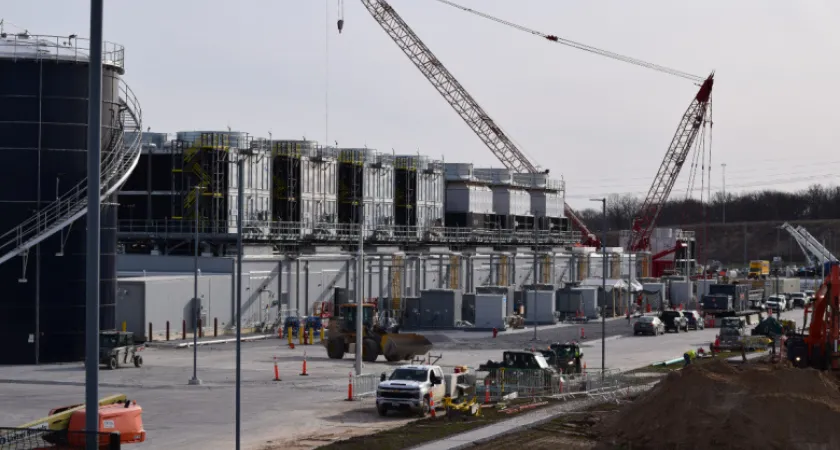
Kansas City is experiencing a major construction surge driven by the rapid expansion of data centers, creating strong demand for skilled trades while raising long-term concerns about how artificial intelligence (AI) could reshape the broader job market.
.webp)
Construction workers across the region are benefiting from what many describe as one of the largest building booms in decades. But experts warn that the long-term employment impact may look very different once projects are completed and AI systems become more widely integrated into everyday work.
Andrew Jonas, a union plumber who has spent several years working on data center projects in Kansas City’s Northland, captured the mixed sentiment during a recent public hearing.
“They’re popping up like crazy everywhere,” Jonas said. “Do I love them? No. Not at all. But they’ve got money and they make for damn good jobs.”
The scale of development tied to data centers is reshaping the local construction economy. Kansas City has become a hotspot, with dozens of facilities either proposed, underway, or already operational—representing tens of billions of dollars in investment.
Despite a cooling national labor market, construction stands out as a rare bright spot. While overall job growth has stagnated and some sectors have seen declines, construction employment in the Kansas City area grew significantly, driven largely by data center development.
Major projects include large-scale campuses from global tech firms, many of which require thousands of workers during peak construction phases. These projects are not only creating jobs but also pushing wages higher, with many workers logging overtime and earning six-figure incomes.
Ralph Oropeza, a longtime leader in the building trades, emphasized the unprecedented scale of current activity.
“It’s like the ‘90s on steroids,” Oropeza said. “Those jobs were in the millions (of dollars). Now we’re talking about jobs in the billions.”
Union leaders say the boom is also expanding apprenticeship programs and attracting new entrants into the trades, including individuals with college degrees seeking more stable and better-paying careers.
Damon Miles highlighted the quality of these jobs and the opportunities they provide.
“Those are jobs with pensions, jobs with health insurance,” said Miles, adding that projects like this are “starting points that give people an opportunity.”
While construction jobs are booming, the long-term employment outlook tied to data centers is more uncertain. Once facilities are completed, workforce needs drop dramatically.
For example, projects that employ more than a thousand workers during construction may only require around 100 permanent staff once operational. This sharp decline raises concerns about sustainability in job creation.
Economist Chris Kuehl noted that this pattern is typical for large-scale infrastructure investments.
“It’s like most technologies,” Kuehl said. “The startup phase is always the best part, because that’s when you’re getting all the building and all the investment. But once it’s completed, it settles into another pattern.”
Still, some ongoing opportunities remain. Data centers require continuous maintenance, upgrades, and energy infrastructure support, creating steady—if smaller—employment pipelines in specialized fields.
Moreno pointed out the recurring nature of maintenance work.
“They’re kind of the gift that keeps giving when it comes to jobs,” Moreno said.
Beyond construction, the rise of AI presents a more complex challenge for the broader labor market. The same data centers fueling construction jobs are also powering technologies that could automate many white-collar roles.
Recent research suggests that office-based professions—particularly those involving data, administration, and analytical tasks—are among the most exposed to AI disruption. In contrast, skilled trades remain relatively insulated due to their physical and hands-on nature.
This shift is already influencing career decisions. Trade unions report increased interest from individuals with advanced degrees seeking stable employment in construction and related fields.
Kuehl described this shift as a reversal of long-standing workforce trends.
.jpg)
“It’s kind of the revenge of the trades,” Kuehl said. “Once upon a time, you looked at the kids that went into trade school as, ‘Oh, those are the losers that can’t cut it in college.’ Now you’ve got a bunch of college grads borrowing money from the people who went to trade schools.”
Despite uncertainties, the current data center boom represents a significant economic opportunity. It is driving investment, supporting high-paying jobs, and reshaping workforce pipelines across Kansas City.
At the same time, it is laying the groundwork for a future defined by AI-driven transformation—one that may benefit skilled trades while challenging traditional white-collar career paths.
Originally reported by Thomas White in The Beacon News.



.png)