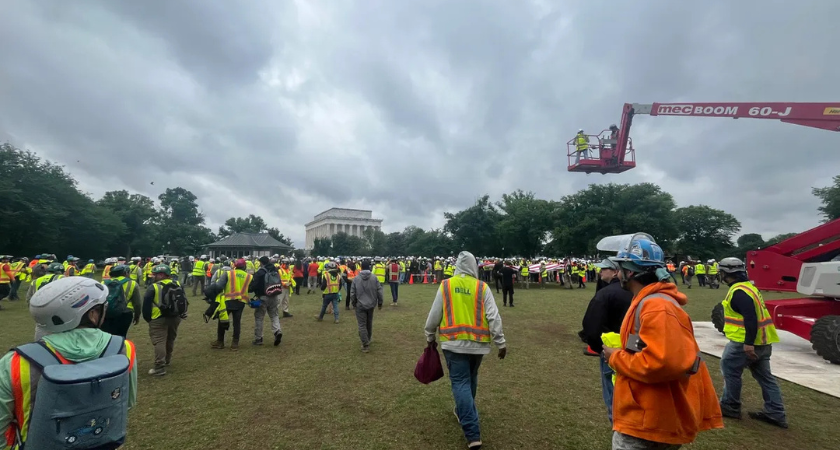
Construction Safety Week 2026 has officially begun, with contractors across the United States pausing jobsite operations to reinforce safety practices and promote a stronger culture of hazard awareness. The annual initiative, which runs for five days, brings together leading builders to emphasize shared responsibility in protecting workers.
This year’s theme, “All In Together,” builds on prior campaigns but introduces a sharper focus through three guiding actions: recognize, respond and respect. Industry leaders say the updated framework aims to deepen engagement and improve how teams address high-risk conditions on jobsites.
“Themes are anchored in this unified call to action on high energy, high hazard work to prevent serious injuries and fatalities,” said Adam Jelen, CEO of Gilbane Building Co. and chair of the Construction Safety Week executive committee.
For many contractors, the “All In Together” message underscores the importance of consistency across jobsites, particularly as workers often move between multiple employers and projects.
Shaun Carvalho, chief safety officer at Shawmut Design and Construction, said his firm began collaborating with competitors and the Associated General Contractors of Massachusetts in 2017 to establish a unified safety approach.
“We need to be all in this together, because the trades that work on our individual jobs also work on our competitor’s jobsites,” Carvalho said.
According to Jelen, inconsistent terminology and differing safety systems across companies can lead to gaps in hazard recognition and response. Standardization, he said, is critical to ensuring that workers can quickly identify risks regardless of where they are working.
“When companies use different terms and different models, the same exposure can be treated differently from job to job, and that creates gaps in recognition, response and adoption across the project life cycle,” he said. “What we are driving toward is simplification and standardization, especially in how we recognize, respond and respect high-risk work. This way crews are not translating between systems every time they change jobsites.”
The 2026 campaign centers on addressing high-energy hazards—sometimes referred to as “stuff that can kill you” or STCKY—which pose the greatest risk of serious injury or death. These hazards often involve working at heights, heavy equipment or fast-moving materials.
Safety Week organizers outlined the three core actions in advance bulletins. The first step, recognize, calls for identifying potential dangers before work begins. The second, respond, emphasizes implementing controls and safeguards to mitigate risks. The third, respect, focuses on taking hazards seriously while valuing the well-being of every worker on site.
Steve Spaulding, senior vice president and chief environmental health and safety officer at Turner Construction, said the approach reinforces shared accountability among crews.
“The millions of people that work in the construction industry, no one there is alone. And we’ve got to make sure that everybody that’s working on the jobsite is looking out for each other as well as themselves,” Spaulding said. “We need to make sure that we’re recognizing hazards and responding to them and respecting the people doing the jobs. But also that everyone’s doing that for everybody else as well.”
As Safety Week continues, contractors are expected to host training sessions, safety stand-downs and discussions aimed at reinforcing best practices. Leaders say the goal is not only to reduce incidents but also to build a culture where safety is consistently prioritized across the industry.
Originally reported by Zachary Phillips, Senior Editor in Construction Dive.