Mental health has become an increasingly important component of construction safety programs as employers address risks that extend beyond physical jobsite hazards. MCAA is expanding resources for mechanical contractors while working with labor and industry partners to increase awareness, peer support and access to crisis assistance.
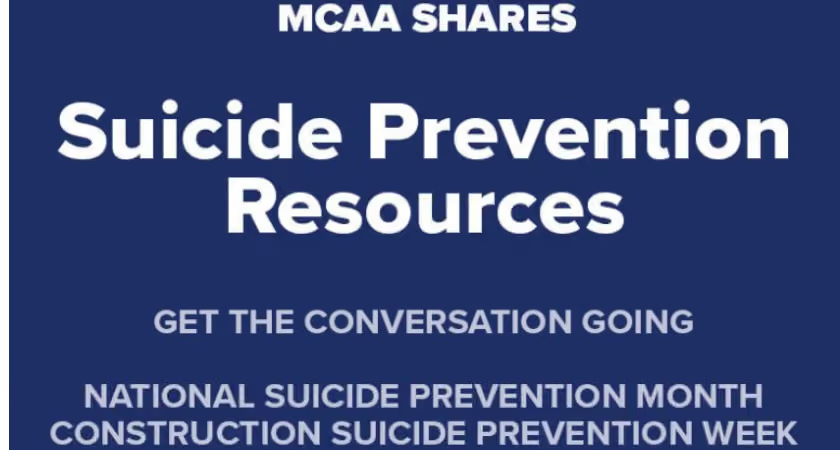
Construction Suicide Prevention Week will take place Sept. 14-18 as part of National Suicide Prevention Month. The initiative provides resources for construction employers, unions, supervisors and workers and includes a nationwide stand-down on Sept. 14. Participating jobsites are encouraged to observe a moment of silence and reinforce mental health awareness.
The issue remains significant for the construction workforce. CPWR data cited by MCAA indicates approximately 5,000 construction workers ages 16 to 64 died by suicide in 2024, corresponding to a rate of 41.9 deaths per 100,000 workers. The 2024 figure was down from approximately 5,100 deaths and a rate of 43.2 in 2023.
Earlier CPWR research found that construction workers experienced more than five times as many suicide deaths as fatal occupational injuries in 2022, with approximately 5,200 suicide deaths compared with 991 fatal work injuries. CDC data cited in the material also reported a 2021 suicide rate of 65.6 per 100,000 among male construction and extraction workers and 49.4 per 100,000 among male pipelayers, plumbers, pipefitters and steamfitters.
MCAA has incorporated mental health and suicide prevention resources into its Safety Excellence Initiative. Contractors can use the materials during safety orientations, toolbox talks, stand-downs and supervisor meetings to incorporate mental health into broader safety and health programs.
A central component is the United Association's Pipe PALS program, which establishes trained peer allies within UA local unions in the United States and Canada. The program addresses suicide prevention, mental health and addiction while helping workers identify warning signs and connect colleagues with appropriate assistance. Its training resources include VitalCog suicide prevention education.
MCAA also works with the UA and industry organizations including NECA, SMACNA and TAUC to increase awareness of the 988 Suicide & Crisis Lifeline. Calling or texting 988 provides access to free, confidential crisis support.
MCAA and the UA are scheduled to hold their inaugural Mental Health Summit Oct. 18-21, 2026, at the Grand Hyatt Washington in Washington, D.C. The event will bring together labor and management leaders, safety and health professionals, field representatives and mental health specialists.
The summit will address suicide prevention, substance use, peer support, employee assistance programs and workforce education. Participants will also examine ways to improve access to resources, prepare supervisors for difficult conversations and strengthen organizational support systems.
MCAA's available resources also include mental health toolbox talks in English and Spanish, a workforce-focused suicide prevention video, 988 awareness materials and a recorded construction suicide prevention webinar. The association says its Safety & Health Resource Center contains more than 700 safety and health resources.
For mechanical contractors, the initiative places mental health within the same broader safety framework used to address physical workplace risks. The combination of toolbox talks, peer-support training, supervisor education and readily accessible crisis resources gives contractors multiple mechanisms for incorporating mental health into existing workforce safety programs.
The decline in construction suicide deaths from 2023 to 2024 provides a positive data point, but the roughly 5,000 deaths recorded in 2024 underscore the continuing scale of the issue. For owners and contractors, the development reinforces the importance of maintaining mental health and suicide prevention efforts beyond a single awareness week.
Source: MCAA.