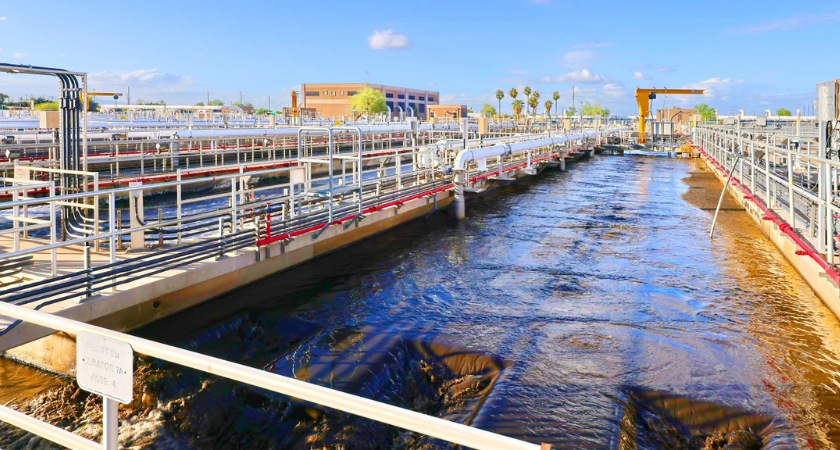
The completion of a major wastewater treatment rehabilitation in the Phoenix metropolitan area marks a significant investment in extending the service life and reliability of infrastructure shared by five Valley cities. The $73.5 million Plant 2B project modernizes essential treatment systems at the 91st Avenue Wastewater Treatment Plant, which serves Phoenix, Glendale, Mesa, Scottsdale and Tempe.
Originally built around treatment systems designed in the 1980s, Plant 2B required extensive upgrades to address aging equipment, structural deterioration and evolving operational requirements.
The rehabilitation covered four primary sedimentation basins, each measuring 140 feet in diameter. Work also included concrete and structural repairs in aeration basins, installation of new coarse- and fine-bubble aeration diffusers, and rehabilitation of primary sludge and return activated sludge/waste activated sludge pump stations.
Additional improvements addressed secondary sedimentation basins, effluent distribution structures, buried piping, electrical equipment and process controls. Crews also upgraded a reuse water pump station and chlorination facility.
A major component of the project was the installation of an in-ground soil media biofilter to replace the existing chemical scrubber odor-control system. The system uses biological treatment to manage odors generated by wastewater operations.
The biofilter contains four treatment cells with specialized filtration media, air-distribution piping, fans and supporting equipment. The project team described it as one of the largest in-ground soil media biofilters in the United States.
Across the facility, the upgrades are intended to improve equipment reliability, simplify future maintenance and support continued wastewater treatment operations.
The project was delivered through a construction manager at risk arrangement, with McCarthy serving as construction manager and Hazen and Sawyer providing design engineering services. Specialized trade partners included OCM Inc., The Truesdell Corporation, Penington Painting Company and Industrial Power Solutions.
Work took place within an operating treatment facility, requiring coordination to maintain wastewater services while crews replaced equipment and rehabilitated critical structures.
The plant is operated by the City of Phoenix through the Sub-Regional Operating Group, a partnership involving five Valley municipalities. The facility supports public health and environmental protection across the region.
The Plant 2B rehabilitation demonstrates the scale of investment required to maintain aging water and wastewater infrastructure while preserving essential public services. By upgrading treatment equipment, structural components and process systems, the project helps extend the useful life of a regional facility and supports its long-term maintainability.
For municipalities and infrastructure owners, the work also highlights the importance of phased construction, operational coordination and collaboration among public agencies, engineers and contractors when modernizing facilities that cannot be taken offline.
Source: McCarthy.