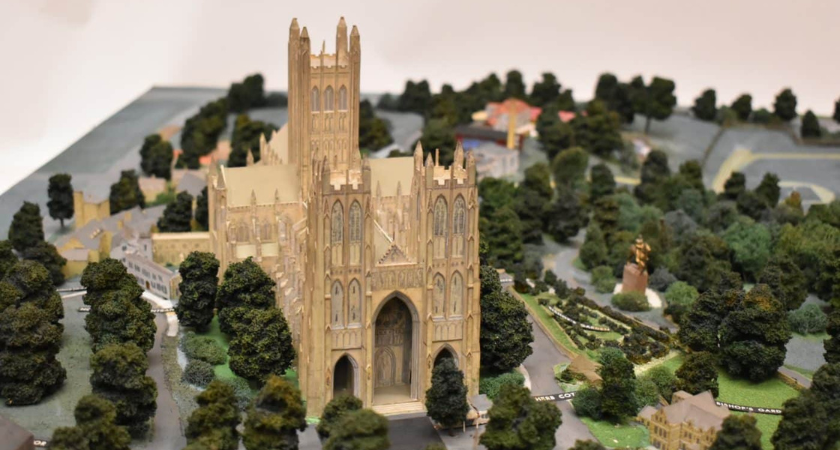
The National Building Museum is spotlighting a remarkable archival collection that offers a rare behind-the-scenes look at the making of one of the nation’s most iconic religious landmarks — the Washington National Cathedral.
.webp)
First gifted to the Museum in 2015, the Washington National Cathedral Construction Archives comprise more than 32,000 historic architectural drawings. Spanning from 1896 to 2007, the collection chronicles more than a century of design development, craftsmanship and construction across the Cathedral’s 57-acre campus in Washington, D.C.
The archives trace the Cathedral’s architectural evolution from early conceptual sketches to highly detailed construction documents. Stained glass studies, stone carving drawings, ironwork details and woodwork plans reveal the precision and artistry required to bring the Gothic Revival structure to life.
Beyond the Cathedral itself, the materials document the broader institutional landscape surrounding it. Included are drawings for Saint Albans School for Boys, the National Cathedral School for Girls, Beauvoir Elementary School, the Cathedral College, the Cathedral Library, the Deanery and Olmsted Woods — illustrating how the campus developed as an integrated architectural and educational environment.
Sketches on delicate trace paper sit alongside correspondence between architects, contractors and master craftsmen, offering researchers a layered understanding of collaboration across generations.
Among the prominent figures represented in the collection are Ernest Flagg; the British architectural firm Bodley & Vaughn; Frohman Robb & Little; and Trevillian Architects. Each contributed to various phases of the Cathedral’s prolonged construction timeline.
A particularly central figure was Philip Hubert Frohman, who served as principal architect for much of the twentieth century and helped solidify the Cathedral’s Gothic Revival identity. His influence extended beyond Washington through other ecclesiastical and civic commissions nationwide.
The Cathedral’s surrounding landscape was shaped in part by Frederick Law Olmsted Jr., whose planning reflected a holistic integration of architecture and natural setting — a hallmark of early twentieth-century campus design philosophy.
Complementing the Cathedral archive is the Philip Hubert Frohman Architectural Drawings Collection, which provides broader context for his work across the country and deepens understanding of his stylistic and structural approach.
.webp)
While the Cathedral Construction Archives are still being fully cataloged and preserved, select materials are already available through the Museum’s Online Collections Database. As processing continues, additional drawings and documents will be added, expanding public access to this rich architectural resource.
Museum officials describe the archives as a testament to long-term collaboration — not only among architects and builders, but also across institutions and generations of patrons, educators and craftspeople. The materials illuminate how major civic and religious landmarks evolve over decades, often adapting to shifting aesthetic, technological and financial realities.
Researchers interested in accessing the Washington National Cathedral Construction Archives can submit a Research Request Form through the Museum. Additional holdings can be explored via the Museum’s searchable online database.
As more of the collection becomes accessible, the archive is expected to serve scholars, preservationists and design professionals seeking deeper insight into one of America’s most ambitious Gothic Revival undertakings.
Originally reported by National Building Museum.