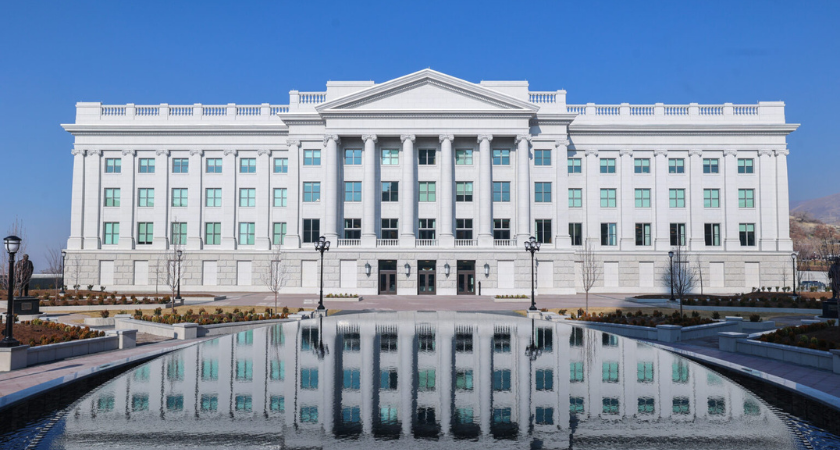
After three years of construction, Utah’s new North Capitol Building is officially complete, opening to the public just in time for the start of the 2026 legislative session. Designed to complement the Capitol’s neoclassical architecture while expanding public access to Utah’s history, the building fulfills a master plan for Capitol Hill that dates back more than 100 years.
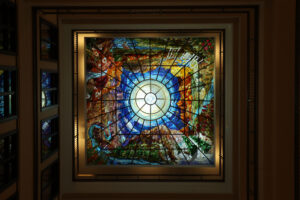
Located on the north end of the Capitol campus, the structure serves both functional and symbolic roles. It houses Utah’s first dedicated state history museum and creates a new ceremonial entrance to the Capitol grounds. Visitors entering from the north pass through the building and out onto the lawn, following a pathway beneath a dramatic stained glass skylight that visually and physically guides them toward the Capitol.
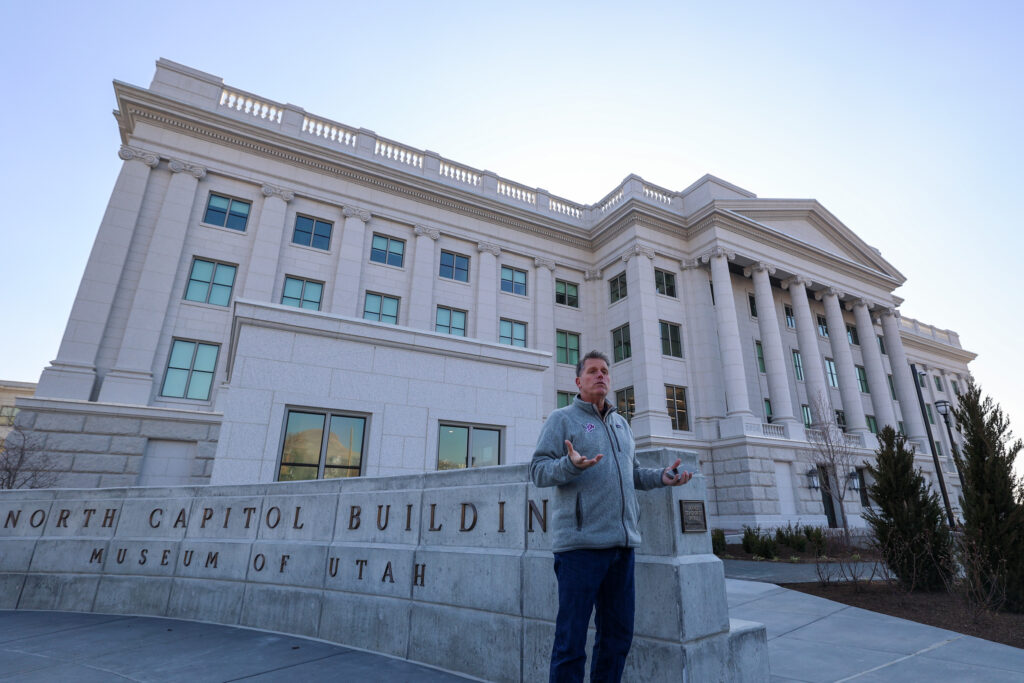
“It was imperative in the master plan that the new North Capitol Building fit within the neoclassical design of the campus,” said Nathan Levitt, the project’s principal architect with VCBO Architecture.
Preservation was a major priority throughout construction, extending beyond architectural aesthetics to the surrounding natural landscape. To protect historic sequoia trees on the north lawn, construction teams altered the building’s underground footprint.
According to Capitol Preservation Board Executive Director Dana Jones, a wall inside the parking garage was shifted 18 inches to avoid disturbing the trees’ root systems.
“I think that that’s a really special fact, because to me, it speaks to the level of care that our team has as a whole,” Jones said. “This is us paying forward to many generations.”
At the heart of the building is a $1.6 million stained glass laylight featuring more than 14,700 individual pieces of glass. The installation incorporates sand collected from all 29 Utah counties and depicts the state’s defining landscapes and cultural symbols, including the Great Salt Lake and southern Utah’s red rock formations.
The project’s final cost reached $320 million, significantly higher than the original $165 million estimate, according to Andy Marr, director of Utah’s Division of Facilities Construction and Management.
“Over a number of years (the budget) grew through different amounts of appropriations that the legislature approved as the project scope started to evolve,” Marr said.
Initially envisioned as a replacement for parking, the project expanded in ambition as planners recognized its potential to complete the Capitol Hill campus.
“We were talking about this building as just a replacement for parking,” he said. “That conversation quickly evolved into, ‘this is the opportunity to finish the master plan of Capitol Hill.’”
Marr also cited industrywide inflation as a key factor driving up costs.
“We went through a pretty rough period of construction escalation, peaking at 14% (inflation),” he said. “That was a part of the cost factoring here that’s pretty standard industry wide.”
Oakland Construction led the build, working alongside VCBO Architecture, the Capitol Preservation Board and numerous trade partners. Project director Michael Despain said the building was deliberately designed to remain visually secondary to the Capitol itself.
“We wanted this building to not be as formal as the Capitol,” he said. “The Capitol is the highlight of the campus, and everything here is intentionally just a little bit more subdued.”
The scale of the work was substantial. Crews poured more than 450,000 cubic yards of concrete—enough to fill 4,500 trucks or create a four-foot-wide sidewalk stretching nearly 200 miles.
Construction employed an average of 266 workers per day, with staffing peaking at 350 workers. In total, the project required 581,000 labor hours.
“For one person, that’s roughly 283 years for one guy to build this,” Despain said.
“Lots of collaboration between VCBO, the Capital Preservation Board, DFCM, Oakland, and all of our trade partners,” he added. “It’s been an amazing, historical, iconic project.”
A cornerstone of the North Capitol Building is the Museum of Utah History, the state’s first dedicated history museum, scheduled to open in June 2026.
“This is the space where, really, Utah’s fine art collection and history’s preservation will happen for the next 100 years,” said museum director Tim Glenn.
When it opens, the museum will feature approximately 950 artifacts, with rotating exhibits drawn from a much larger collection. The building also includes specialized storage designed to preserve the entirety of the state’s historical holdings.
“This is purpose-built and state of the art. It provides (an) opportunity for us to grow. All of the state’s treasures will be here, and future state treasures will be here,” Glenn said. “Our collection currently has around 30,000 artifacts, 28,000 books, 8,500 manuscripts, 23,000 pamphlets, and many, many other materials. All of that will be stored in this space.”
The museum also expands public access to the collection through an engagement room where researchers can request direct access to artifacts and manuscripts.
“We also have our engagement room in this building,” Glenn said. “If (visitors are) doing research or have an interest in a particular artifact or manuscript collection, they can make an appointment in our engagement room and pull artifacts from this space right up into that research area.”
A ribbon-cutting ceremony is scheduled for Friday at 12:30 p.m. The North Capitol Building officially opens to the public Tuesday, coinciding with the first day of the 2026 legislative session.
Originally reported by Will Ruzanski in Utah News Dispatch.