Airfield construction in extreme summer conditions requires careful control of concrete placement, sequencing and airport operations. At Mesa Gateway Airport in Arizona, Pulice is using overnight paving operations and an on-site concrete batch plant as part of the Taxiway G Realignment and Reconstruction project.
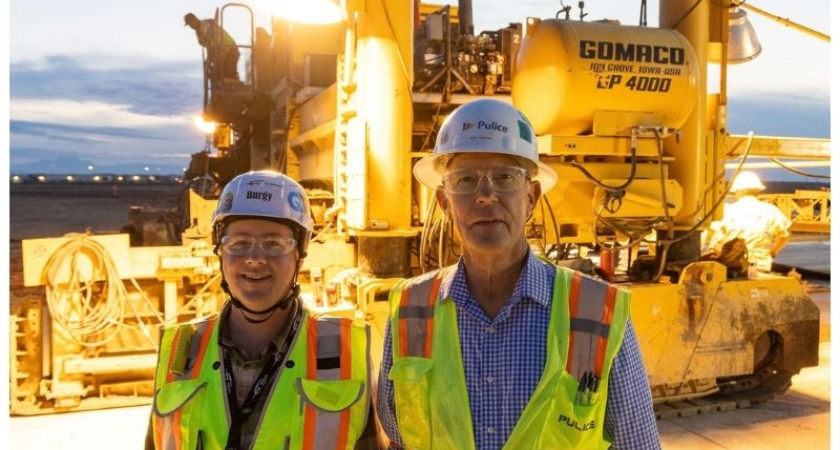
Crews are carrying out concrete placement from approximately midnight through sunrise, when temperatures are substantially lower than during the daytime. The schedule helps crews manage concrete placement and finishing while limiting heat-related effects during curing.
McNeil Brothers operates a portable batch plant near the work area. Concrete is mixed on site and transported in 10-cubic-yard loads to a Gomaco 4000 slipform paver. The short hauling distance allows material to reach the paving operation within roughly 12 to 15 minutes of batching.
The paving operation includes batching, hauling, slipform paving, hand finishing, jointing and dowel placement. Work must meet applicable Federal Aviation Administration requirements for airfield pavement.
The Taxiway G project is replacing an older diagonal taxiway arrangement with a 90-degree connection to the runway. The revised configuration is intended to provide pilots with a more direct view of runway traffic before entering an active runway.
Pulice is delivering the project through a construction manager at-risk approach. Its scope includes earthwork, storm drainage, electrical work and related infrastructure, while McNeil Brothers is responsible for concrete paving.
The project is part of continuing airfield improvements at Mesa Gateway Airport, where Pulice has completed multiple airside projects since 2018.
Construction is being coordinated with Pulice's rehabilitation work on nearby Runway 12R-30L. The airport requested that the Taxiway G work proceed while the runway is already closed for rehabilitation.
Completing the two work programs concurrently is intended to avoid a separate future runway closure for the taxiway connection. The sequencing allows the airport to limit additional operational interruptions affecting commercial, private and flight-school aviation.
The project demonstrates how airport construction schedules can be adapted to local climate conditions and operational constraints. Overnight concrete placement, on-site batching and concurrent runway and taxiway work provide a coordinated approach for completing airfield improvements while maintaining control over pavement installation and minimizing additional runway disruptions.
Source: Pulice.