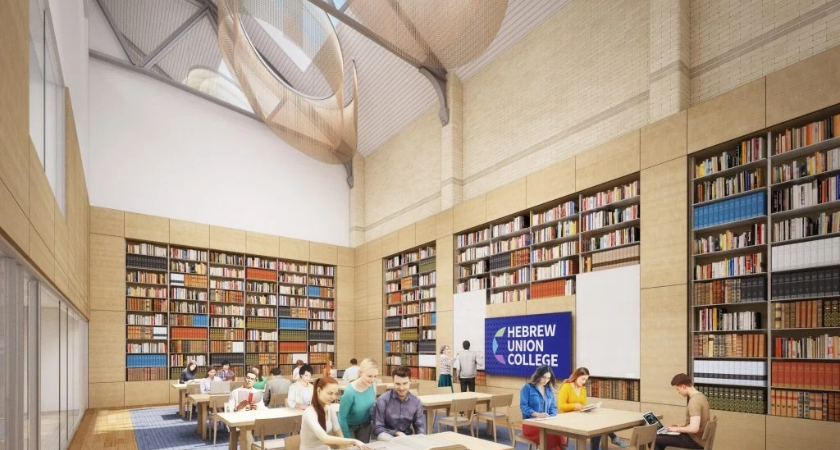
New renderings have revealed plans to transform the First Battery Armory at 56 West 66th Street into Hebrew Union College’s future New York City campus, bringing educational and community facilities to Manhattan’s Upper West Side.
Unveiled on Oct. 27, 2026, the designs show how the historic building will be adapted to support the college’s teaching, clergy formation, worship and cultural programming. Shawmut is leading construction, while Beyer Blinder Belle Architects & Planners is responsible for the design.
The project will provide facilities for in-person and hybrid learning, public programmes, communal gatherings and arts and cultural activities. The college plans to occupy the campus after the winter/spring academic term in 2027.
The design repurposes the former drill hall into three triple-height spaces: a sanctuary, a library reading room and a multipurpose event area. Each space will receive natural light from above, creating distinct environments for worship, study and gatherings.
Additional facilities will include classrooms overlooking the former drill hall and faculty and staff offices within the building’s masonry headhouse. A connecting zone with skylit communicating stairs will link the interior spaces.
The redevelopment is intended to accommodate the college’s changing educational needs while retaining the character and legacy of the historic structure.
The new campus will return Hebrew Union College to Manhattan’s Upper West Side, near the area where the Jewish Institute of Religion was founded on West 68th Street in 1922 before merging with Hebrew Union College.
Its location between Central Park and Lincoln Center places the institution near cultural and educational destinations and within an established Jewish community.
For institutional construction projects, the redevelopment illustrates the work involved in adapting historic buildings for modern educational use. The design combines specialised learning and worship spaces with flexible areas for events and community engagement while retaining elements of the existing structure.
Source: Shawmut.