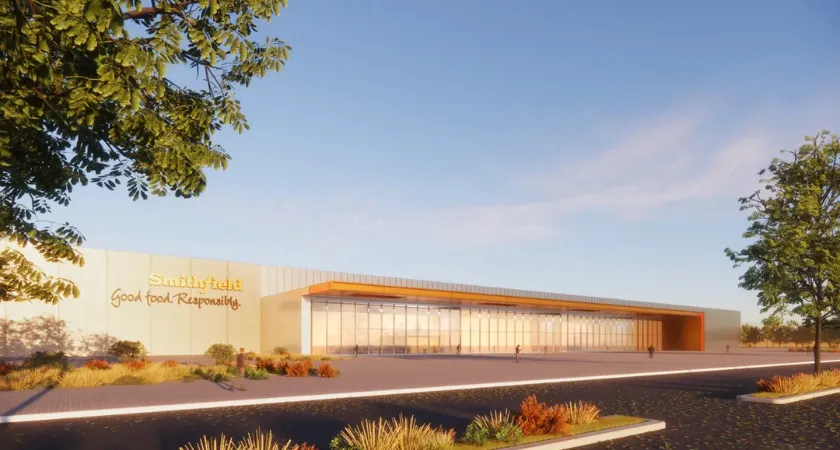
Smithfield Foods announced plans to invest up to $1.3 billion over the next three years to construct a new pork processing and packaged meats facility in Sioux Falls.
.webp)
The highly automated plant will combine fresh pork processing with packaged meat production and is expected to begin operations by the end of 2028. The company said the facility will be “the most modern of its kind in the U.S.” and will deliver “significant efficiency gains” across its operations.
The new build will replace Smithfield’s current Sioux Falls plant, which has operated for more than a century. The existing facility began operations in 1909 under John Morrell & Company before being acquired by Smithfield in 1995. Today, it employs roughly 3,200 workers.
The investment marks a significant modernization effort as Smithfield reshapes its U.S. manufacturing footprint. Aging infrastructure, rising livestock costs and competitive pressure have pushed meat processors to re-evaluate plant efficiency and automation capabilities.
By consolidating pork processing and packaged meats production into a single, state-of-the-art campus, Smithfield aims to streamline workflows, reduce waste and improve throughput. Automation and advanced production systems are expected to lower long-term operating costs while increasing consistency and product quality.
The company described the new plant as central to its long-term growth strategy, particularly in value-added packaged meats — one of its most profitable segments.
“Smithfield’s investment supports our long-term strategy of continuing to grow and optimize our value-added packaged meats and fresh pork operations to deliver innovation, convenience and value to our customers.”
Smithfield’s decision comes amid shifting market dynamics. After a period of relatively low prices, hog costs began climbing in 2025 and are forecast by the U.S. Department of Agriculture to continue rising as protein demand strengthens meat sales.
Meanwhile, historically low cattle supply has driven beef prices to record highs, encouraging consumers to consider alternatives such as pork and chicken. Although Smithfield is primarily focused on pork, it has gradually expanded into beef and other packaged meat offerings.
Last year, the company acquired Nathan’s Famous all-beef hot dog brand for $450 million, broadening its exposure to the cattle market. That diversification strategy underscores the importance of operational efficiency across product lines.
To further cut costs, Smithfield recently announced the closure of a dry sausage plant in Massachusetts, shifting production to other facilities within its network.
Smithfield is not alone in investing heavily in automation. Other meat processors have also turned to technology to offset labor pressures and rising input costs.
For example, Cargill announced a $90 million investment in computer vision technology at its Fort Morgan, Colorado plant. The system enables the company to process more meat per animal by improving cutting precision and yield optimization.
Such investments reflect a broader industry shift toward digital monitoring, robotics and data-driven process controls to improve margins in a volatile commodity environment.
The $1.3 billion capital outlay is expected to generate significant construction activity over the next three years, supporting contractors, equipment suppliers and local labor markets in the Sioux Falls region.
Once operational, the plant could reinforce South Dakota’s position as a major hub for protein processing in the Midwest. While Smithfield has not yet detailed workforce plans for the new facility, modern automated plants typically require specialized technical and maintenance roles alongside traditional production staff.
As protein consumption trends remain resilient despite broader economic uncertainty, large-scale investments like this signal continued confidence in long-term demand — even as companies work to protect margins through modernization and efficiency upgrades.
Originally reported by Sarah Zimmerman, Editor in Construction Dive.