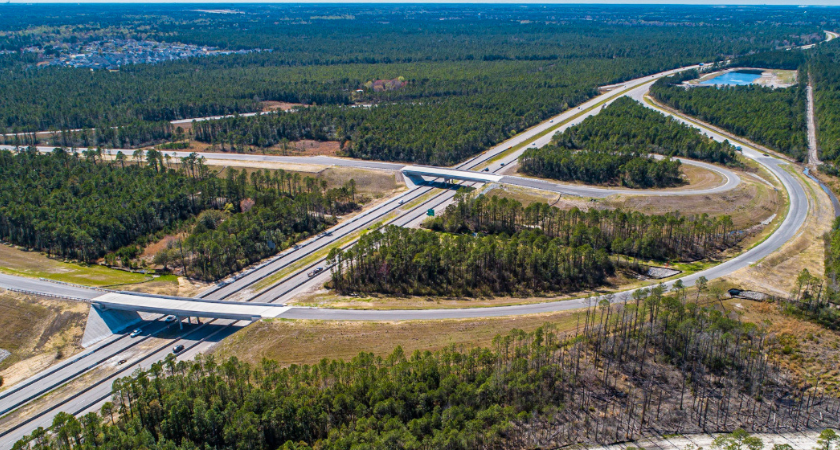
Growing traffic demand in the Wilmington region is driving investment in transportation infrastructure designed to improve roadway capacity and connectivity. The North Carolina Department of Transportation engaged STV to support design and delivery of the Military Cutoff Road Extension, a major corridor improvement in New Hanover County.
The U-4751 project provides an additional north-south route while strengthening connections between Wilmington's growing residential, commercial and employment areas.
The Military Cutoff Road Extension incorporates new roadway connections, bridges, culverts and noise walls along with pedestrian and bicycle infrastructure.
The corridor also incorporates access-management measures at several intersections. Right-in/right-out configurations and nearby U-turn locations are intended to reduce turning conflicts and support traffic movement.
A multi-use path and sidewalks provide additional transportation options for residents and improve connections to surrounding neighborhoods and community destinations.
The project also serves as an important southern connection to the broader Hampstead Bypass program. The Military Cutoff extension and Hampstead Bypass are being developed as components of a larger U.S. 17 mobility strategy connecting New Hanover and Pender counties.
STV's responsibilities included roadway and structural design, hydraulics, traffic control, permitting and construction administration support.
During design, STV used three-dimensional corridor modeling to visualize roadway grading, drainage conditions and structural relationships. The modeling helped project teams identify potential conflicts and refine design solutions before construction.
The approach also supported planning for the corridor's connection at NC 140/I-140 and helped coordinate the roadway with longer-term transportation network plans.
The project corridor includes wetlands, flood-prone areas and established residential areas, requiring coordination between transportation design and environmental considerations.
Design work also addressed stormwater infrastructure near the proposed right of way and historic cemetery resources near Market Street.
These conditions required adjustments to roadway and drainage plans while maintaining transportation and community objectives.
For transportation owners and contractors, the Military Cutoff Road Extension illustrates the complexity of delivering roadway capacity improvements in rapidly developing regions.
The combination of roadway, structural, drainage, pedestrian and environmental requirements demonstrates how major transportation projects can integrate multiple infrastructure functions into a single corridor. The extension also establishes a key connection within the broader Wilmington-area and U.S. 17 transportation network.
Source: STV.