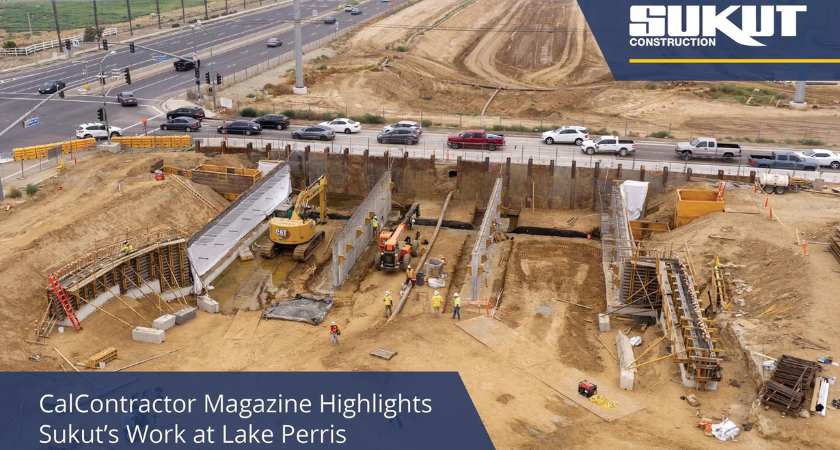
Complex ground conditions, utility conflicts and extensive infrastructure requirements are shaping construction of an emergency water-release facility at Lake Perris in Southern California. The project, being delivered by Sukut Construction for the California Department of Water Resources, is designed to provide a controlled route for rapidly lowering the reservoir during an emergency.
The 115-acre facility is part of the broader Perris Dam Modernization Program. Its new levee and channel system will direct emergency releases toward the Perris Valley Channel, helping protect surrounding residential, commercial and transportation infrastructure.
Sukut’s scope includes approximately 6,500 linear feet of levee, 240,000 cubic yards of levee embankment and 342,000 cubic yards of channel excavation. Crews are also installing 35,000 cubic yards of rock slope protection.
The project includes two roadway bridges at Evans Road and Lake Perris Drive, a precast concrete box culvert crossing at Fair Way, drainage improvements, utility relocations and roadway reconstruction. Approximately 6,000 cubic yards of structural concrete are incorporated into the work, along with electrical infrastructure improvements.
Groundwater and saturated soils created significant challenges during early excavation. Because portions of the channel extend as much as 15 feet below existing ground, Sukut installed a temporary dewatering system consisting of 105 wells and 45 pumps.
Wet conditions also required changes to the earthmoving approach. When saturated material limited scraper operations, crews used articulated trucks and excavators to continue material handling. A wide-track dozer was deployed to support work through soft material in the Perris Valley Channel.
Existing water, recycled-water and sewer infrastructure conflicted with the deeper channel alignment. Sukut coordinated phased relocations to maintain service while opening additional areas for excavation.
The work required coordination among replacement utilities, tie-ins, bridge construction and traffic changes while maintaining access through the surrounding transportation and recreation corridor.
Unforeseen utilities, buried concrete structures, environmental restrictions and design conflicts also affected the planned construction sequence. Sukut reviewed the work plan to identify activities that could be accelerated, shifted or performed concurrently.
Through revised sequencing and coordination with the Department of Water Resources, projected completion was moved from April 2028 to November 2027.
The project combines large-scale earthwork, underground construction, structural concrete, roadway work and utility relocation within a constrained infrastructure environment.
Field teams are coordinating the different work scopes while responding to changing site conditions. The approach demonstrates the importance of sequencing excavation, dewatering, utility relocation and structural work when construction takes place around active infrastructure and environmentally sensitive areas.
The Lake Perris project illustrates the construction complexity involved in major dam-safety and water infrastructure upgrades. Large earthwork quantities, deep excavation, groundwater management and utility conflicts require close coordination between field operations and project planning.
For contractors working on water infrastructure and civil projects, the project also highlights how adaptive construction sequencing can help address unforeseen site conditions while maintaining progress toward a revised completion target.
Source: Sukut Construction.