Data centers have a reputation problem, and it is getting worse. As artificial intelligence drives an unprecedented surge in computing demand, the facilities powering that revolution are consuming electricity at a staggering rate, drawing millions of gallons of water to cool their servers, and triggering community opposition wherever they try to put down roots.
The U.S. data center sector already consumes around 70 terawatt-hours of electricity annually, roughly two percent of the country's entire electric generation capacity, and cooling accounts for more than 40 percent of that bill. For communities fighting new data center proposals, the twin grievances of grid strain and water consumption have become rallying cries.
What if the fix to all of it was already on the market, independently validated by a U.S. Department of Energy laboratory, and priced at less than what conventional air-cooled infrastructure costs to build?
That is the claim of LiquidCool Solutions, a Minnesota-based company that has spent more than a decade quietly perfecting single-phase rack immersion cooling with forced convection, and whose technology is now drawing attention from early-stage AI infrastructure investors looking for any edge they can find.
The premise is simple, even if the engineering is not. Traditional servers cool their chips by blowing air across them using internal fans. Those fans are inefficient, noisy, and add to the heat removal burden rather than solving it.
LiquidCool Solutions takes a different approach entirely.
Inside an LCS chassis, every component sits fully submerged in a dielectric liquid coolant. The fluid is a poly-alpha-olefin oil, a synthetic hydrocarbon with a Global Warming Potential of zero. It is non-volatile, does not evaporate, and never needs to be replaced.
Electric utilities have been using PAO oil to cool high-voltage transformers for decades, so its long-term stability is well-documented. In some extreme outdoor environments, these fluids have been shown to retain their essential physical and electrical properties for well in excess of 30 years.
The key differentiator, and the source of the company's patent portfolio of 72 granted patents across the United States, United Kingdom, Germany, France, Japan, Korea, Taiwan, and China, is what LCS calls forced convection.
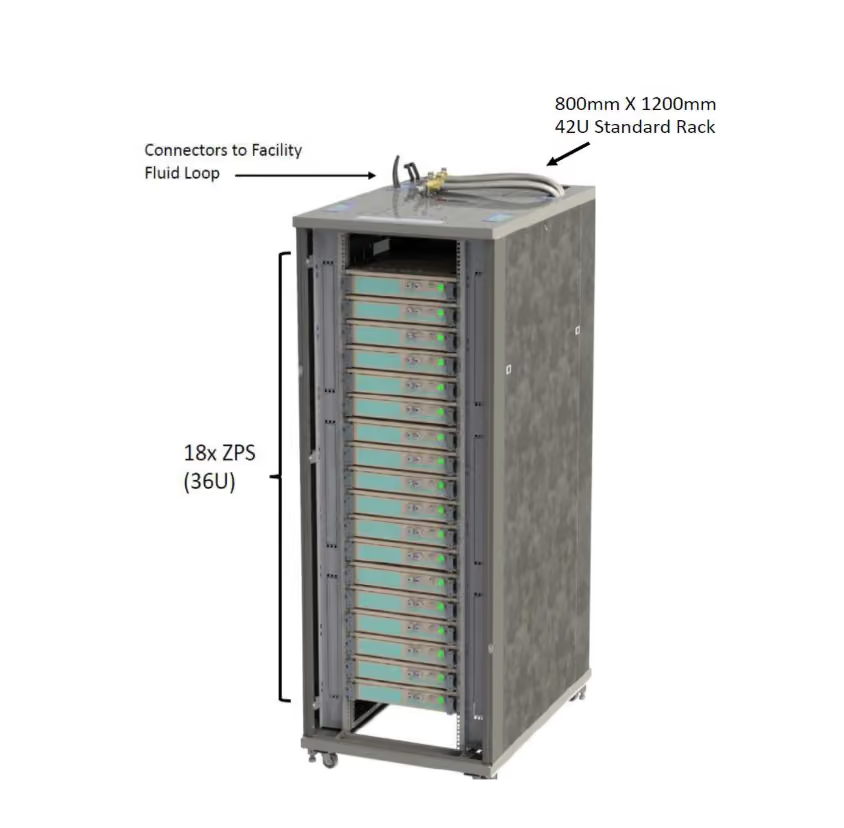
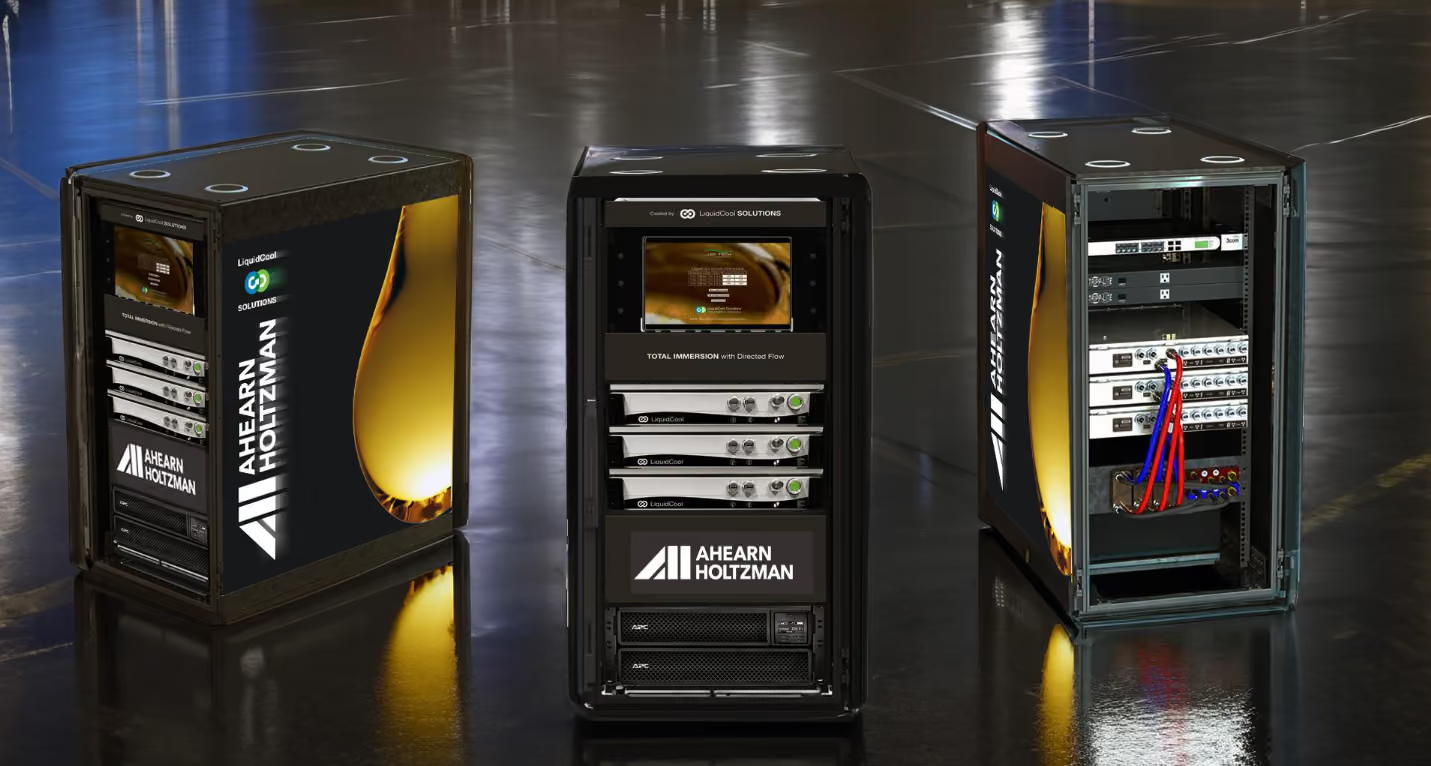
Rather than letting the fluid passively absorb heat from whichever components it happens to touch, the coolant is actively directed toward the processors and the components with the highest power density first. It targets the hottest parts of the board, removes heat directly, and then carries that thermal energy away through the remaining electronics before exiting the sealed enclosure through a drip-free fitting. The chassis fits into a standard data center rack, which means the transition from air to liquid cooling requires no structural changes to the facility.
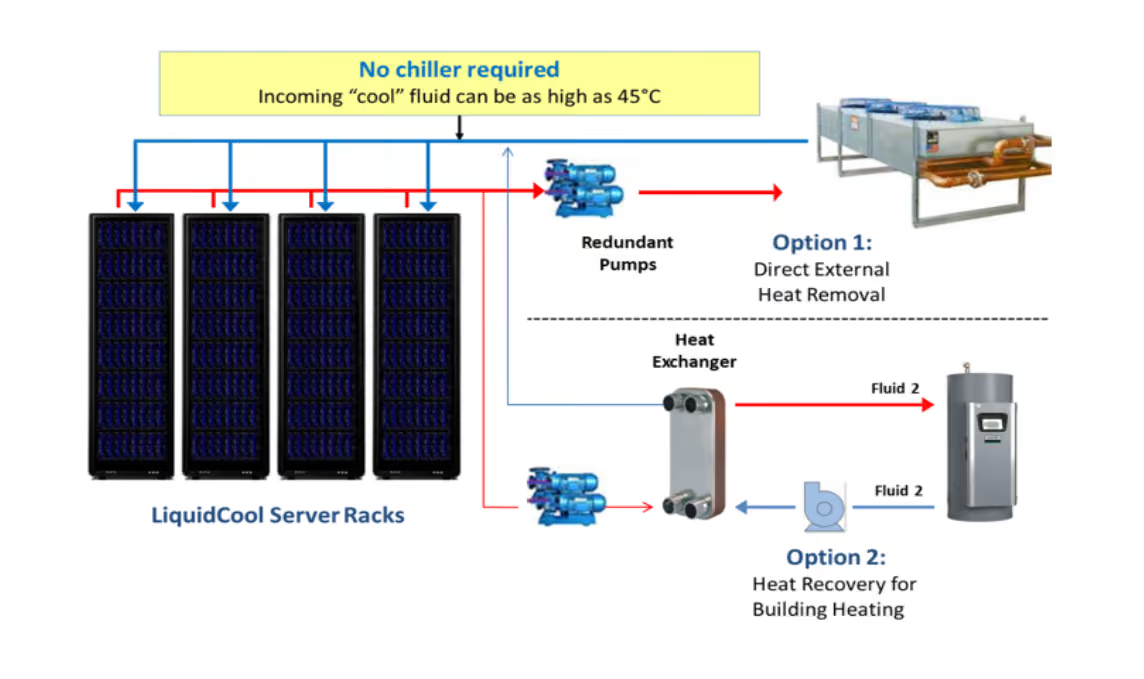
Once the heated coolant exits the servers, it can be circulated to dry coolers or, importantly, returned as usable heat for building heating systems at temperatures of up to 60 degrees Celsius. That heat recovery capability is one of the technology's most commercially compelling features.
LiquidCool Solutions spent two years being tested at the National Renewable Energy Laboratory's Energy Systems Integration Facility in Golden, Colorado, one of the most advanced data center research environments in the country. What emerged from that evaluation, published as a formal technical report in December 2017, was striking.
The NREL team found that the LCS liquid submerged server system could maintain CPU temperatures well below the 100-degree Celsius threshold at which processors begin to throttle themselves, even under maximum thermal load conditions.
During a nine-hour period of peak computing, all CPU temperatures were held at or below 77 degrees Celsius. Memory temperatures stayed safely below the 85-degree specification limit. Heat recovery efficiency was measured between 90 and 95 percent, meaning that the vast majority of thermal energy generated by the servers was captured in the liquid stream rather than dissipated into the surrounding room air.
The verdict from NREL was unambiguous. The laboratory designated LCS technology the gold standard for cooling electronics in connected buildings. A scenario analysis modeled by the laboratory found that widespread adoption of the technology could reduce U.S. data center energy consumption by 26 terawatt-hours annually, a reduction of roughly 37 percent from the business-as-usual baseline.
The following conversation with Herb Zien, board member and vice chair of LiquidCool Solutions about the real-world picture of deploying their technology.
"Air cooling is in the rear-view mirror because the chips are too hot, and the question is what liquid cooling technology will win the race," the company says. "LCS cools electronics by means of chassis-based single-phase immersion with forced convection. Using off-the-shelf components, LCS technology combines the energy efficiency of total immersion with the targeted cooling capability of direct-to-chip. An LCS chassis fits into standard data center racks, so the transition from air to liquid cooling is inexpensive and seamless."
The company claims a true Power Usage Effectiveness of approximately 1.03, a figure that deserves explanation. PUE is defined as total facility power divided by IT power. The problem as pointed out by Herb Zien, is that most manufacturers do not report the power consumed by onboard server fans, which can account for more than 15 percent of total device power. In a 350-watt server, that could mean 45 watts of fan power being misclassified as IT load rather than cooling overhead. LCS systems have no fans, and pump energy is separately measurable, making their PUE figure a genuinely honest comparison.
"When the cost of infrastructure is considered, LCS cooling is less expensive to deploy and operate than air or any other form of liquid cooling," said Herb Zien. "Corporate culture and 'Not Invented Here' seem to be key barriers. Data centers are big bets, but there is no logical reason not to try out rack-based immersion on a pilot scale."
That cultural inertia is real. A Facebook data center analysis prepared by LCS compared the capital costs of the company's 30-megawatt Altoona, Iowa facility as built versus what it might have cost with LCS technology. The conclusion was that Facebook paid a 14 percent upfront capital premium by building with air cooling. The LCS design would have required 477 racks instead of 955, used 8,591 square feet of data hall space instead of 23,864, and eliminated air handling units, server fans, water usage, and nearly two-thirds of the facility footprint entirely.
"Because LCS hardware fits in standard racks, migration can be one server at a time when money is being spent on upgrades," Herb explained. That modularity matters. An operator does not need to rip out and replace an entire data center to begin benefiting from the technology.
A real-world migration scenario documented by LCS modeled upgrading a 4,500-square-foot section of an enterprise data center with 115 air-cooled racks and a true PUE of approximately 2.25. Replacing that section with 24 LCS-cooled 48U racks reduced the floor footprint by nearly 80 percent, eliminated all seven CRAC air handling units, cut annual electricity consumption by 43 percent, and reduced annual electricity costs from over half a million dollars to under a quarter million.
"LCS hardware mitigates all the externalities associated with data centers: power, water, facility size, and noise," said Herb Zein. "LCS servers use no air and don't need water if it is cooler than 110 degrees Fahrenheit outside." That last point is significant.
For data center developers facing community opposition rooted in water consumption concerns, an architecture that eliminates water cooling requirements entirely under most ambient conditions is a genuinely different conversation to walk into a planning meeting with.
"The upfront investment is offset on day one because the data center costs so much less to build." That is a bold claim, but the capital cost comparisons across multiple case studies tend to support it. The combination of smaller buildings, fewer racks, eliminated HVAC infrastructure, and lower ongoing electricity bills makes the economics self-evident once operators are willing to look past the cultural inertia.
"The temporary solution is direct-to-chip cooling, but this is a transition technology because only 70 percent of server heat is removed by the fluid," said Herb Zein. "Tank immersion resolves that problem, but it is a horizontal form factor in a vertical world and maintenance is a mess. Rack-based immersion with forced convection that targets hot processors should win in the end."
Adoption remains in the early-stage. A handful of AI infrastructure companies have begun taking interest, drawn by the possibility of a competitive advantage in energy costs as GPU clusters grow denser and hotter. The processors powering modern AI training runs are pushing thermal envelopes that air cooling systems simply cannot handle, and direct-to-chip cold plate systems, while an improvement, still leave roughly 30 percent of server heat to be managed by conventional air handling.
The irony is that the technology most likely to solve data centers' biggest reputational problems, the water draw, the grid strain, the sheer physical scale of the facilities required, is a form factor that fits into an existing rack and can be deployed one server at a time. It does not require a ground-up redesign of the data center. It does not require chillers, cooling towers, or acres of air handlers. It requires a dry cooler, a pump, some piping, and the willingness to try something that a U.S. Department of Energy laboratory has already validated in production conditions.
The communities fighting data center proposals on environmental grounds are not wrong to raise their concerns. But the operators sitting across the table from them may soon find that the most persuasive answer they can offer is not a longer environmental impact report. It is a rack full of submerged servers and a cooling bill that is 40 percent lower than the one they walked in with.