Construction firms and project owners continue to evaluate lower-carbon building methods as sustainability requirements expand across public and private development programs. Turner Construction recently participated in an industry collaboration showcasing commercially viable approaches to reducing embodied carbon in building systems during the Structural Engineering Institute’s Structures Congress in Boston.
Turner Construction Company joined several industry organizations to develop and construct the exhibit titled “Reframing the Future: With Low-Carbon Construction” at the engineering conference in Boston, Massachusetts.
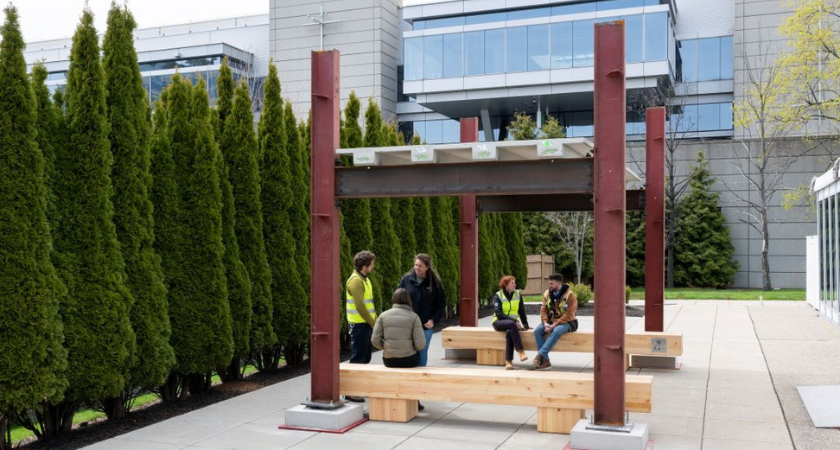
The installation featured multiple low-carbon construction components, including reclaimed structural steel, salvaged wood materials and a low-carbon concrete floor system. Project participants designed the structure to support future disassembly and reuse as part of a broader focus on circular construction practices.
Organizations involved in the collaboration included Buro Happold, Cambium Carbon, Cora Structural, Tridome Structures and Massachusetts Clean Energy Center, among other project partners.
Turner Construction managed on-site coordination activities for the exhibit, including collaboration with designers, suppliers and fabrication teams. The project team also delivered a code-compliant, permitted and insured structure intended to demonstrate scalable low-carbon construction approaches for broader industry adoption.
The pavilion emphasized material optimization and reuse strategies aimed at reducing embodied carbon associated with building materials and construction processes. The structure’s reusable design allows future assembly at additional exhibitions and educational events.
Embodied carbon reduction has become an increasing priority across commercial construction, institutional development and public infrastructure projects as owners and regulators expand sustainability requirements tied to procurement and project delivery.
Construction firms, designers and material suppliers are continuing to evaluate reusable systems, alternative materials and circular economy practices that can support lower lifecycle emissions while maintaining constructability and code compliance.
For owners, developers and contractors, demonstration projects such as the Structures Congress pavilion provide insight into how low-carbon materials and reusable structural systems may be incorporated into future building programs without significantly altering conventional delivery methods.
Source: Turner Construction.