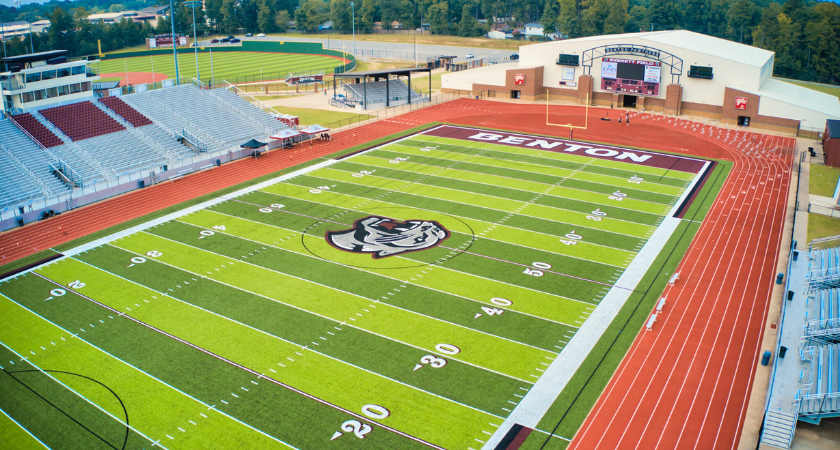
School athletic facilities require fencing systems that account for player safety, spectator control, field operations and long-term maintenance. United Fence & Construction has published guidance for facility managers addressing how fencing specifications can vary by sport and site conditions.
The North Little Rock-based fencing contractor serves athletic facilities throughout Central Arkansas, including baseball, football, basketball, tennis and soccer venues. Its athletic fencing services include chain-link, iron and temporary fencing systems.
Baseball facilities require specialized fencing configurations, particularly around home plate and spectator areas. Backstops provide a barrier for foul balls and other errant pitches, while properly designed post footings contribute to the structural stability of the system.
Tennis courts generally use perimeter fencing to keep balls within the playing area and establish separation from surrounding facilities. Multi-use athletic complexes can require different fence configurations depending on how fields, spectator areas, player zones and service access are arranged.
The selection of fencing material also depends on the facility's operating requirements. Chain-link fencing is commonly used around athletic fields because sections can be repaired and maintained without replacing an entire system. Iron fencing can be used where appearance and architectural integration are priorities, while temporary systems can support phased construction or changing site requirements.
Fencing at athletic facilities serves purposes beyond defining field boundaries. Properly positioned systems can separate spectators from playing areas, control movement and provide additional protection around dugouts and bleacher sections.
Gate planning is similarly important. Athletic facilities may require pedestrian entrances, equipment access points and openings that accommodate maintenance operations. The configuration needs to reflect how the facility will be used rather than treating every access point as the same application.
For owners and facility managers, coordinating fencing and gates during the design and procurement stages can help ensure access, security and maintenance requirements are incorporated into the overall site plan.
United Fence & Construction has provided commercial fencing services in Central Arkansas for more than six decades and lists Little Rock, North Little Rock, Benton, Bryant, Conway, Cabot, Hot Springs, Jacksonville, Maumelle and Sherwood among its service locations.
The company's athletic fencing portfolio includes baseball fields, football fields, basketball courts, tennis courts, soccer fields, batting cages and other sports facilities.
For school districts, athletic facility owners and construction teams, fencing decisions affect safety, circulation, maintenance and field operations after a project is complete. Establishing the appropriate fence type, configuration and access strategy during planning can reduce the need for modifications once a facility is in service.
United Fence & Construction's guidance reinforces the need to treat athletic fencing as a project-specific construction component rather than a one-size-fits-all perimeter system.
Source: United Fence Company.