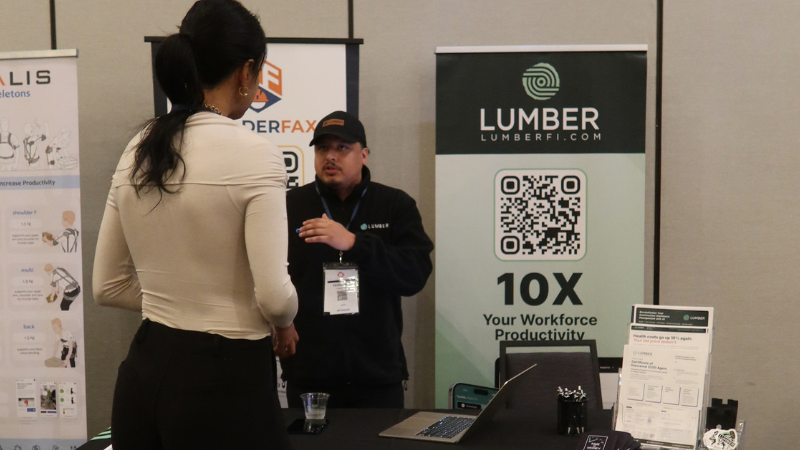
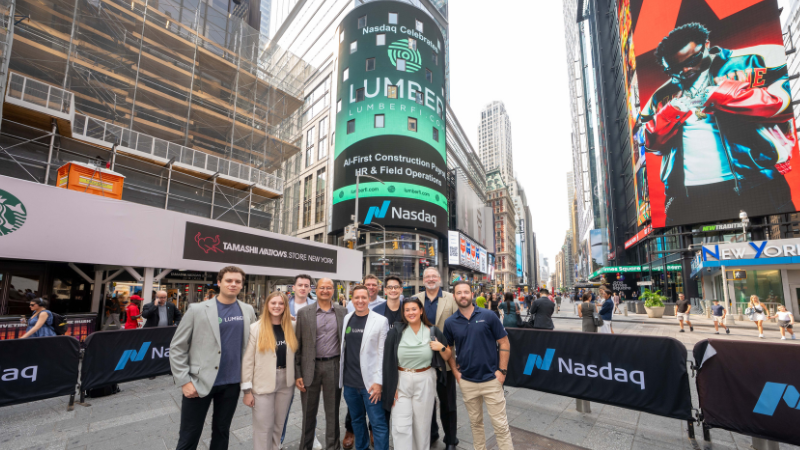
For the second year running, Lumber brought contractors, trade associations, and AI builders to Nasdaq's Times Square headquarters to work through the three forces reshaping the industry right now: the data center boom, a labor shortage that isn't solving itself, and the widening gap between AI hype and what actually holds up on a jobsite.
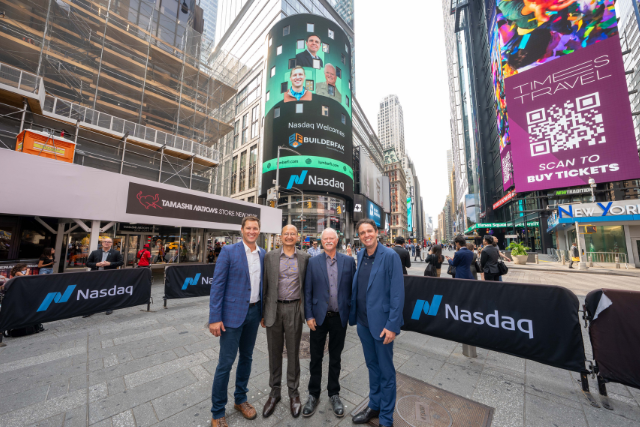
Ten floors above Times Square, the Nasdaq MarketSite tower does something most construction events don't bother trying: it puts the industry's growth on a billboard. This year, that board carried Lumber and its partner BuilderFax, named among the fastest-growing fintechs in the country. It was a fitting backdrop for a room built to ask a harder question than any billboard can answer: what does construction actually look like on the other side of the AI conversation everyone's having?
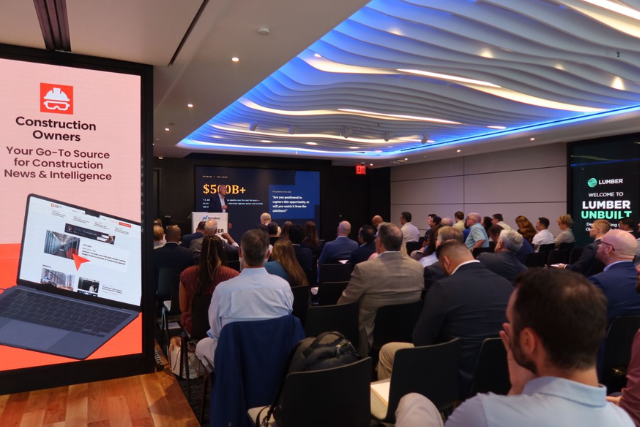
That question was the point of Lumber Unbuilt: Deconstructing the Old Way of Building, now in its second year. Around 100 general contractors, subcontractors, trade associations, and technology partners gathered on August 11, following a welcome reception the evening before.
Lumber, the AI-powered construction workforce management platform behind the event, designed it around a bet that contractors are done sitting through pitches and ready for something they can act on the following Monday.
Every session on the agenda fed the same underlying argument: construction is being reshaped at once by AI, by a data center boom pulling money and labor toward it, and by a workforce shortage that shows no sign of correcting on its own. None of the day's speakers treated those forces as separate panels to get through. They treated them as one problem, viewed from different desks, and the exchanges between contractors and the people building their tools felt less like presentations and more like a shared effort to work out what to do next.
The morning opened with Kris Jensen of The State Group and Jensen Technologies, who took on a question a lot of contractors have been asking quietly: is there still room in the data center boom for anyone who isn't already a hyperscaler's preferred vendor? Jensen's read, worked out with the room rather than delivered to it, was yes, but not in the obvious places. The exchange that followed, less a debate than a shared search for where the real opportunity sits beyond the headline-grabbing hyperscaler deals, set the tone for a day built around collaboration over the usual conference back-and-forth.

The day's next session tackled a problem with no clean fix: the skilled trades shortage that's been building for years and, by most accounts, is worse in 2026 than it's ever been. Neil Shah of the Construction Financial Management Association, Matt Abeles of Associated Builders and Contractors, and John Somers of the Association of Equipment Manufacturers joined moderator Felice Farber of the Subcontractors Trade Association for a conversation that spent less time on the scale of the problem, everyone in the room already knew it, and more time on what intelligent workforce management can, and can't, do about it. Sitting in that room were the people who feel the shortage from every angle: general contractors, subcontractors, and the technology partners trying to build tools that actually help.
Shah later described the skills gap as a challenge the whole industry can take on together, one that, solved, lifts the broader economy along with it. It's a framing that ran through the room all day: the shortage isn't a Lumber problem or an association problem, it's a shared one, and the panel's value was in naming, plainly, where technology helps and where it doesn't.
After a networking lunch, KP Reddy of Shadow Ventures took the stage for the AI Founder Spotlight. Reddy has spent enough time on both sides of construction technology, building it and funding it, to skip the hype and talk plainly about what's actually working in the field versus what's still mostly theater. In a year when almost every construction event has an AI keynote, the value of Reddy's session was less in predicting the future and more in drawing an honest line between the tools already earning their keep on a jobsite and the ones still looking for a use case.
The afternoon's centerpiece ran nearly two hours: "The AI-Native Contractor: A 5-Phase Roadmap to 2030," led by Shel Waggener of Lumber. Billed as hands-on, it delivered. Attendees worked through their own operations phase by phase and left with a concrete 90-day action plan specific to their business, not a framework to file away next to the tote bag. It was the clearest expression of the day's underlying argument: the conversation about AI in construction is only useful once it turns into something a contractor can start doing on a Monday morning.
Strip away the view and the agenda, and Lumber Unbuilt was making one argument: the old way of running a construction back office, spreadsheets, disconnected systems, compliance handled by guesswork, is already being replaced, whether or not any given contractor has caught up to it yet. But almost everyone who spoke about the day afterward pointed to the same thing, and it wasn't a session or a slide. It was the people.
Caroline Raffetto, from Lumber and helped shape the day, put it plainly afterward: every conversation about AI and automation kept circling back to the same truth, that it's the relationships and shared ideas in the room that actually move the industry forward, and technology is only the tool.
Carli McCulloch, who works in strategic alliances at Lumber, echoed the same idea from a different seat, describing the room as customers, technology partners, association leaders, and contractors from across the country, together in a way that let all of them learn from each other rather than sit through a pitch.
That community was visible beyond the agenda, too. Contractors including DPR, K2 Construction, Northline Building Systems, and AdamsBrown, along with BuilderFax (Construction Credential Wallet platform), all made the trip to Times Square, several posting afterward about what the day meant for where their own companies are headed.
Oleg Pravdin, who leads product for BuilderFax, tied it back to the billboard overhead: every bit of growth Nasdaq celebrated, he said, traces back to the crews and partners who trusted Lumber and BuilderFax to build it with them.
By late afternoon, when closing remarks wrapped, the skyline was still doing what it does, blinking away below a room that had spent the day trying to see past it. Whether the roadmap sticks is up to the ninety days that follow.