
New federal data reveals widening gaps between the three major construction subsectors, with one showing rising fatalities even as the others improve.
Construction remains one of the most hazardous industries in the United States. In 2024, it recorded the highest number of fatal work injuries of any sector. But the headline number masks a more complicated story: depending on where workers build and what they build, their risk of being killed or seriously injured looks very different.
A new data bulletin from CPWR, the Center for Construction Research and Training, breaks down injury trends across the three major construction subsectors from 2011 through 2024. The findings offer a roadmap for where intervention is most urgently needed.
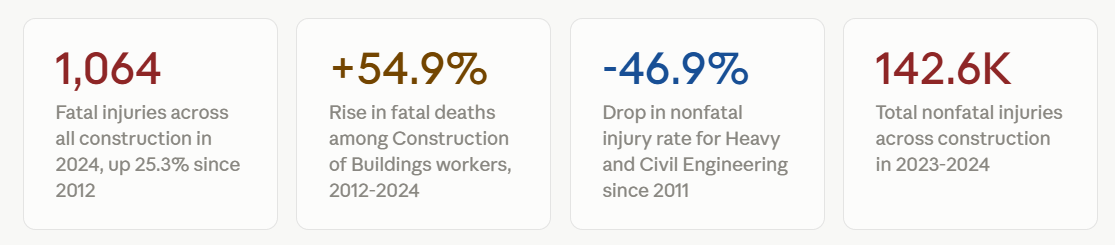
The federal data covers three segments of the construction industry: Construction of Buildings (NAICS 236), Heavy and Civil Engineering (NAICS 237), and Specialty Trade Contractors (NAICS 238). Each operates in different environments, uses different equipment, and exposes workers to different hazards. That shows up clearly in the injury data.
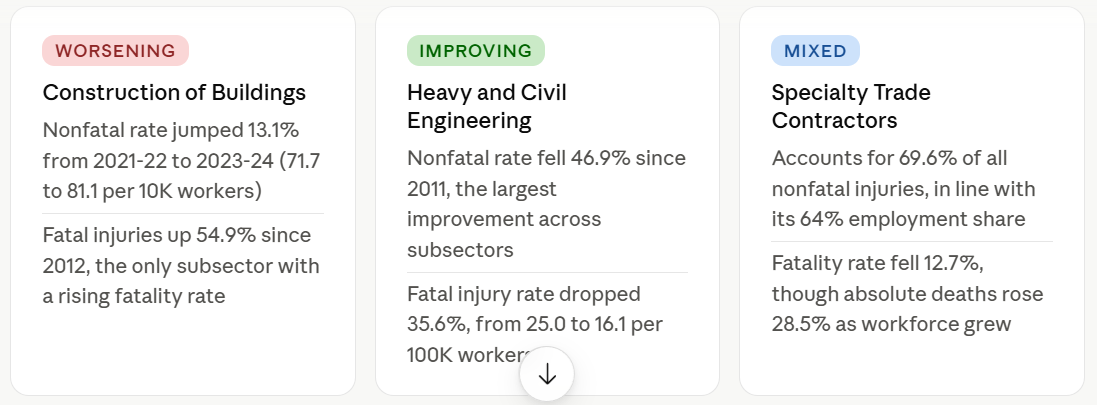
Specialty Trade Contractors, which includes electrical, plumbing, HVAC, and similar work, account for the largest share of injuries by sheer volume. That reflects the fact that this subsector employs roughly two-thirds of all private construction workers. When adjusted for workforce size, its injury rates have trended downward since 2011.
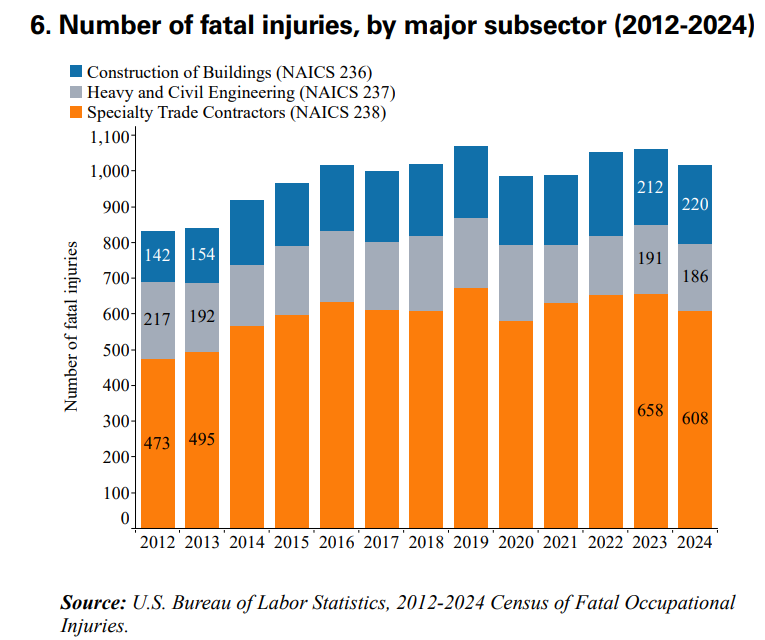
Watch closely: Construction of Buildings is the only major subsector where both the number and rate of fatal injuries increased from 2012 to 2024. Fatal deaths rose from 142 to 220, and the fatality rate climbed from 11.4 to 11.9 per 100,000 workers. This warrants targeted attention from owners and safety managers overseeing commercial and residential building projects.
The type of work each subsector performs shapes the nature of the injuries workers face. The data shows meaningful differences in both fatal and nonfatal injury patterns.
For nonfatal injuries across all three subsectors, contact incidents were the leading cause in 2023-2024, accounting for roughly 53,000 injuries in total. Falls, slips, and trips were second, responsible for more than 45,000 nonfatal injuries industry-wide. Parts and materials were the most common primary source of injury, with Specialty Trade Contractors alone reporting 22,500 such injuries.
Upper extremities were the most frequently injured body part among Specialty Trade Contractors and Construction of Buildings workers. In Heavy and Civil Engineering, lower extremities saw the highest number of injuries, reflecting the different physical demands of road, bridge, and infrastructure work.
In building and specialty trade work, falls kill. In Heavy and Civil Engineering, it is the road itself that poses the greatest threat.
For fatal injuries in 2024, the contrast between subsectors is stark. Falls, slips, and trips were the leading cause of death for Construction of Buildings workers (96 deaths, 43.6% of that subsector's fatalities) and for Specialty Trade Contractors (253 deaths, 41.6%). Specialty Trade alone accounted for nearly 69% of all construction fall fatalities nationwide.
In Heavy and Civil Engineering, transportation incidents were the primary killer, responsible for 88 deaths, nearly half (47.3%) of that subsector's fatal injuries. Workers on highways, bridges, and other civil projects face vehicle-related hazards that simply do not appear at the same scale in building construction.
A bright spot: Heavy and Civil Engineering has made substantial progress. Its nonfatal injury rate fell nearly 47% over 13 years, and its fatal injury rate dropped more than 35%. This kind of improvement is achievable with sustained investment in safety systems and training.
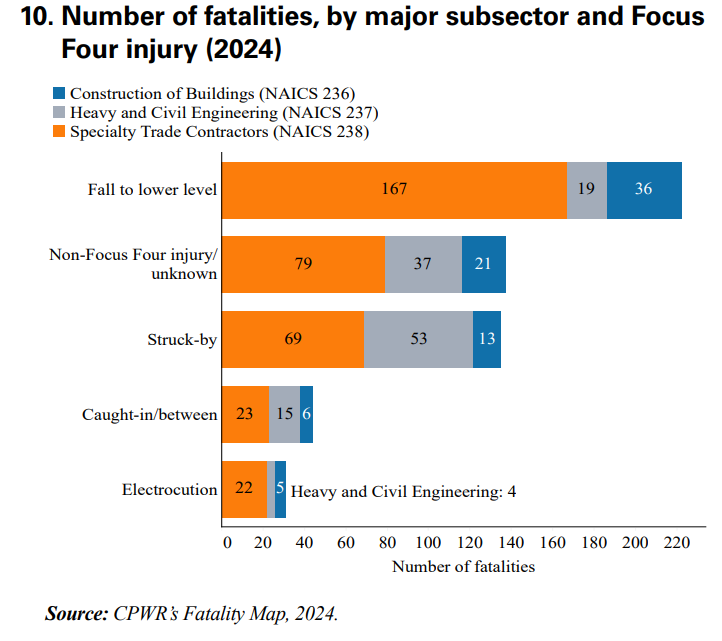
Among detailed subsectors, Roofing Contractors recorded the most workplace fatalities in 2024, with 70 deaths. Highway, Street, and Bridge Construction followed with 56 fatalities, accounting for nearly a third of all Heavy and Civil Engineering deaths. Site Preparation Contractors and Commercial and Institutional Building Construction rounded out the top four, with 49 and 35 fatalities respectively.
Roofing's position at the top of the list is not surprising given that falls to a lower level were the most common Focus Four injury across construction. Among Specialty Trade Contractors, 167 workers died from falls to a lower level in 2024, representing 27.5% of that subsector's total fatalities.
Fatality data by age offers additional nuance. Among Specialty Trade Contractors, nearly half of all deaths involved workers between 35 and 54 years old. Heavy and Civil Engineering had the highest proportion of fatalities among workers 24 and younger, at 10.7%. Construction of Buildings had the highest share of deaths among workers aged 25 to 34.
These patterns point to different workforce compositions across subsectors and suggest that training and intervention programs may need to be calibrated not just to the type of work, but to the age distribution of the workforce doing it.
The data carries practical implications for anyone overseeing construction operations. The improvement in Heavy and Civil Engineering shows that long-term gains are achievable. The deterioration in Construction of Buildings, particularly the recent uptick in nonfatal injury rates and the sustained rise in fatal injuries, signals that current prevention measures are not keeping pace with the sector's growth.
CPWR offers hazard-specific resources and training tools targeting the most common exposures, including falls and transportation-related incidents. OSHA and NIOSH provide additional materials focused on construction hazards. For owners in the roofing and building trades, fall prevention remains the most urgent area for investment. For those in highway and civil construction, worker protection from vehicle traffic is the primary priority.
As construction employment continues to grow across all three subsectors, the gap between those improving on safety and those falling behind will only become more consequential.
Source: Cpwr.com