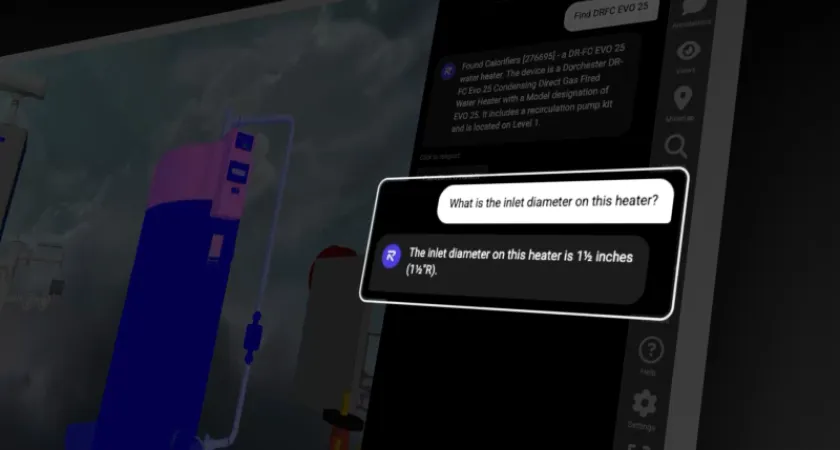
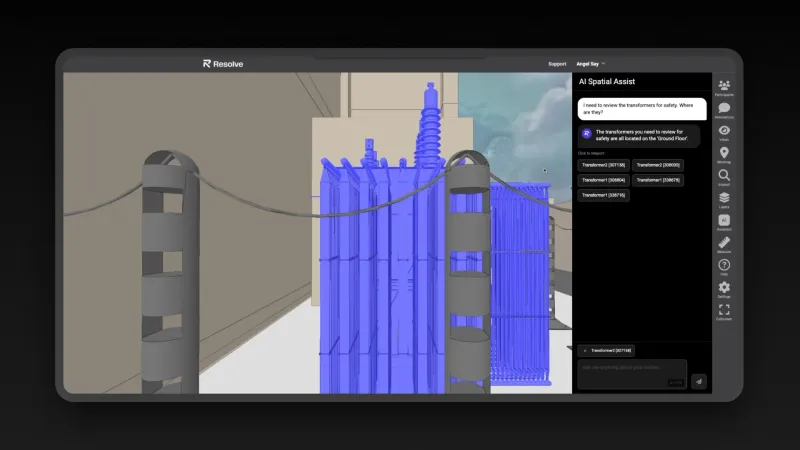
NEW YORK — Resolve, the Design-Delivery Alignment platform for mission-critical infrastructure, has introduced AI Spatial Assist, a new capability designed to open complex BIM models to every project participant through simple natural language commands.
The tool is available across Resolve’s web viewer and immersive VR environment and allows users to ask questions, locate equipment, and move through 3D models without relying on BIM specialists or advanced software skills. The company says the release directly targets one of construction’s most stubborn inefficiencies — the time spent searching for information inside digital models.

Industry studies estimate that teams spend about 20% of their week in meetings and another 14% tracking down information, much of which involves model reviews, screen-sharing sessions, and back-and-forth requests to BIM experts. Even with this effort, unresolved coordination issues frequently lead to costly rework during procurement and installation.
Resolve argues that the problem is becoming more urgent as demand for AI infrastructure and data centers accelerates, compressing project schedules and increasing complexity.
Eliminating the BIM Bottleneck
For years, effective BIM navigation has required trained VDC professionals, creating a bottleneck that prevented owners, operators, and field leaders from interacting directly with design information. AI Spatial Assist is intended to remove that barrier.
Users can now ask questions such as:
- “Take me to the electrical room on Level 2.”
- “Where are the cooling towers located?”
- “Which P&ID is this valve a part of?”
The AI agent interprets geometry and metadata to deliver instant answers. If a user selects an object, the system can respond to prompts like “what is this?” using contextual awareness.
Improving Speed and Quality at the Same Time
The company says the technology is built to enhance both project velocity and accuracy rather than forcing teams to choose between them. By allowing subject-matter experts to review models directly, coordination cycles can shrink from weeks to minutes.
“Speed and quality have historically been treated as tradeoffs,” said Angel Say, CEO of Resolve. “You either move fast and accept risk, or slow down to reduce it. Our vision is eliminating that tradeoff entirely. When reviews are effortless, you go faster because quality is higher, not in spite of it.”
Broader access also means more perspectives. Facilities managers can evaluate maintainability, contractors can assess installation risks, and operators can verify access and safety — all before ground is broken.
Capturing What Rules-Based AI Misses
Many AI tools currently entering the construction market focus on checking models against written codes and standards. While valuable, Resolve notes that some of the industry’s most important knowledge is rarely documented.
Practical insights about service access, real-world usability, and constructability often live only in the experience of veteran field teams. As workforce shortages and retirements accelerate, capturing that intelligence is increasingly critical.

By enabling those stakeholders to engage directly with BIM through natural language, the platform aims to preserve expertise that would otherwise remain siloed.
The First Step Toward Compounding Intelligence
Resolve views AI Spatial Assist as the foundation for a broader learning ecosystem. Every interaction — risks flagged, conflicts surfaced, feedback recorded — contributes to a growing intelligence layer across projects.
“In an AI-enabled future, it’s even more important that humans can efficiently review deliverables,” says Resolve COO Russell Varriale. “Our goal is to amplify human judgment so reviews happen earlier, faster, and with greater confidence. We want teams to move from design to construction at the speed of light.”
AI Spatial Assist is currently rolling out to select partners, and organizations can join the waitlist at https://www.resolvebim.com/ai.
About Resolve
Resolve is the Design-Delivery Alignment platform helping companies build mission-critical infrastructure at the pace modern markets require. By combining BIM intelligence, immersive VR, and AI-driven navigation, the platform closes gaps between design intent and field execution. More than 6GW of data center capacity has been delivered using Resolve across sectors including healthcare, semiconductors, and water treatment.
Originally reported by Resolve in Construction Dive.