ZINOVA Launches Tool Intelligence, the Execution Layer for Physical AI
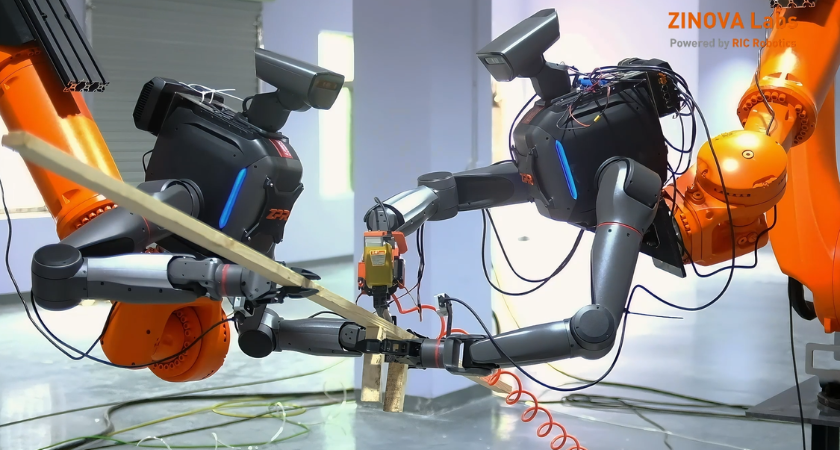
New research company unveils its first demonstration of adaptable robotic systems using existing tools to perform real physical work with real economics
SAN JOSE, CA – September 14, 2026 – ZINOVA, a physical AI research and development company focused on enabling robots to use real-world tools, today announced its launch and unveiled its first physical AI research demonstration. Led by CEO Ryan Cox and Founder Ziyou Xu, ZINOVA brings together researchers, professors and industry veterans with experience spanning Carnegie Mellon University, the University of Pennsylvania, Columbia University, MIT, Tsinghua University.
ZINOVA is developing Tool Intelligence, a hardware and software intelligence layer designed to enable robots to recognize, grasp, sense and operate tools across different tasks and robotic forms. By combining advanced AI models, purpose-built sensing and human oversight, the company is exploring how physical AI can perform productive work using the tool ecosystem that already exists.
“Almost everything humans have built, from homes and factories to infrastructure and spacecraft, was made possible through the skilled use of tools,” said Xu. “Our goal is to give physical AI that same capability, allowing the form of the robot to change while the intelligence to use tools remains.”
As an early demonstration of this research, ZINOVA is showcasing multiple experimental robotic systems using existing construction tools to complete portions of a steel-reinforced concrete tilt-up panel segment, a structural element commonly used in data-center and industrial construction. The demo is a validation environment through which the firm can test different physical mounts, experimental modules, control methods and robotic forms while advancing a shared Tool Intelligence layer.
“The opportunity is much larger than building a different robot for every individual task,” said Cox. “ZINOVA is focused on developing intelligence that enables robotic systems to use the tools industries already rely on, independent of any single robotic form, allowing us to test more configurations, learn faster and support many kinds of physical work.”
Building the Tool Intelligence Layer
ZINOVA’s research is organized around three interconnected areas designed to help robots grasp the tool, feel the work and take the form best suited to the task:
- Grasp (General Tool Grasp): Research focused on enabling robots to recognize, pick up and manipulate a broad range of tools designed for the human hand without requiring a custom system for every application.
- Feel (TEISI): ZINOVA’s Tool–Embodiment Interaction Sensing Interface is designed to capture force, torque, vibration, resistance, contact and material response among the tool, the surrounding environment and the robot. This feedback gives the system a form of “hand feel” while also generating operational data that can improve future performance.
- Form (The Third Form): Research into robotic embodiments designed around the work rather than human anatomy. These experimental forms may offer greater reach, height, payload or physical capability while drawing on the same Tool Intelligence layer and existing tool ecosystem.
Together, these areas form ZINOVA’s approach to developing intelligence that can move across tools, tasks and robotic forms. As foundation models, humanoids and other physical AI platforms continue to advance, ZINOVA believes tool use will remain essential to translating their capabilities into productive work. Rather than attempting to build every future robotic body, the company aims to develop an intelligence layer that can expand what a range of platforms can accomplish in the physical world.
Construction as the First Proving Ground
ZINOVA is using construction as the first applied environment for Tool Intelligence. The industry combines persistent skilled-labor constraints, high-value physical tasks, an extensive ecosystem of existing tools and variable jobsites that require greater adaptability than a controlled laboratory.
Through human research demonstrations and field validation, robotic systems can perform useful work while generating data about tool grasp, force, resistance, vibration, task execution and environmental conditions. ZINOVA intends to use those insights to improve its Tool Intelligence, expand the range of tasks the systems can perform and support future commercial applications. Through its commercial relationships, the company is also building a pipeline of potential residential, commercial and government projects on which emerging technologies may be evaluated as they mature.
Construction is the starting point, not the endpoint. Over time, ZINOVA sees potential applications for Tool Intelligence across manufacturing, energy, maintenance, infrastructure, aerospace and other sectors that depend on skilled physical work, particularly in remote or hazardous environments where human access may be limited.
A Distinct Research Platform
ZINOVA operates as a distinct research and development company while collaborating with organizations that contribute complementary robotics, engineering and construction expertise. Its initial demonstration partners with Leading robotic platforms from LimX Dynamics,KUKA robotics and construction-industry experience from RIC Robotics.
Cox and Xu bring extensive experience advancing construction robotics through their work with RIC Robotics, a construction technology company focused on autonomous robotics and large-scale 3D concrete printing. While ZINOVA is independently focused on early-stage physical AI research, validation models and experimental modules, its relationship with RIC Robotics can provide select technologies with a pathway to jobsite testing and potential commercialization. The companies share a belief that adaptable robotics can expand the capabilities of the skilled workforce, but maintain distinct research and commercial priorities.
From the Jobsite to General Physical AI
ZINOVA’s long-term vision is to establish Tool Intelligence as infrastructure for physical AI. Different organizations may develop the underlying models and robotic bodies, ZINOVA is focused on the intelligence that helps those systems interact productively with tools.
That vision extends from construction sites and factories on Earth to remote, hazardous and, eventually, off-world environments where capable physical labor will be essential. Whatever form future robots take, ZINOVA believes the ability to understand and use tools will remain fundamental to the infrastructure they can build and the work they can perform.
Video and still imagery for this announcement can be found HERE.
About ZINOVA
ZINOVA is a physical AI research and development company focused on Tool Intelligence, the hardware and software infrastructure designed to enable robots to grasp, feel and operate real-world tools. Led by CEO Ryan Cox and Founder Ziyou Xu, its core research spans General Tool Grasp, the Tool–Embodiment Interaction Sensing Interface (TEISI) and The Third Form, with construction serving as its first real-world validation environment. ZINOVA’s long-term goal is to develop a Tool Intelligence layer that allows robotic systems, regardless of form, to perform productive physical work.