At Fort Bliss in West Texas, the U.S. Army Corps of Engineers and its partners have officially launched a groundbreaking construction initiative—building military barracks using advanced 3D-printing technology.
.webp)
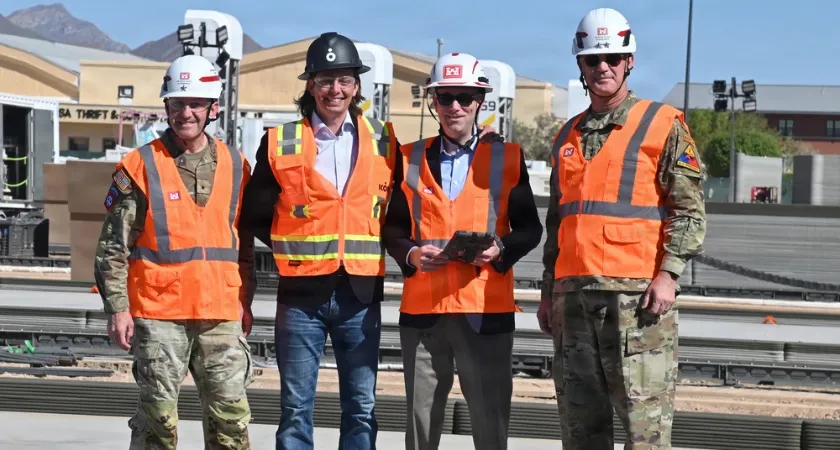
The milestone was marked by a “bead-laying” ceremony, where leaders, engineers, soldiers and contractors gathered to witness the start of construction on 10 new 3D-printed buildings. The project represents a significant shift in how the U.S. Army approaches infrastructure development, focusing on speed, efficiency and resilience.
Developed in collaboration with the Army’s Fort Worth District, the 1st Armored Division and ICON, the effort highlights the growing role of additive construction in large-scale government projects.
During the ceremony, a large gantry-style 3D printer began extruding layers of specialized concrete—referred to as “beads”—to form the structural walls of the barracks. The method allows for precise, automated construction with reduced labor demands and minimal material waste.
“Last year, the Secretary of the Army challenged us to break free from legacy processes and embrace ‘speed over bureaucracy’,” said the commanding general of the U.S. Army’s 1st Armored Division and Fort Bliss, Maj. Gen. Curtis Taylor. “Today, the project behind me stands as visible proof that real change is happening across the Army.”
Each of the 10 planned buildings will house up to 56 soldiers, helping to improve living conditions and operational readiness at the installation. Officials emphasized that the approach can significantly shorten construction timelines compared to traditional methods—an advantage in both peacetime and rapid deployment scenarios.
The project also addresses immediate infrastructure challenges at Fort Bliss. Recent troop deployments created a shortage of adequate housing, forcing many soldiers into temporary accommodations far from key base facilities.
“The deployment of soldiers to protect our southern border created an acute shortage of barracks here at Fort Bliss. As a temporary solution, hundreds of soldiers were housed for months in substandard, remote lodging over 20 miles from here,” said Taylor. “This summer, when the next unit rotates into the El Paso sector, soldiers will be housed right here, steps away from gyms, mess halls, and a first-rate shopping and recreation area.”
From a private-sector standpoint, ICON views the initiative as a major step forward for scalable, technology-driven construction.
“Our buildings and the way we build should dignify and ennoble our military, should project American power and dynamism, and should support the mission and well-being of our troops,” said Jason Ballard, CEO of ICON. “In short, the time has come to build faster, stronger, more efficiently, and more effectively. We should demand as much from our buildings as we demand from our soldiers. And the time is here and what we are witnessing here at Fort Bliss with our waking eyes is making more history.”
.webp)
The Fort Bliss project is expected to be completed in approximately six months—far faster than conventional barracks construction. If successful, it could serve as a model for military installations across the United States and globally.
Beyond defense applications, the use of 3D printing in construction is gaining traction in the commercial sector as well, particularly in housing, disaster recovery and remote infrastructure projects. The technology’s ability to reduce costs, accelerate timelines and improve sustainability is drawing attention from both public and private stakeholders.
As the first layers of concrete take shape in the Texas desert, the initiative underscores a broader transformation in construction—one where automation, digital design and advanced materials are redefining how buildings are delivered.
Originally reported by Patrick Adelmann in Dvidishub.