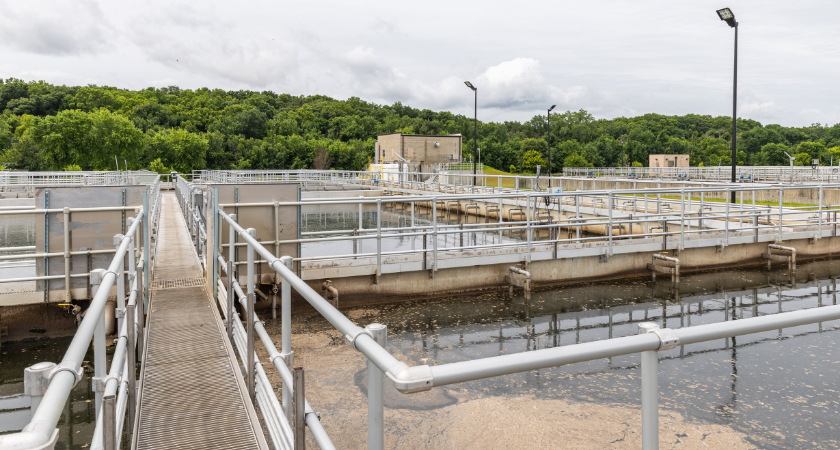
The City of De Soto has completed a major wastewater infrastructure expansion intended to support industrial growth tied to electric vehicle battery manufacturing in the Kansas City region. The project increases wastewater treatment capacity while positioning the community for future commercial and residential development.
Burns & McDonnell and CAS Constructors completed the $40 million expansion of the De Soto wastewater treatment plant, doubling treatment capacity from 1.3 million gallons per day to 2.6 million gallons per day. City officials marked the completion with a ribbon-cutting ceremony following the facility’s operational startup earlier this year.
The project was developed to accommodate increased utility demand associated with Panasonic’s battery manufacturing facility in De Soto. The manufacturing plant represents a multibillion-dollar investment expected to add thousands of jobs and increase industrial activity in the area.
Project teams accelerated design, procurement and construction activities to meet Panasonic’s operational schedule while also addressing updated wastewater discharge requirements related to nitrogen and phosphorus removal.
The expansion incorporated chemical, biological and physical treatment processes as part of the facility upgrade. Coordination with the Kansas Department of Health and Environment was also required to align treatment performance with permit standards and projected industrial flows.
Burns & McDonnell and CAS Constructors used a progressive design-build delivery model for the project. According to project information released by the team, the approach enabled early collaboration between designers, contractors and city officials during project development.
The delivery strategy allowed the team to advance the project to approximately 30% design within six months, supporting accelerated procurement and phased construction activities.
CAS Constructors managed construction operations while Burns & McDonnell led project design efforts. The project team emphasized schedule management and early equipment procurement to avoid delays tied to supply chain constraints and equipment lead times.
Utility infrastructure upgrades are increasingly becoming a prerequisite for large-scale manufacturing developments tied to the electric vehicle supply chain. Water and wastewater systems, electrical infrastructure and transportation improvements are among the primary construction needs associated with battery manufacturing investments across the United States.
For contractors and public owners, the De Soto project highlights the growing role of collaborative delivery methods in accelerating municipal infrastructure projects tied to economic development initiatives. The expansion also demonstrates how local governments are scaling utility capacity to support industrial growth while maintaining long-term service reliability for surrounding communities.
Source: Burns & McDonnell.